Om Ka Hari review: Raghubir Yadav, Anshuman Jha hold this flawed family film together
Indian fathers are often expected to know everything except how to be fathers. They are taught to earn, provide, protect and, somewhere along the way, make sure their children choose the “right” life. But who teaches them how to listen, how to show affection, or how to tell a child that they are proud of him/her? Om Ka Hari finds its most affecting idea in this uncomfortable gap between being a father and knowing how to be one.
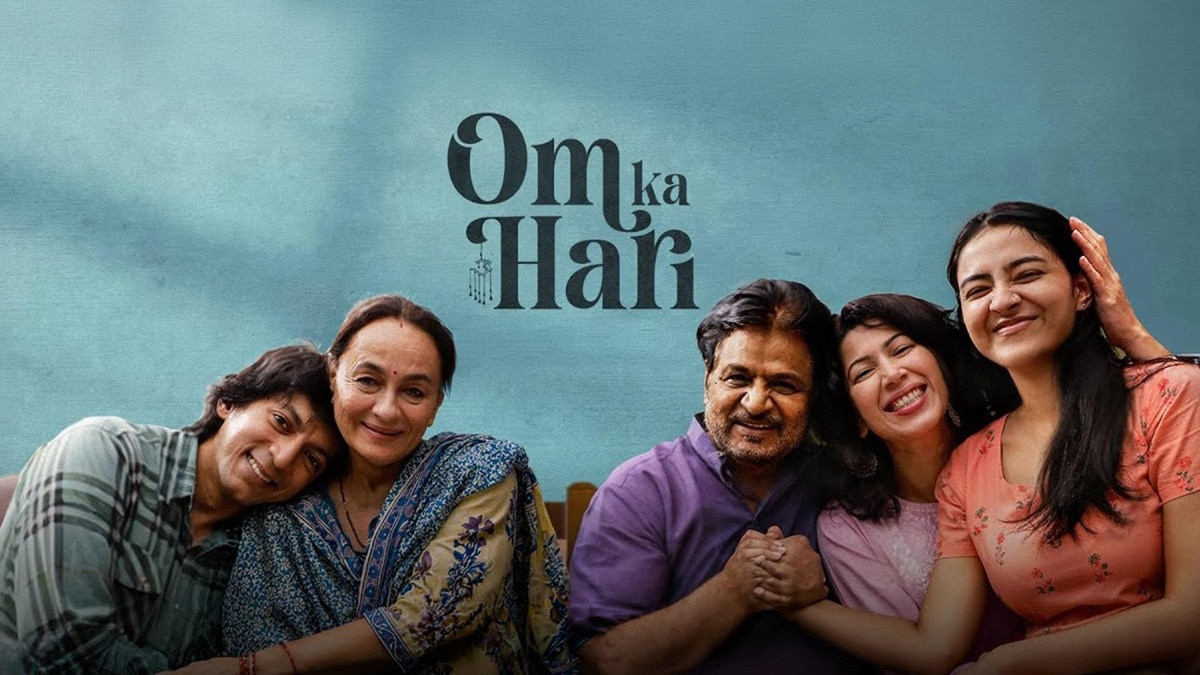
Harish Vyas’ film, starring Anshuman Jha, Raghubir Yadav and Soni Razdan, takes that familiar father-son friction and puts it on a route to Kashi. A retired astrologer, Hari Prasad Sharma (Yadav), convinced that he has only six days left to live after what appears to be a heart attack (read: gas attack), decides to spend his final days in the holy city. Om (Jha), the son who has spent years feeling diminished by his father, still chooses to take him there. What begins as a journey towards death gradually becomes an attempt to understand a relationship that neither father nor son has quite known how to fix.
The first half of Om Ka Hari establishes just how exhausting this relationship has become. Hari is the kind of father who can turn almost anything his son does into evidence of his inadequacy. Om has chosen to run a salon instead of taking up a government job, something Hari simply cannot accept. To him, a government post means security, dignity and, perhaps most importantly, the kind of success that can be explained to the world without embarrassment. His disappointment becomes a permanent presence in their home.
There is a painful familiarity in the way Hari operates. He does not necessarily believe he is hurting his son. In his mind, he is preparing him for life. He flatters his boss, Gupta Ji, in the hope of securing a stable job for Om, makes decisions on his behalf and constantly reminds him of what he could have been. Yet, in trying to build a better life for his son, he ends up making Om feel as though the life he has chosen is never good enough.
Hari has, in many ways, made his son's inferiority part of his parenting vocabulary. And yet, Om never quite stops being a son.
That is where Anshuman Jha brings a lovely tenderness to the character. Om is angry, wounded and tired, but there is still respect in the way he treats his father. He does not suddenly become the ideal son because Hari believes he is dying. The affection was always there, buried under years of frustration. Jha plays that contradiction particularly well in the quieter moments, when Om's irritation gives way to concern without requiring a grand speech or an emotional outburst.
The film finds its real heart in the second half. Once the journey to Kashi begins, Om Ka Hari settles into a more emotionally rewarding rhythm. Hari wants to spend what he believes are his last six days in the holy city, and Om makes sure he gets there, even while quietly questioning whether his father's absurd countdown is real. The physical journey slowly becomes an emotional one. There is no sudden, convenient transformation. Instead, small conversations, silences and shared moments begin to chip away at years of resentment.
This is also where Raghubir Yadav's Hari becomes much more than the difficult father established in the first half. Yadav is terrific, giving him enough arrogance to be frustrating and enough vulnerability to make him human. Hari can be deeply irritating one minute and oddly endearing the next. Yadav never turns him into a caricature of the overbearing Indian father. He understands that Hari belongs to a generation that was rarely taught how to express love except through responsibility.
That makes his chemistry with Jha the film's biggest strength. Their relationship is the glue holding Om Ka Hari together. The two actors make their scenes feel lived-in, particularly because the affection between them never completely disappears, even when the relationship is at its most bruised. Om may have every reason to walk away, but something in him keeps bringing him back to his father.
The supporting cast adds further texture to this family. Soni Razdan brings warmth to a woman who has spent years navigating Hari's temperament, while the film also touches upon how women in such households often end up quietly absorbing the consequences of male stubbornness. Hari's wife, Priya, gives up her own career aspirations, while his daughter is married to the richest available suitor, with little consideration for what she might actually want. These details broaden the film beyond a simple father-son conflict, even if they are not explored as deeply as they could have been.
Even for a cameo, Jagat Rawat's Atmaram provides another interesting counterpoint to Hari. Through him, the film makes a simple observation: two fathers can want the same thing for their children and still choose completely different ways of showing it. The idea of cremating an older version of oneself and returning home changed is also a thoughtful piece of symbolism. At times, though, these threads feel more deliberately placed than organically woven into the central story.
That unevenness is perhaps the film's biggest weakness. The first half takes its time without always digging deep enough into the wound between Hari and Om. Their conflict is believable, but the screenplay sometimes builds it through a collection of everyday disagreements rather than one defining emotional fracture. Some of the side tracks, particularly Atmaram's and the younger daughter's romantic subplot, also feel slightly forced.
The music by Rajive Sarang, Paresh Pahuja and Achal Yadal, including a moving track by the late Asha Bhosle, does not leave behind much of a memory. Yet the lack of a particularly memorable soundtrack does not weigh heavily on the film because Om Ka Hari is driven more by its characters than its songs. As the journey progresses, its various pieces gradually fall into place. The cinematography by Rakesh Rawat and editing by Aaisf Pathan similarly remain unobtrusive, allowing the actors and the story to take centre stage.
Ultimately, the film's USP is its cast. Jha and Yadav carry the father-son story with sincerity, while Razdan and the supporting actors give the family enough lived-in texture to make its dynamics believable. Om Ka Hari does not reinvent the Indian family drama, and its six-days-to-live premise could have been used to dig much deeper into the relationship at its centre.
But it does understand something quietly profound about fathers and sons: love can survive years of criticism, disappointment and silence. Because, the hardest thing is not loving someone, it is learning how to show them that you do.- EndsPublished By: Anisha RaoPublished On: Sep 18, 2026 08:11 ISTALSO READ | Asha Bhosle's final film song Ae Meri Zindagi out on birth anniversary. Video