Opinion | At the UN, a tale of two world orders — and the growing divide between Canada and Donald Trump’s America - Toronto Star
Where Guterres talked of the need for multilateral world order and a stronger United Nations, Trump laid out his ambition to dominate the world and boasted of how he forced cuts at the UN, Susan Delacourt writes.
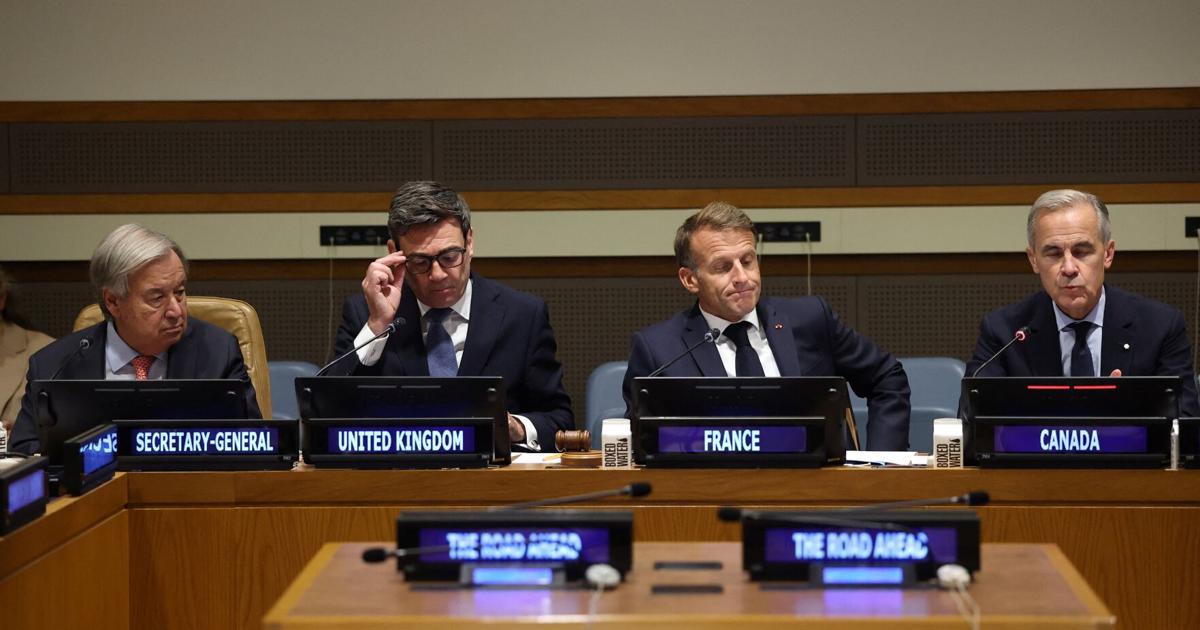
From left, U.N. Secretary-General Antonio Guterres, British Prime Minister Andy Burnham, French President Emmanuel Macron and Canadian Prime Minister Mark Carney attend a talk during the United Nations General Assembly on Tuesday.
Susan Delacourt is an Ottawa-based columnist covering national politics for the Star. Reach her via email: sdelacourt@thestar.ca or follow her on X: @susandelacourt
Mark Carney was in the room when two starkly different visions of the world order were laid before the United Nations General Assembly.
One came from the secretary-general of the UN, António Guterres. The other came from Donald Trump.
It was immediately evident, within the span of two hours, which world view would be embraced by Canada’s prime minister. Another day, another milepost in Canada’s increasing distance from Trump’s United States.
Guterres, making his last address to the general assembly, framed his speech as a manifesto, which could also stand as a powerful sequel to the speech Carney gave in Davos, Switzerland at the beginning of this year.
U.N. Secretary-General Antonio Guterres vowed to "champion the conviction that peace is possible" and "human dignity is universal" even after 31 December 2026 when his tenure as the U.N. Secretary-General comes to an end. (Sept. 22, 2026)
It couldn’t have been more different than Trump’s, which was a 40-minute round of self-congratulation, bravado and warnings to other nations about going offside with his hard-fisted diplomacy.
Where Guterres talked of the need for multilateral world order and a stronger United Nations, Trump laid out his ambition to dominate the world and boasted of how he forced cuts at the UN.
Where Guterres warned of the need to regulate artificial intelligence, Trump made a bid to rename it “super intelligence” and shrugged off regulation. Where Trump mocked climate change as a hoax, the UN secretary-general placed it among the chief worries of the world right now.
President Donald Trump sought to rebrand artificial intelligence as “super intelligence” Tuesday in remarks to the UN General Assembly, saying the existing name makes the technology sound “fake.” Trump said government documents will use the new term and he hopes it catches on. (Sept. 22, 2026)
“To the victor go the spoils,” Trump proclaimed about the U.S. incursion into Venezuela earlier this year.
“No country can solve today’s challenges alone,” Guterres said. “Superpowers must recognize their power has limits.”
Carney opted for a diplomatic nonanswer when asked directly which speech spoke best to him. But no one needed to read between the lines of his opening statement at the press conference of where he lands on the scale with Guterres on one end and Trump at the other.
“What comes ahead? It’s not wishful multilateralism, which defends only the status quo, nor a cold realpolitik that dismantles the status quo altogether. The alternative that Canada and many others are pursuing is values-based realism,” Carney said. “Progress can be signalled through monologue, only achieved through dialogue and action.”
That just might have been a slight dig at Trump’s 40-minute, self-referential monologue.
President Donald Trump returned to the United Nations General Assembly to discuss why America first is his strategy. The underlying theme of President Trump's speech was that the US remains a dominant force on the world stage. (Sept. 22, 2026)
For a president who’s been staying up late in recent weeks to post insulting memes about Canada, his UN address was notably silent on the current disintegrating relationship with this country.
Nor did Carney and Trump have any meetings while in the same building. Carney shrugged that off.
“I find that when you have 160 leaders come to New York, that it’s most valuable to meet those who you don’t normally see,” Carney said when asked at the news conference about it. “That’s what I did last year at the general assembly, and that’s what I always intended to do here.”
Nor did Carney bite when asked where he stood on the matter of artificial intelligence — was he with Guterres or Trump? The prime minister said he favours regulation, given his previous life in the financial sector, but that he would listen to citizens and Canadian expertise.
Ever since Davos, a view has been emerging of Carney as the unofficial leader of nations united against Trump. In July, the Wall Street Journal dubbed him in a headline: “The Canadian Who Steered Europe Away From the U.S.”
The “new alliance” announced last week when Carney addressed the European Union was another step in that emerging international reputation for this prime minister. Trump called that “laughable,” but no one was laughing on Tuesday when Guterres laid down the new world order as he sees it, and it sounded an awful lot like what Carney has been saying.
They both said on Tuesday, without mentioning Trump, that the future of the world won’t be written by just one nation. They both said multilateralism still is that best future. Guterres said history argues for that view; Carney said that realism makes that true.
Carney and Trump arrived at this general assembly meeting with two different objectives. For Trump, it was a flying visit, as is his practice, arriving in the room after Guterres spoke and staying just long enough to put himself at the centre for a day.
For Carney, this is a networking occasion over multiple days, loaded with low-profile meetings, and eschewing the opportunity to take centre stage himself.
The differences between these two leaders, and their world views, grow sharper every day.
Tuesday at the UN was a vivid snapshot, again. No one at the UN general assembly will be asked to vote between Trump and Carney, but Guterres’ speech was a strong hint of how that vote would turn out.
Error! Sorry, there was an error processing your request.
There was a problem with the recaptcha. Please try again.
You may unsubscribe at any time. By signing up, you agree to our terms of use and privacy policy. This site is protected by reCAPTCHA and the Google privacy policy and terms of service apply.
Opinion articles are based on the author’s interpretations and judgments of facts, data and events. More details
Susan Delacourt is an Ottawa-based columnist covering national politics for the Star. Reach her via email: sdelacourt@thestar.ca or follow her on X: @susandelacourt