Opinion | Why this trade war with U.S. is like no other in our history - Toronto Star
This latest chapter in Canada’s long battle over trade with the Americans differs in at least four ways.
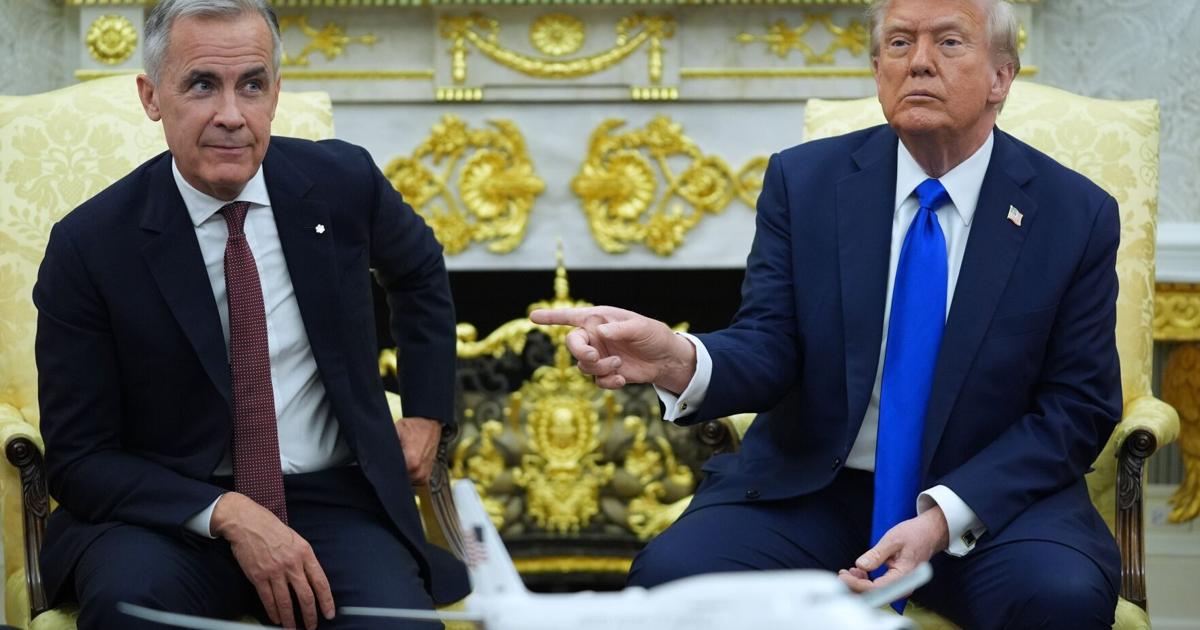
President Donald Trump with Prime Minister Mark Carney in the Oval Office on Oct. 7, 2025. “Never has the U.S. been led by a completely deranged, malicious and utterly ignorant president,” writes Dimitry Anastakis. “Cooler heads cannot prevail when there are none on the other side of the bargaining table.”
Dimitry Anastakis is a professor of history at the University of Toronto. His book Car Nation Canada (Lorimer) comes out this month.
This isn’t the first time Canada has been in a major trade dispute with the United States. And while history can’t predict the future, it does provide examples of circumstances that Canadians have dealt with before — and helps us realize important differences.
In a recent national address, Prime Minister Mark Carney used quite a bit of history to explain why Canadians find themselves in the middle of a trade war with our erstwhile closest friend and greatest ally, the U.S. Carney specifically pointed to Conservative Prime Minister John A. Macdonald’s own protectionist 1879 National Policy and the efforts of 1890s U.S. President William McKinley to use heavy tariffs to attack and attempt to subjugate Canada.
In fact, from the late 19th century until the 1990s, Canada was almost always in a tariff war, and the question of protectionism versus free trade with the Americans was often the central question in Canadian politics and the economy, just as it is today.
Reciprocity — or the idea that the two countries should have a mutually beneficial, fully equal free trade relationship, as it was once called (“NO RECIPROCITY — NO ACCESS!” someone recently spewed) — was a key ballot issue in most elections until the 1940s, but particularly so in the brutal trade battles of 1891, 1911, 1988 and, to a slightly lesser degree, in 2025.
Given our proximity to and relationship with the U.S., for generations, Canadians have debated this existential matter with fortitude and alacrity and often had to make tough decisions about our economic future, just as today.
So, we’ve been here before, so to speak, and we’ve always adapted.
In the 1860s, when Americans cut off access to their market, Canadians created Confederation to establish their own internal market, imposed tariffs to protect it and built a railway to serve it. Canadians created an east-west economy.
In the 1890s, when the annexationist/tariff war intensity was eerily similar to today, Canadians diversified trade to British markets around the world through preferential arrangements, and in 1911 turned down the option of American free trade.
In the 1930s, when Americans once again waged tariff wars that extended the Great Depression, Canadians pushed for reciprocal trade agreements that lowered barriers and helped to establish the postwar American-led trade world.
And, in the 1960s, Canadians began the process of moving toward continental duty-free trade with the 1965 Canada-U.S. Auto Pact, itself a product of a trade war over how the North American auto sector should best function.
Indeed, during the postwar period cross-border trade flare-ups happened regularly over issues from cars to lumber to oil, ultimately resulting in the Canada-U.S. 1989 Free Trade Agreement and Trump’s own Canada-U.S.-Mexico Agreement, signed in 2020.
In almost all of these instances, cooler heads prevailed, and escalation leading to full-fledged wars was avoided — because the costs are so high, no one wins a trade war, whether they are consumers, companies or countries.
But this latest chapter in Canada’s long battle over trade with the Americans differs in at least four ways.
• First, this is the first digital trade war. It’s not just that some of the key fights are over issues like digital services taxes, sovereign data or, implicitly, artificial intelligence. It’s that the main front in the battle is in the digital attention economy, where everyone with a phone is force-fed a relentless barrage of trade war slop, pumped directly into their brains by anyone with an opinion and a meme, including people who should know better, but clearly don’t.
• Second, previous Canada-U.S. trade wars were always over legitimate economic issues. Today, the trade war being waged against Canada is not about trade at all — fentanyl, renaming Lake Ontario, cultural protections, or personal piques reveal an American approach aimed at Canadian sovereignty, not economic issues.
• Third, in nearly every previous trade war, the U.S. Congress has been the most important actor in waging — and ultimately resolving — cross-border fights. But congressional Republicans have utterly abandoned their responsibility to trade and have sacrificed themselves to a cult of personality.
• Which leads the final, key, difference: Never has the U.S. been led by a completely deranged, malicious and utterly ignorant president. Cooler heads cannot prevail when there are none on the other side of the bargaining table.
In this unprecedented historical instance, only once Congress takes back its power, or the administration changes, will there be any realistic movement toward trade peace.
Error! Sorry, there was an error processing your request.
There was a problem with the recaptcha. Please try again.
You may unsubscribe at any time. By signing up, you agree to our terms of use and privacy policy. This site is protected by reCAPTCHA and the Google privacy policy and terms of service apply.
Dimitry Anastakis is a professor of history at the University of Toronto. His book Car Nation Canada (Lorimer) comes out this month.
Opinion articles are based on the author’s interpretations and judgments of facts, data and events. More details