Orangutans in Odisha: Does India have to repatriate the primates? What law says - The Indian Express
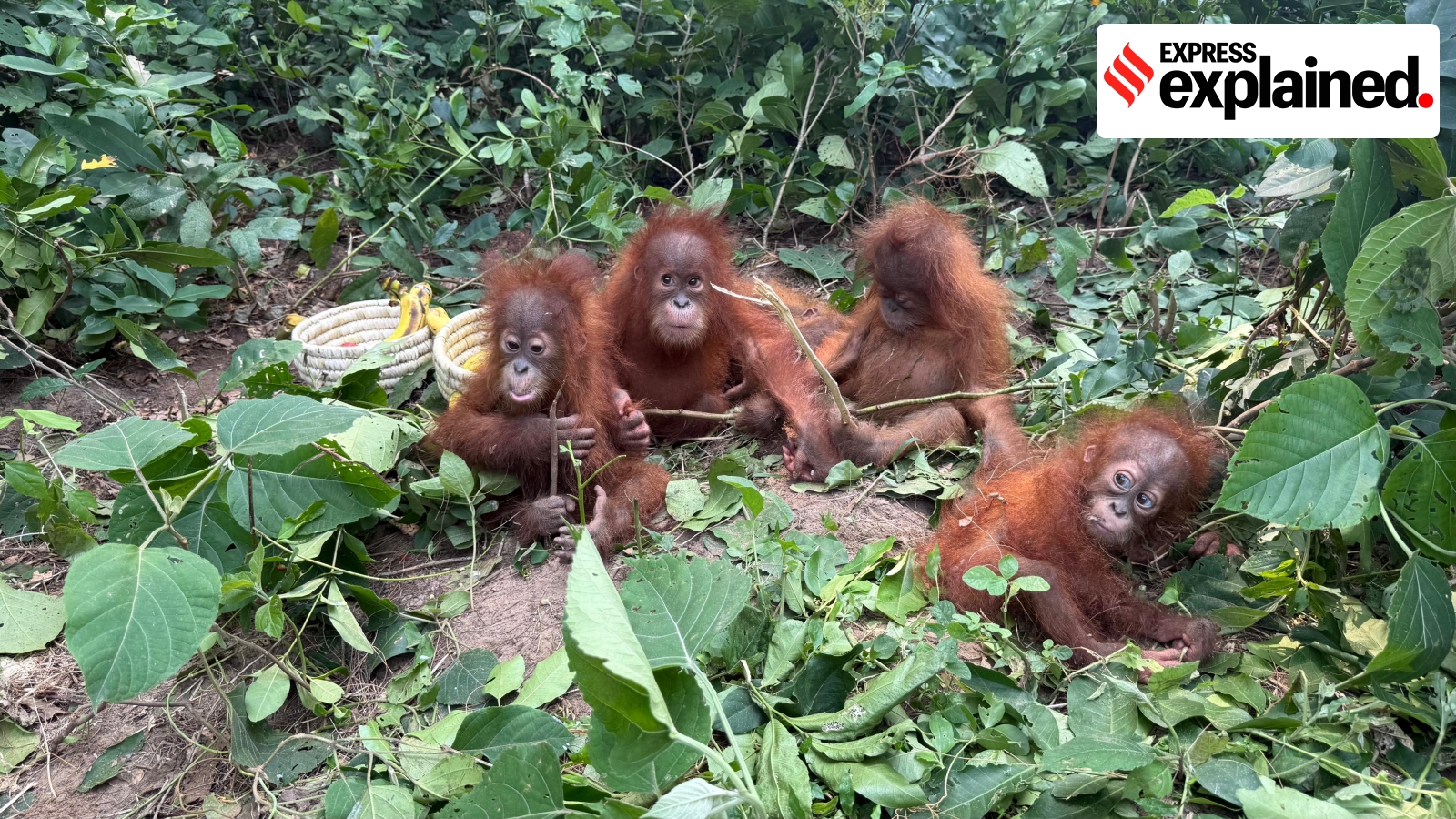
Last week, the Odisha Forest department rescued five baby orangutans, a critically endangered animal, from a forest in Balasore district. As orangutans are native to the rainforests of Indonesia and Malaysia, the incident prompted multiple questions — How did they reach India’s shores? Were they smuggled? And does India need to return them?
After the rescue, all eyes are also now on their safe return, with the sight of their condition raising public attention on their welfare. The incident also brings to the fore a trend that has been repeatedly flagged by anti-wildlife trade experts and advocates: That India is no more just a transit route, but is fuelling demand for exotic pets.
The international trade of wildlife, their body parts and trophies is not prohibited. But is strictly regulated and governed through the Convention on International Trade in Endangered Species of Wild Fauna and Flora (CITES). The international treaty entered force in 1975, and India became a party to it in 1976. The treaty’s aim is to ensure that cross-border trade in wildlife and plants is legal, sustainable and traceable without harming their survival in the wild.
It is essentially a licensing system that puts in checks and controls on the import, export and re-export of live animals and plants, wildlife body parts, and trophies. The controls are implemented via an exhaustive “CITES species-list”, which is divided into three appendices. These appendices determine the level of protection accorded to those species.
CITES protects around 6,700 species of animals, comprising 339 mammals, 159 birds, 113 reptiles, 24 amphibians, 26 fish, and 69 invertebrates.
Appendix-I listed species are those facing the threat of extinction. Trade in specimens of these species is generally prohibited, permitted only in exceptional circumstances and mostly never for commercial reasons; trade in Appendix-II species is also controlled strictly.
Appendix-I species can be traded with valid permits — provided they are captive-bred and are for conservation purposes. Protection for species or fresh entries are made routinely during intergovernmental meetings — Conference of Parties — based on their conservation status and proposals from parties. Some notable and controversially allowed trade related to charismatic species includes elephant ivory, rhino horn, elephant and lion trophy hunting, and crocodile skin.
India’s Wild Life (Protection) Act, 1972, was amended in 2022 to harmonise it with CITES. The amendment added a Schedule to include CITES-listed species.
There are three species of orangutans — Bornean, Sumatran and Tapanuli. All of them are found only in the islands of Borneo and Sumatra (in Malayasia and Indonesia), and are listed under Appendix-I of CITES. This means their trade is strictly restricted to non-commercial purposes, such as research, transfers between recognised zoos and breeding projects.
The orangutans found in Odisha are suspected to be from Sumatra. Since they appear to have been traded for commercial purposes, in alleged violation of CITES , the treaty’s provisions and the 1972 Act mandate certain steps for their welfare and return.
Indeed, Indonesia’s Ministry of Forestry has reached out to Indian authorities. It is learnt to be “preparing the technical requirements” for their repatriation if investigations confirm they are from Indonesia.
Under CITES, it is recommended that the management authority implementing its provisions — in this case, the Environment Ministry — consult with the scientific authorities and, if possible, the state of export or origin of the species before taking a call on repatriation. If repatriation is feasible, it has to be carried out at the expense of the state of origin. If it is not feasible, it has to be sent to a rescue centre or “such other place” as the management authority deems appropriate. The treaty does not make it obligatory to return animals to the wild.
The treaty underlines that the authority which has confiscated the animal must ensure that recipient states are cognisant of the impacts of repatriation. Meanwhile, the amended Act, which is in line with CITES provisions, prescribes a similar line of action, calling or consultation with the country of “export” for the animal’s return, or welfare at a recognised zoo or rescue centre in case it cannot be returned.
Repatriation may seem easy on paper. But it is filled with complexities, involving establishing the country of origin, following protocols, legal tangles, and most importantly, maintaining the health and welfare of the confiscated animals. The rescue of the orangutans from a forested area is not a typical case of illegally trafficked wildlife seizure.
Across India’s airports, sea ports, and land border posts, seizures of illegally trafficked wildlife consignments are usually of multiple animals, and sometimes in bulk quantities. Small mammals, reptiles, and amphibians are stuffed in gunny sacks, small cages or plastic boxes. In an infamous May 2022 case from Mizoram’s Champhai district near the Myanmar border, authorities seized 468 animals comprising 6-7 different species.
The first challenge on the hands of enforcement agencies is to look after the survival of trafficked species.
A report on exotic pet trade in India by the global nonprofit Humane World for Animals India, released this July, said that repatriation is complex as the wildlife consignments change multiple hands, passing through different geographies, making a return to the wild rarely feasible. Many species, it said, are captive bred with no known geographic origin.
Pawan Sharma, advocate and founder of the Mumbai-based wildlife rescue organisation Resqink Association for Wildlife Welfare, who assists and advises the Maharashtra Forest department in seizure cases said that in the case of airport seizures, most of them are returned to the place of origin in accordance with July 2025 guidelines of the Directorate General of Civil Aviation (DGCA) on deportation of animals detected in imports. At airports, DGCA mandates that airlines send back the illegally transported live animals immediately, eliminating the process of repatriation.
Repatriation, Sharma said, is a more complex issue. “We have to keep science, conservation, welfare, and legalities in mind. The repatriation has to factor in what is the exact state of origin, whether that country is willing to take back the animals. Several times the place of origin is not the same as the range or habitats where they are originally found in the wild. The personnel handling these issues across our agencies need competent training, because it is a complex issue,” he added.
The Odisha case has brought to the fore, once again, a repeatedly flagged trend of demand for exotic wildlife in India. While external demand for tiger, leopard skins, animal body parts sourced from India is not new, the demand to acquire exotic pets has been witnessed through regular seizures of wildlife consignments.
This trade poses the risk of zoonotic diseases, which spill over from under-stress smuggled animals to intermediary hosts, and then to humans. Wildlife traffickers also have documented linkages to criminal groups known for illegal narcotics trade, as per the 2024 World Wildlife Crime Report.
Uttara Mendiratta, an expert on wildlife trade and consultant with conservation organisation Wildlife Trust of India, said, “If you look at the data from social media and seizures it is clear that Indians are acquiring many of the species that are listed in CITES. And then there is also a massive trade in species which are not on the CITES list at all. We don’t even have a fair idea on the extent of breeding centres of exotic pets in India.”
Mendiratta said that it is hard for buyers to know if their exotic pet is ethically and legally sourced. “Wild caught and illegally bred individuals could be laundered into the system and sold as legally bred individuals with fake paperwork. This is especially true for CITES-listed species whose trade needs to be highly regulated,” she added.
The Humane World for Animals India report noted that an appeal for “unique and unusual” pets is driving rising trade in exotic wildlife. “Seizures indicate two primary routes, overland through Northeast India’s borders with Bangladesh and Myanmar, and by air via major international airports,” the report stated. Chennai, Bengaluru, and Mumbai airports stand out as major nodes, the report added.
Official data first came to the fore in 2021, when the Centre brought a voluntary disclosure scheme allowing citizens to declare possession of exotic live animals that were acquired without paperwork or illegally. Tackling zoonotic diseases and creating an inventory of such species were the motives.
Information obtained under RTI by the think-tank Vidhi Centre for Legal Policy showed that 43,693 applications for amnesty were made from 30 states and Union Territories. Lemurs, kangaroos, rhinoceroses, and iguanas were some of the species declared. This remains the only piece of official information on the extent of exotic species, with the exception of seizure reports made public in reports of Directorate of Revenue Intelligence.
An award-winning journalist with 14 years of experience, Nikhil Ghanekar is an Assistant Editor with the National Bureau [Government] of The Indian Express in New Delhi. He primarily covers environmental policy matters which involve tracking key decisions and inner workings of the Ministry of Environment, Forest and Climate Change. He also covers the functioning of the National Green Tribunal and writes on the impact of environmental policies on wildlife conservation, forestry issues and climate change. Nikhil joined The Indian Express in 2024. Originally from Mumbai, he has worked in publications such as Tehelka, Hindustan Times, DNA Newspaper, News18 and Indiaspend. In the past 14 years, he has written on a range of subjects such as sports, current affairs, civic issues, city centric environment news, central government policies and politics. ... Read More