Police say cameras ‘caught’ murder, rape accused at CJP protest – some were actually in jail - The Indian Express
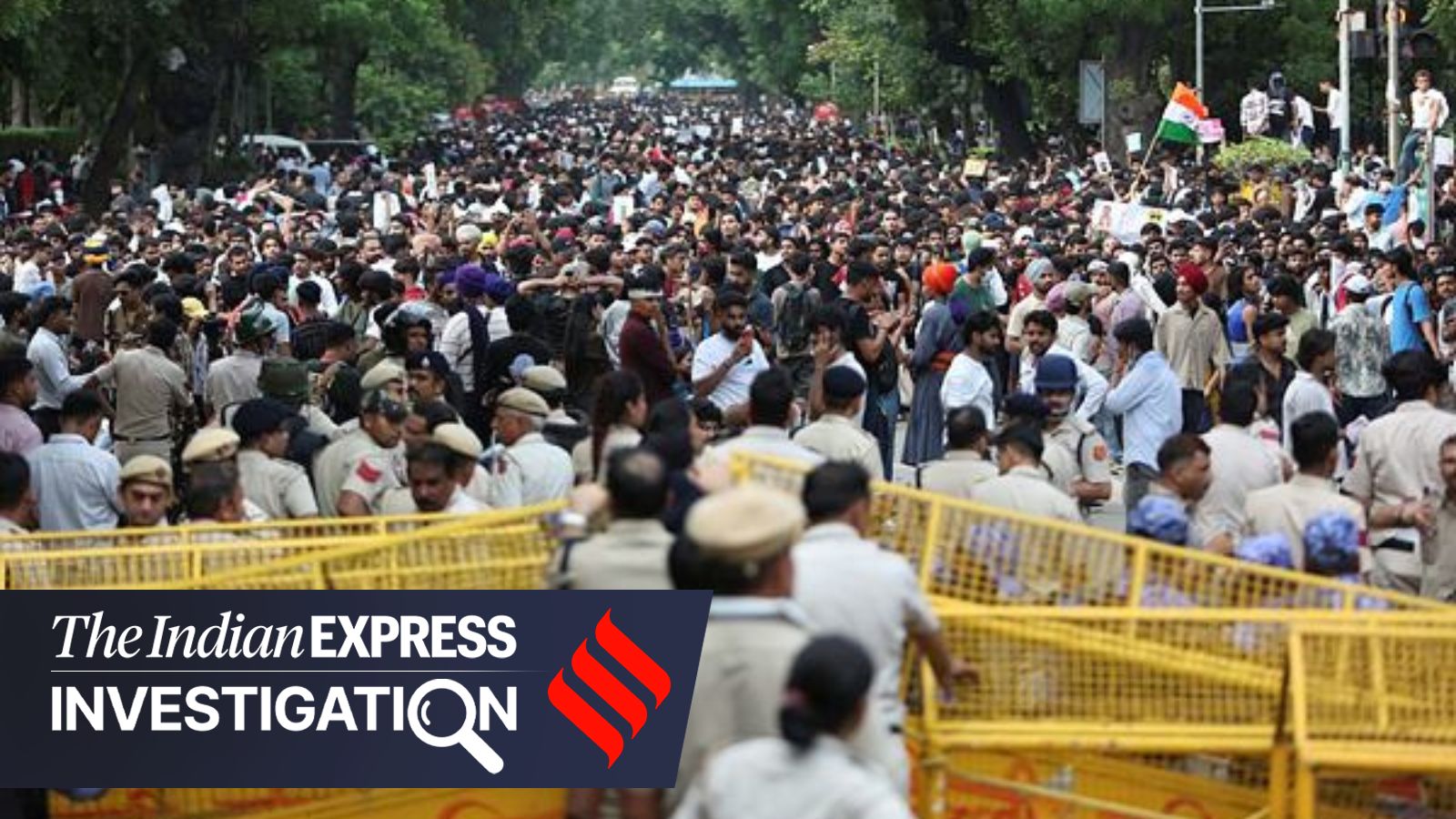
On Tuesday, when the Supreme Court quashed all FIRs related to the exam leak protests by students, it let the government proceed against the 2,873 people who the Delhi Police claimed had criminal records and were identified by its facial recognition software at the main protest site in Jantar Mantar between July 20 and 26. For their part, the police have made it clear that any action will be taken only after “field verification”, not merely on facial recognition.
An investigation of those with serious charges, murder, attempted murder and rape, and child abuse, shows that at least 25 people on the list, identified by the Facial Recognition System (FRS) at Jantar Mantar, were in jail as per police, jail and court records.
Of the 2,873 people identified in the police affidavit, the Express focused on those who were accused of murder, attempt to murder and rape. This accounted for 205: 101 (murder), 61 (rape), six (Protection of Children from Sexual Offences Act) and 37 of the 62 listed in the affidavit under attempt to murder.
In this group, 17 faced charges of murder; four of rape, including two in POCSO cases; and four more of attempt to murder were lodged in Delhi’s three prison complexes at Tihar, Mandoli and Rohini when the FRS flagged them at Jantar Mantar, records show.
These 25 individuals included three identified by the FRS on July 24, 21 on July 25, and one on July 26, the last day of the protest at Jantar Mantar.
Responding on Monday to a questionnaire from the Express, the Delhi Police said: “During the protests, 2873 individuals identified as prima facie having criminal antecedents were spotted. However, further verification in this regard is pending.”
According to the police affidavit submitted on August 17, its FRS identified individuals with criminal records at the protest site whose “particulars matched with existing records available in official police databases”. It said that 2,402 people were identified by the Delhi Police’s biometric database,’Crime Kundli‘, and 471 through criminal records.
At least one of these cases is linked to a high-profile killing in the capital. Yogesh alias Raju was arrested for his alleged role in the murder of gym owner Nadir Shah in South Delhi’s upscale Greater Kailash-1.
According to records, he was a sharpshooter for the syndicates of gangsters Lawrence Bishnoi and Hashim Baba, and was arrested after an exchange of fire during which he sustained a bullet injury to his left leg.
The Delhi Police’s facial recognition software places boxes around detected faces and compares them with images in police databases. In response to a Right to Information (RTI) request in 2022, the police had revealed that it considered a match to be “positive” if its system showed an accuracy rate of 80 per cent. The result is not, by itself, proof of identity. Performance varies with the algorithm, camera angle, lighting, image quality, masks, and the database being searched.
The Delhi Police’s affidavit in the Supreme Court was in response to petitions being heard alleging excessive force and use of surveillance at the students’ protest in Jantar Mantar.
District-wise, the data shows that Delhi’s North recorded the highest number of identified persons at 285, followed by Outer (257), North West (256), North East (174), East (173), and South West (166). Other districts and units listed included Railways, Shahdara, Central, South-East, West, Dwarka, South, Rohini, New Delhi, Crime Branch, IGI Airport, Metro and Special Cell.
However, the affidavit does not specify whether those identified were accused, convicts, or merely named in criminal cases.
According to the affidavit, “the face and other material of only those accused would be available in the police record who are facing serious offences and not petty offences like traffic challans/ violations offences, etc”.
It also said: “No actions are taken solely based upon the result of the facial recognition system which is only the first step to identify a person in the crowd who has a criminal record. After the said face is recognised, there is a field verification done with respect to the individual concerned since that person’s details are already in the police records and if, on field verification, it is found that he was, in fact, present at the site, actions are taken.”
Mahender Singh Manral is an Assistant Editor with the national bureau of The Indian Express. He is known for his impactful and breaking stories. He covers the Ministry of Home Affairs, Investigative Agencies, National Investigative Agency, Central Bureau of Investigation, Law Enforcement Agencies, Paramilitary Forces, and internal security. Prior to this, Manral had extensively reported on city-based crime stories along with that he also covered the anti-corruption branch of the Delhi government for a decade. He is known for his knack for News and a detailed understanding of stories. He also worked with Mail Today as a senior correspondent for eleven months. He has also worked with The Pioneer for two years where he was exclusively covering crime beat. During his initial days of the career he also worked with The Statesman newspaper in the national capital, where he was entrusted with beats like crime, education, and the Delhi Jal Board. A graduate in Mass Communication, Manral is always in search of stories that impact lives. ... Read More