
Premium economy is getting better, but is it actually worth the price?
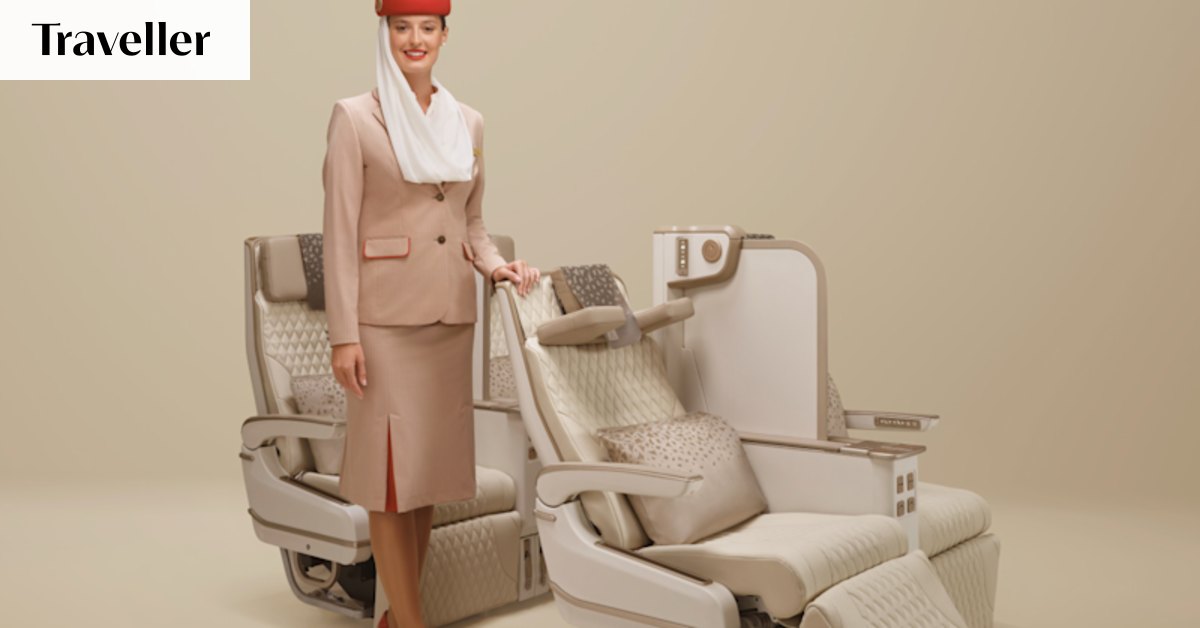
Emirates has just announced its premium economy flyers will get adjustable privacy screens between seats, the first of its kind for PE flyers. The electrically operated screen rises from the armrest to the full height of the seatback.
In a major upgrade, the Safran-designed seat now comes with wireless charging plus a USB-C socket, a slot in the tray table that lifts your phone upright for easy viewing and a U-Dream headrest which splits into three, with side wings that fold down for improved head support. The seat reclines into a cradle, which means you can recline anytime, apart from take-off and landing, without annoying the passenger seated behind. The leather leg rest is also electrically powered.
It’s not a game changer, but privacy when you’re eating or snoozing is a plus, and you can watch your video screen without being distracted by your seat buddy’s screen. It’s an example of the incremental changes that nudge PE slightly closer to business class, but no hiding the fact that there’s a gulf between PE and business class.
Emirates’ new A350 fully electric premium economy seat with full-height privacy divider and industry-first U-Dream leather headrest.Emirates is trumpeting the sliding screen as the world’s first electrically powered screen, and that’s true, but Japan Airlines already has a privacy screen that extends horizontally rather than vertically, and it’s a pull-out rather than powered. So far, the screen only appears on the airline’s A350-1000s.
Australian travellers won’t be sitting in Emirates’ new seat for some time, at least not on flights departing from home. The privacy screen is not being retrofitted, it will only feature on newly delivered Airbus A350 aircraft. The only Australian city from which Emirates operates an A350 is Adelaide. From Sydney, Melbourne, Brisbane and Perth, all the airline’s flights are aboard superjumbo A380s. Something else that Emirates isn’t saying – seat pitch gets shaved in the new seats. Emirates is promising “seat pitch is up to 39 inches (99 centimetres)” in PE on the new A350s. However, that’s 2.5 centimetres less than the same seat on the airline’s A380s.
Emirates was a late adopter of PE, launching the class in January 2021, almost 30 years after Virgin Atlantic introduced so-called “Mid Class”, rechristened premium economy two years later. Taiwan’s EVA Air launched its own version, “Economy Deluxe” just a few months after VA. Since its debut, Emirates’ PE has become one of the best performers in its class. In the 2025 Skytrax World Airline Awards, Emirates’ PE was rated third best, taking the gold award in the Best Premium Economy Class Airline Seats category.
Not all premium economy cabins are equal ... Japan Airlines’ A350 premium economy seats stand out with large privacy partitions and class-leading legroom.More legroom, and that’s the single reason most travellers are prepared to pay around 60 per cent more for a PE fare compared with an economy class fare.
Seat pitch in PE is generally in the range of 86 to 91 centimetres. That’s about 15 to 20 centimetres more than in economy, and 15 centimetres is the height of the current Apple iPhone 17. The seat is also two to five centimetres wider than in economy, the footrest is more supportive and the recline angle is slightly greater.
Cabin configuration on a wide-body aircraft is either 2-3-2 or 2-4-2, and if you’re in one of the middle seats you might be wondering why you forked out that extra cash.
PE flyers usually get a separate cabin, although only rarely is there a dedicated toilet. It’s also quieter, infants and small children are less frequently seen compared with the economy cabin. Food, beverages and service are marginally better than in economy, meals are often served with linen and decent cutlery. There’s a separate check-in, a more generous checked baggage allowance, and PE customers generally board before economy flyers.
Not all premium economy cabins are equal. Japan Airlines, Qantas, Singapore Airlines, Cathay Pacific, Eva Air, Emirates and Delta all have excellent PE cabins on their long-haul flights. If you’re looking for the ultimate legroom, Japan Airlines takes the gong with a seat pitch of 107 centimetres on international flights, and that’s a class-leading feature to crow about. The airline even gives PE flyers on international flights admission to their airline and partner lounges, provided the booking was made with JAL.
I fly Singapore Airlines premium economy to India when I need to hit the ground running.The issue of flying PE over economy or business is hotly debated among flyers. If the price lands at 30 to 40 per cent more than the economy fare, that’s a winner. However, PE usually comes in about 50 to 60 per cent more.
That doesn’t deter the well-heeled retirees, who typically make up a high proportion of the passengers choosing to fly PE, lured by the extra comfort of a well-designed seat located in a separate, comparatively spacious cabin. The payoff is getting off at your destination feeling happier and healthier than you would after the same flight at the back end of the aircraft.
I fly to India at least once a year, flying PE with Singapore Airlines. I need to hit the ground with a smile, meet my tour group and take them around some of the highlights of Delhi, and after a 16-hour trip in economy I won’t be wearing a happy face.
Emirates puts a premium on its PE services. For a return flight from Melbourne to London flying PE in April, the airline is charging $6258. For that same route, same dates, a business-class seat costs $7621 flying a combination of Malaysia Airlines and Oman Air. That’s a two-stop flight, 26 hours each way. Kuala Lumpur to Muscat is a seven-hour flight on a Boeing 737 and while it’s not a lie-flat seat, it is an evening flight. That’s the deal I’d go for, and for a saving of more than $3000 on a one-stop Melbourne-London return business flight with a premier-league carrier, I’d put up with a couple of inconveniences.
Where quiet luxury takes flightSix ways to get an elusive flatbed seat using frequent flyer pointsEverything you need to know about airport lounges – and how to get inA 14-day flight to London: On board the recreation of historic Kangaroo RouteInside the high-security kitchen where airline food is madeSee 15 storiesSaveYou have reached your maximum number of saved items.
Remove items from your saved list to add more.
