Pride and grudges: Don’t wait for the funeral to say what matters - IOL
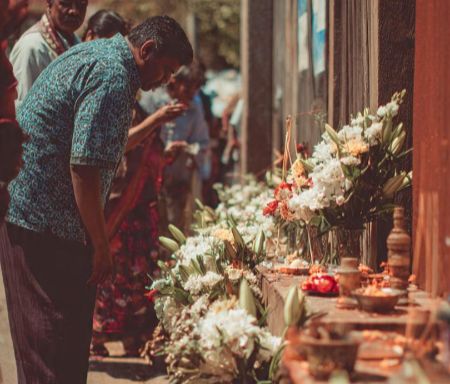
Family grudges can last for decades, but death makes reconciliation impossible. One call today may prevent a lifetime of regret,
Family grudges can last for decades, but death makes reconciliation impossible. One call today may prevent a lifetime of regret, writes Sanjith Hanuman. This piece is inspired by “The Flowers Can’t Hear Your Apology”, by Sam The Motivator.
EVERY South African family has a photograph like it. Taken outside the old house on a Sunday, a pot on the fire, too many people squeezed into the frame in the best clothes we could afford.
Children on shoulders, not only your own, because then every child belonged to everybody. Nobody in that picture had much, and nobody cared. Some of them are no longer with us.
Look at it now and count the people who no longer speak.
A sister and brother whose last real conversation was at his wedding. Two cousins, once inseparable, until one said something at a party the other never forgave.
An uncle who walks past his nephew at the market as if they never shared a bed as boys. Ask any of them how it started and you will get a shrug. All that remains is the distance, growing for ten years, twenty, sometimes thirty.
Then one day the phone rings with the news nobody planned for, and the whole family is in the same room again. Not the yard this time.
A funeral parlour, a family home, a crematorium.
Everyone in their best black, standing a little apart, all thinking the same thing: I should have called. Instead, the flowers did the talking. If that sounds familiar, it is because it happens in every family.
I have seen it more times than I can count.
Sam The Motivator’s song has travelled across millions of phones this year because it refuses to dress this up.
It says what your grandmother said and what you have told yourself at two in the morning.
The people who need your apology can only hear it while they are alive. The tears at the graveside are real, but they are late.
Think about where most of us come from. Three to a bed. One bathroom for nine people. School shoes passed down until the soles gave out. A mother who ate last, and less, and told you she was not hungry. We could not afford to fall out then. We needed each other too much.
And yet it is precisely those families, the ones that survived everything, that are now broken over the smallest things. Money lent and never returned.
The house left to one child and not the others. A word said in anger, repeated to the wrong person, and carried like a stone ever since. Now think about who is waiting.
There is a mother somewhere who knows every one of her children’s birthdays without a calendar. She knows their anniversaries too, and their children’s birthdays,
and sends the message every year at six in the morning. Half of them do not reply. They did not forget. They remembered, and decided not to, because she once told them something they did not want to hear, and she was right, and they have never forgiven her for it. She sets his place every year anyway. His number is still on the fridge.
There is a father who sits on the stoep on his birthday with his phone face up beside him, checking it as if it might have rung without him hearing.
There is a grandmother in a small place two hours from the city, on a dirt road, where the signal comes and goes. She raised half the grandchildren in that house.
On Mother’s Day she puts on her good dress after church and waits. On Father’s Day the old man sits outside so he can hear the phone through the window. Nothing comes. Not because the children are cruel, but because they are not speaking to each other and each assumes the other will call. So, the old people sit in the quiet, wondering what they did.
And it is not only family. Think of the boy you sat next to in Grade 4, who shared a lunch tin with you because one of you never had one.
The team on a dusty field with one ball between fourteen of you. Best friends for fifteen years, until competition crept in, or somebody carried a story between you that was never true.
You grew up together and have missed the entire middle of each other’s lives. But you are both still here, with golden years ahead for two old men to sit on a bench and laugh about that field.
Try it. One call before the flowers. You have nothing to lose but a grudge you cannot explain.
I sit with families after a death more often than I would like. The money is seldom the real problem. Estates get wound up. What never gets settled is what nobody says at the table.
The brother who cannot look at the sister he punished for a decade. The daughter who was too busy for Sunday lunch and would give anything now for one more plate. They are not only grieving a person. They are grieving a conversation they were always going to have next month.
That phrase, next month, is the whole disease. Nobody decided never to reconcile.
They postponed it, and because postponing costs nothing today, it feels free. It is not free. It is a debt, it accrues in silence, and the due date is not yours to choose.
Withholding forgiveness feels like strength. As long as the wound stays open, you hold something over the other person. But that is worth something only while they are alive.
Once they are gone, you hold the wound alone. Being right is expensive when the price is a person.
Sam The Motivator says it plainly at the close of his song: pride has put more families in the ground than death has, and a funeral is a terrible place to become a family again.
Forgiveness is not a verdict that what was done to you was acceptable. It asks only that you put the weight down and, while the door is still open, say so.
So, one name. Not a list. The one that came to you before you finished this sentence. A sibling, a cousin, a parent, a friend who might as well be blood.
Someone you wronged, or who wronged you, or neither of you remembers which.
Love is the only thing in it that was ever precious. Make peace while you still can. Say it now, while somebody can still answer. You owe it to them. You owe it to yourself. You owe it to your mother, still setting that chair, and to your father on the stoep. You owe it to the old people on the dirt road,
to the children who are watching, to this world and the people in it, and to whoever you pray to. And you owe it to your own ego, which has cost you enough already.
The flowers will be there either way. They will be beautiful, on time, and deaf to every word you say. Do not let them speak for you. Pride has buried enough of us. Pick up the phone. Today. Before the flowers arrive.
Sanjith Hannuman is a director at AVIB and an employee benefits consultant who holds an MBA from UKZN, is an FSA of the Financial Planning Institute of South Africa, a Human Values Practitioner, and a Behavioural Life Coach who believes in the betterment of life for all.