Public transport fares to rise by 12 to 13 cents per ride for adult card users from Dec 26 - CNA
The record increase in cash terms for public transport fares was driven mainly by a substantial increase in energy prices between July 2025 and June 2026 due to the Middle East conflict, said the Public Transport Council.
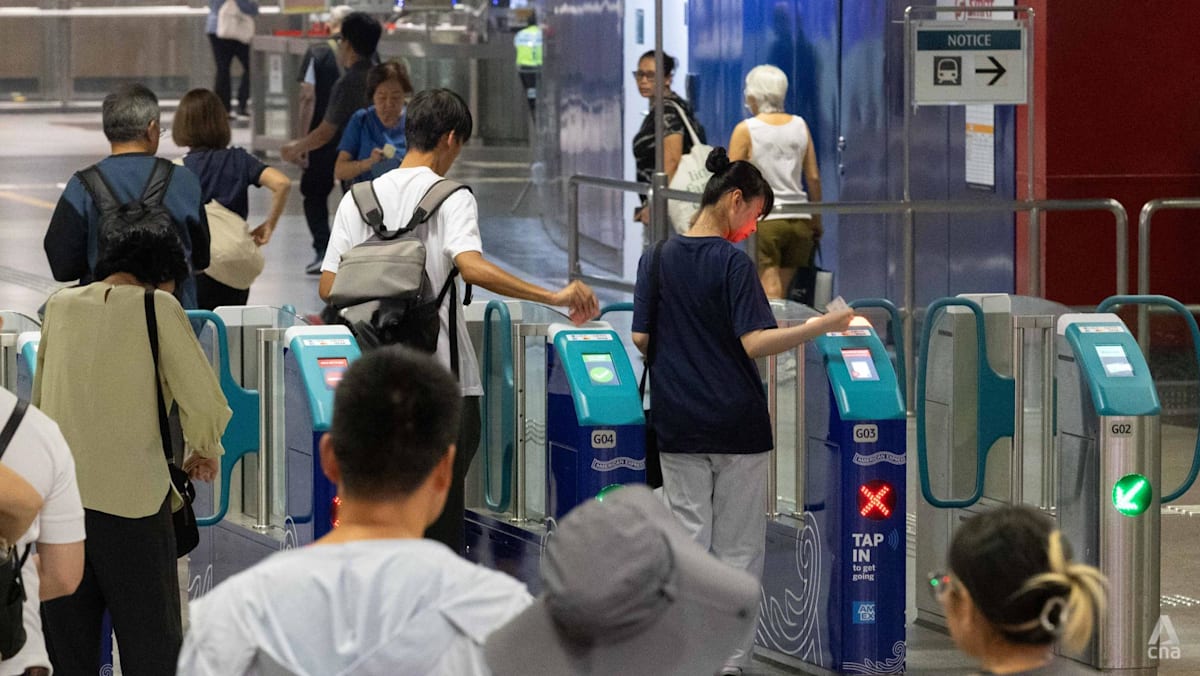
Commuters at Harbourfront station on Sep 29, 2026. (Photo: CNA/Ili Mansor)
This audio is generated by an AI tool.
Vanessa Lim 29 Sep 2026 05:00PM (Updated: 29 Sep 2026 10:50PM) Bookmark Bookmark Share WhatsApp Telegram Facebook Twitter Email LinkedIn Set CNA as your preferred source on Google Add CNA as a trusted source to help Google better understand and surface our content in search results. Read a summary of this article on FAST. Get bite-sized news via a newcards interface. Give it a try. Click here to return to FAST Tap here to return to FAST FAST SINGAPORE: Public transport fares will rise by 12 to 13 cents per journey for adult card users from Dec 26, a record increase in cash terms, the Public Transport Council (PTC) announced on Tuesday (Sep 29).
Adult commuters travelling up to 3.2km will pay 12 cents more per journey, while those travelling farther will pay 13 cents more per journey.
Overall, public transport fares will increase by 7 per cent, higher than last year's 5 per cent increase.
The PTC said the higher fare formula output was driven by a "substantial increase" in energy prices between July 2025 and June 2026 due to the Middle East conflict.
CNA Games Guess Word Crack the word, one row at a time Buzzword Create words using the given letters Mini Sudoku Tiny puzzle, mighty brain teaser Mini Crossword Small grid, big challenge Word Search Spot as many words as you can Show More Show Less In the last five review exercises from 2022 to 2026, fare adjustments ranged between 2.9 per cent and 7 per cent. This year’s increase in cents surpasses the hike in 2023, when adult card fares rose by 10 to 11 cents.
For concession cardholders, including students, seniors and people with disabilities, card fares will rise by 5 cents per journey.
Card fares for lower-wage workers under the Workfare Transport Concession Scheme (WTCS) will remain unchanged, with the government absorbing the increase for about 190,000 cardholders.
Cash fares will increase by 20 cents per journey for adults and 10 cents per journey for students, seniors and people with disabilities. Less than 1 per cent of public transport journeys are paid for in cash, according to PTC.
Prices of all monthly passes will remain unchanged. There are currently about 126,000 monthly pass users, and the PTC estimates that another 110,000 card commuters could potentially save money by switching to a monthly hybrid pass following the fare increase.
The hybrid monthly pass provides unlimited travel on both basic bus and train services over a one-month period.
PTC said it encourages commuters who travel frequently to consider buying monthly passes to help manage public transport expenses.
Over the past three years, the number of monthly passes sold has more than doubled from 56,000 in 2023 to 126,000 this year.
The average monthly savings of a pass user, as compared to paying card fares, has also increased from S$11 to S$26 over the same period, it added.
The council said commuters can use the transit expense summary feature in the SimplyGo app to track their expenditure on public transport, in order to decide whether a monthly pass represents better value over paying card fares.
The PTC said the proportion of household income spent on public transport has remained at 2.4 per cent for lower-income households and 1.7 per cent for average-income households over the past decade. It added that it would continue to monitor fare affordability.
The government will set aside an additional S$15 million for public transport vouchers this year compared to last year, with each eligible household receiving S$80 in vouchers, up from S$60 last year.
The income eligibility ceiling for public transport vouchers will also be raised from a monthly household income per person of S$1,800 to S$2,100.
About four in 10 households will qualify for the vouchers as a result, including about 60,000 additional households, according to a joint release by MOT and the People's Association on Tuesday.
Households can use the vouchers to top up fare cards or buy monthly passes.
The distribution of the vouchers will take place in two stages. In the first stage, households that received a voucher in the 2025 exercise and continue to meet the income criterion will automatically receive another voucher.
Notification letters will be sent by post or SMS from the end of December, based on the contact preference indicated in the previous exercise.
In the second stage, from early 2027, eligible households that did not receive a voucher in the first stage can apply online or in person at their local community centres or clubs. The vouchers will be valid until Mar 31, 2028.
Public transport operators will also contribute to the support measures. SBS Transit Rail and SMRT Trains are required to contribute 30 per cent of their expected increase in fare revenue to the Public Transport Fund, amounting to S$23.94 million in total.
The PTC recommended that the government draw on the public transport fund to provide additional support to cushion the impact of the fare increase for lower-income households.
Under the fare adjustment formula, which applies from 2023 to 2027, the 2026 fare adjustment quantum generated by the formula was 5.3 per cent.
The formula takes into account changes in the core consumer price index, wages and energy costs, as well as productivity and public transport capacity.
Taking into account the 9.4 percentage-point adjustment carried over from previous fare review exercises, the maximum allowable fare adjustment quantum was 14.7 per cent.
The PTC decided to grant a fare adjustment quantum of 7 per cent and defer the remaining 7.7 percentage points to future fare review exercises.
"Over the past five years, the Public Transport Council has moderated fare increases to strike a balance between keeping public transport fares affordable for commuters and ensuring the financial sustainability of Singapore's public transport system amid rising operating and energy costs," the council said.
"Commuters have been shielded from the full increase in costs, whenever fares were not fully adjusted by the quantum determined by the fare formula."