Rebels, workers, radicals: The making of 'Red Berlin'
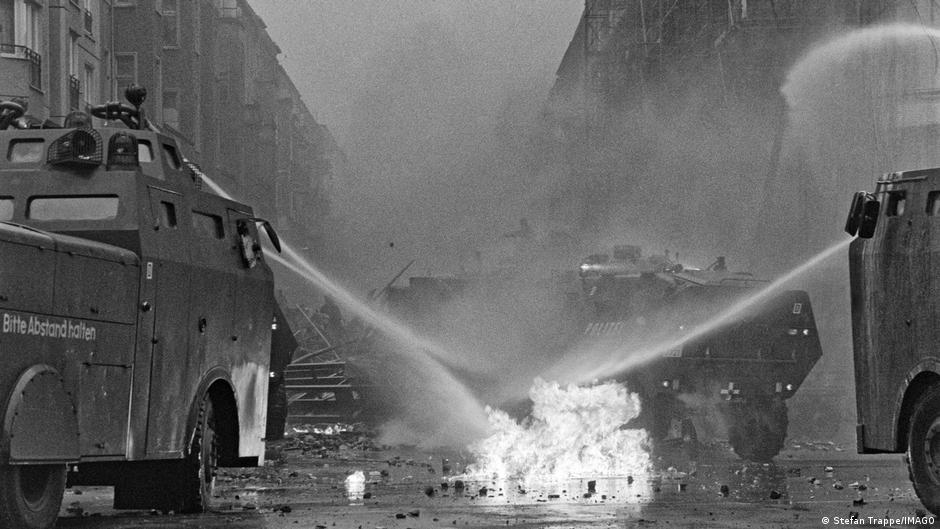
A Molotov cocktail explodes during the forced eviction of a squat in the Berlin district of Friedrichshain in 1990Image: Stefan Trappe/IMAGOAdvertisementBerlin has a reputation for being unruly. When Jospeh Goebbels was appointed the Nazi Party's district leader in 1926, he described Berlin as "the reddest city in Europe besides Moscow." From the Tailors' Revolution of 1830 and the barricades of 1848, to the rise of a vast industrial working class later in the 19th century, revolution, protest and rebellion run deep throughout the city's history.
While the future German philosopher and revolutionary socialist Karl Marx was still in high school in the small town of Trier in Prussia's Rhine Province, Berlin was fast becoming a center of the country's labor movement. It was during the March Revolution of 1848 — a failed attempt to create a democratic German nation-state — that the General Workers' Brotherhood was founded, one of the first worker's organizations to become active in Germany.
By the 1870s and 1880s, major industries from mechanical and railway engineering to ready-made clothing were located in the city. As the working-class population grew, this in turn impacted the city's political culture. "It became more populist in a positive sense: moving away from the traditional, elitist politics of the bourgeois liberals who had long dominated Berlin, and toward the inclusion of ordinary people, since at least men were now also important voters," Axel Weipert, a historian and author of the book "Red Berlin" (2019), tells DW.
Berlin's labor movement became increasingly radical, partly in response to heavy-handed repression under the Chancellor Otto von Bismarck. Although Bismarck created the first modern welfare state to try and undercut the rising popularity of the socialist movement, he also introduced laws banning socialist and communist organizations, newspapers and public gatherings, as well as independent trade unions.
After Bismarck resigned in 1890, the anti-socialist laws were repealed and the ideas of Karl Marx and his fellow revolutionary socialist Friedrich Engels became the ideology of what Weipert describes as a "genuine mass movement" in Berlin. The Social Democratic Party (SPD), Germany's oldest political party, was formed out of a merger between the General German Workers' Association and the social Democratic Workers' Party in 1875. Before World War I, the SPD was able to win far higher vote shares in Berlin than elsewhere in the country.
In 1914, the labor movement was seriously discredited when the SPD leadership and the trade unions decided not to oppose the war pushed by Kaiser Wilhelm II. But from 1916 onwards, Berlin became the center of mass labor strikes against the war. One of the earliest strikes was against the trial of anti-war socialist campaigner Karl Liebknecht. Together with Rosa Luxemburg and other left-wing radicals, Liebknecht founded the Spartacus League in Berlin, an underground group that later became the Communist Party of Germany (KPD).
Triggered by war-weariness, severe food shortages and economic ruin, around half a million Berlin workers joined the January Strike of 1918. Supported by the Spartacus League, the anti-war strike was led by the Revolutionary Stewards, a clandestine network of factory workers and trade unions from large munitions and metal-working factories. The same group became a core organizing force behind the overthrow of the Kaiser in Berlin on November 9, 1918.
In the chaotic, war-torn city gripped by violent revolution, the Spartacist Uprising of 1919 was launched to overthrow Germany's provisional government and establish a republic of workers councils. Its violent suppression, which resulted in scores of deaths — Liebknecht and Luxemburg were both murdered by soldiers of right-wing paramilitary militias — permanently fractured the political left.
As the capital of the newly founded Weimar Republic, Berlin remained a hotbed of radical politics in the interwar period. This was especially true in neighborhoods with large numbers of tenement buildings, such as Wedding, Kreuzberg and Neukölln, where thousands of factory workers lived in squalid conditions. The many large factories in Berlin also created shared interests and laid the groundwork for collective action.
"Bloody May" in 1929 saw brutal attacks on illegal May Day demonstrations which left at over 30 people dead. The SPD police president of Berlin had issued a ban on all public demonstrations for May Day, a ban defied by the KPD. In response, the police opened fire on protestors in the streets and also shot through windows in residential buildings, primarily in the working-class districts of Wedding and Neukölln.
During the Great Depression era, the SPD lost much of its support between 1929 and 1933, as joblessness ravaged the city. "Unemployment is critical — it meant that men were no longer attached to the SPD-led factory floor and trade union and the social bonds of these spaces and organizations," explains Pamela Swett, a historian at the University of Rhode Island. "Unmoored from the rhythm of daily life, men sought new bonds — new ways to feel self-respect and camaraderie with others." Some joined the KPD, which became known as the "Party of the Unemployed." Others joined far-right paramilitary groups such as the Nazi stormtroopers.
After the Nazis took power in 1933, many of the labor movement leaders were killed or exiled. Then, in the aftermath of World War II, Berlin was divided into two separate political systems. East Berlin became the capital of the communist German Democratic Republic. Isolated from the Federal Republic of Germany, West Berlin deindustrialized, the labor movement weakened, and the SPD moved to the right.
During the Cold War, many left-leaning young men moved to West Berlin to evade military service. This intensified the student movement, the center of which was Berlin's Free University (Freie Universität). It was there, in leafy southwest Berlin, that historic sit-ins were held to protest the perceived authoritarianism of the government and the presence of former Nazi officials in positions of power. The fatal shooting of student Benno Ohnesorg by a police officer during a demonstration against the visiting Shah of Iran in 1967 radicalized a generation that led the widespread protests of 1968.
In the early 1970s, a housing shortage led parts of the student movement but also apprentices and young migrant families to squat in West Berlin's empty buildings. "You have migrant laborers and young laborers participating, so this was part of working-class rebellion against capitalist housing," says Ralf Hoffrogge, a labor movement historian at Berlin's Free University.
Today, as gentrification sweeps the city, Berlin is home to the strongest and most radical tenants' movements in Germany. In a 2021 referendum, 59% of voters in the city approved the expropriation of property from private real-estate companies. Hoffrogge was part of the campaign, and his 2025 book "Loud Berlin" ("Das laute Berlin") explores how the housing crisis has become a catalyst for a "socialist renaissance" in the city. "It's not Berlin tenants against Berlin landlords, it's tenants against global capital. I think people have started to realize these contradictions and this is why class-based policy concepts are becoming popular again."