Refugees moved from Durban Home Affairs centre as Umbilo businesses welcome relief - IOL
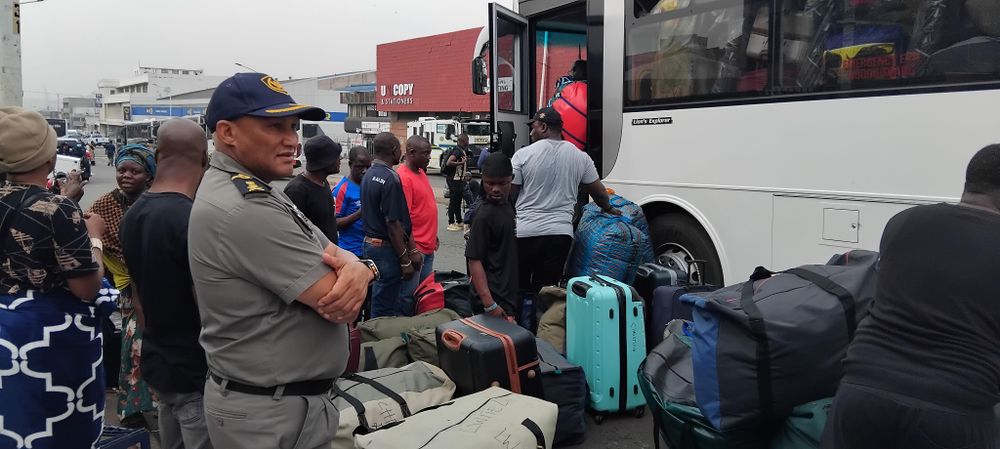
Refugees load their luggage onto a bus outside the Durban Refugee Reception Centre on Che Guevara Road. More than 250 refugees were taken to the Lindela Repatriation Centre in Gauteng on Tuesday.
The Umbilo Business Association (UBA) has welcomed the relocation of refugees who were camping outside the Department of Home Affairs (DHA) Durban Refugee Reception Centre since May 2026.
Four busloads of refugees and one bus with their luggage left Che Guevara Road, formerly Moore Road, on Tuesday. The DHA arranged for the refugees to be transported to the Lindela Repatriation Centre in Gauteng. Approximately 250 refugees were camping outside the centre following several anti-immigrant protests calling for foreign nationals to leave South Africa by June 30.
The refugees who camped outside DHA on Che Guevara Road are from the Democratic Republic of Congo, Burundi, Uganda, Mozambique and Tanzania.
Doran Subiah, the chairperson of the Umbilo Business Association, said the latest development brings long-overdue relief to businesses, employees, and residents of the Umbilo precinct.
The UBA was grateful to Premier Thamsanqa Ntuli and MEC Martin Meyer for their intervention in facilitating the relocation process on Friday.
“Their leadership has demonstrated that the provincial government is willing to act when the plight of communities and businesses is brought to its attention. This intervention is a clear indication that partnerships between business and government can yield tangible results,” Subiah said.
For months the UBA had highlighted the severe health, safety and economic consequences of the occupation of Che Guevara Road. Subiah said businesses had reported declining customer visits, safety concerns for staff, and the looming threat of closure.
“Today, those businesses can breathe a cautious sigh of relief. However, the UBA must flag a critical dislocation that persists at King Dinuzulu Park, where relocation issues remain unresolved,” he said.
The eThekwini Municipality's Cleansing and Solid Waste (DSW) unit removed all the bedding and litter left behind when refugees were relocated from outside the Durban Refugee Reception Centre to Lindela Repatriation Centre on Tuesday.
Subiah was referring to informal camps set up at King Dinuzulu Park by hundreds of homeless people and drug addicts.
“We call on all spheres of government to urgently address the situation at these locations. Without a comprehensive and co-ordinated approach, we risk simply shifting the problem from one part of the precinct to another, perpetuating the cycle of uncertainty and economic harm,” he said.
The UBA said the relocation should form part of a sustainable, long-term solution.
"We call on government to ensure that all relocated individuals are provided with dignified accommodation, access to social services, and, where applicable, proper immigration processing.
“The UBA remains committed to partnering with government to find humane and lasting solutions that balance compassion with the economic viability of our precinct. We want to restore Umbilo to its rightful place as a thriving economic hub and the gateway to the Port of Durban,” Subiah said.
Leanne Sefu, an immigrant who opted to remain in South Africa, said they had relied on donors for food and clothing since May. She said certain areas in the DRC were war-torn and living conditions were dangerous. She said they had valid documents to be in South Africa.
“We are happy for those who are going (back to the DRC). We are all one. It is sad and hectic for us. We lived in the open and were subjected to the wind, rain, and heat. We are not sure where we will go, but it should be a peaceful environment. We pray for our country to get better so that one day we can return,” she said.
The Durban Metro Police, monitoring the situation at the DHA centre, said the occupation on Che Guevara Road contravenes eThekwini Metro bylaws and poses a health risk. Police said the conditions were not suitable for human habitation. The Cleansing and Solid Waste Unit was brought in to remove debris, bedding and dirt left behind when the immigrants left. Police said they were monitoring the area and would check the immigration status of those refugees who remained behind.
In July 2026, the South African government reported that a total of 53,449 foreign nationals had been processed for deportation and repatriation, which is dominated by Malawians (more than 80%) followed by Zimbabweans and Mozambicans. Repatriations to countries beyond SADC amount to 2,615 and include returns to Kenya with a total of 431; Nigeria (1,159); Democratic Republic of Congo (86); and Uganda (939).