Rivers 2023 results: Questions on Wike’s account on Atiku, Obi - Vanguard News
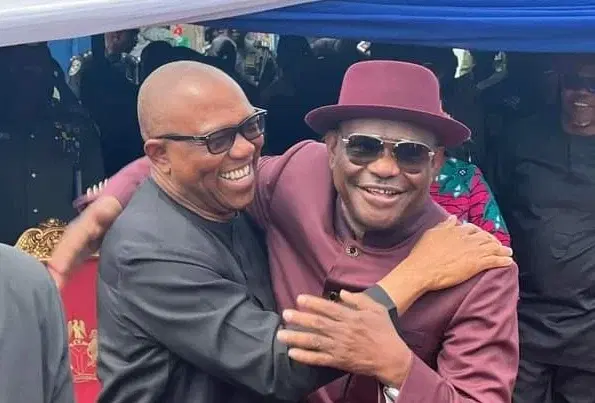
File image of Peter Obi (left) and Nyesom Wike.
ABUJA – The 2023 presidential election has thrown up many post-election arguments, but FCT Minister Nyesom Wike’s latest account has opened a particularly revealing window into the calculations of the five aggrieved Peoples Democratic Party, PDP, governors who opposed Atiku Abubakar, and why Rivers State was treated differently from other South-South states.
Speaking on TVC’s Journalists’ Hangout, Wike said the G5 governors were less concerned about Peter Obi taking votes in parts of the South-South than about preventing Atiku from benefiting from the region’s traditional PDP strength.
“How did he (Obi) win? We, in the G5, had our strategy. We said, PDP is stronger in the South-South. And our problem would be Atiku. Therefore, instead of Atiku to take it, let it go to the Labour Party,” Wike said.
The political calculation was simple. If the PDP’s traditional strength in the South-South translated into votes for Atiku, it could boost his national tally. But if those votes moved to Obi, Atiku would be denied the advantage.
According to Wike, that was precisely what happened in some states.
Wike said the strategy was deployed in Edo and Cross River, but Rivers was deliberately kept outside it.
“We felt that Atiku was more of a factor in that election than Obi. So our strategy was to make sure that you vote for Obi to win in order to deny Atiku the votes,” Wike said.
“It was only in Rivers, I said, ‘No, Obi would not win here because if he does, it would send a wrong signal somewhere and people would not understand it.’ And we stopped it,” Wike said.
That sentence has become the most contentious part of his account.
Wike did not explain publicly what he meant by a ‘wrong signal’. That leaves an obvious question hanging: if an Obi victory was considered useful elsewhere because it would deprive Atiku of votes, why was the same outcome unacceptable in Rivers?
One possible explanation is the peculiar political importance of Rivers to Wike, but that would be an inference rather than something established by his statement.
What Wike’s account does establish is that, according to him, Rivers was deliberately treated differently from other states covered by the G5 strategy.
INEC declared Bola Tinubu the winner in Rivers with 231,591 votes, followed by Obi with 175,071 and Atiku with 88,468. Tinubu’s margin over Obi was 56,520 votes.
Those figures have remained contentious.
The BBC’s 2023 election project published the declared results using INEC data, while subsequent scrutiny of polling-unit result sheets on the IReV portal generated questions about discrepancies in some Rivers results.
But questions about discrepancies are not, by themselves, proof that Wike or the G5 manipulated the election.
Wike has also rejected that interpretation of his remarks. On September 23, he dismissed allegations that he rigged the 2023 presidential election for Tinubu as a ‘baseless narrative’, insisting that what the G5 did was political manoeuvring against Atiku.
The distinction is important because Wike’s latest disclosure is essentially an account of political strategy. The unanswered issue is whether the strategy crossed the line from political mobilisation into interference with voters’ choices.
That is where the controversy has moved beyond the political exchanges.
The Centre for Human Rights and Civic Education, CHRICED, has called for an investigation into Wike’s disclosure, asking relevant institutions to determine what the G5 strategy involved and whether it affected the integrity of the 2023 presidential election.
CHRICED Executive Director, Ibrahim Zikirullahi, said the disclosure raised a fundamental democratic question.
“If state officials can ‘allow’ or ‘prevent’ candidates from winning in their states, then the fundamental principle that sovereignty belongs to the people is gravely undermined,” Zikirullahi said.
The organisation argued that elections should not become exercises in which powerful political actors determine which candidate should benefit from voters’ choices. That is the institutional question hanging over Wike’s account: where does ordinary political strategy end and improper interference with the choices of voters begin?
There is an irony in the episode. The five governors were PDP members locked in a bitter dispute with their party’s presidential candidate and national leadership. Yet, according to Wike, Obi became politically useful to them in parts of the South-South.
He did not have to be their preferred candidate. His votes simply had to come at Atiku’s expense.
That makes the strategy less an alliance with Obi than an attempt to deny Atiku the benefit of a region where the PDP had traditionally enjoyed considerable strength.
Rivers, however, was the exception. And that exception is what has turned an old election strategy into a fresh political controversy.
Social media reactions have since pushed the debate further.
Morris Monye wrote on X: “Look at what Wike is saying on national television. Does he not know that suppressing votes of the people is also treason? Just look at that. This makes me so upset. He’s already shared the votes and said, ‘Oh, we won’t see votes in Delta, Edo, etc.’”
Another X user, Roy, accused Wike of suppressing the popular will.
“When you say you stopped Peter Obi winning Rivers State, you are saying you stopped the will of the people. You used INEC ad hoc staff, law enforcement, dogs, the courts, up to the Supreme Court, to keep Nigeria in oppression. Nothing shouts treason louder than this. But go on, keep talking,” Roy wrote.
Those reactions are political opinions, not independent evidence that the 2023 election was manipulated.
Arise TV broadcaster, Rufai Oseni, has also widened the argument by questioning whether the political calculations Wike described extended beyond Rivers.
“But I’m sure Wike, too, should tell us how we also helped Obi win Lagos, you know, in all of this, because when people talk, they just think that they’re everything,” Rufai said.That was a question, not evidence of a coordinated ntervention in Lagos.
But it points to the larger issue raised by Wike’s account: presidential elections are shaped not only by manifestos, rallies and voting-day activity, but also by alliances, regional calculations and political structures operating behind the scenes.
Wike has supplied part of that story. He has explained why, according to him, the G5 wanted Obi to take votes from Atiku in some South-South states. He has explained why Rivers was excluded from that calculation.
What remains unexplained is what exactly made an Obi victory in Rivers capable of sending the ‘wrong signal’.
Until that question is answered, the most revealing part of Wike’s disclosure may not be who won Rivers in 2023, but why he says some votes were politically useful elsewhere, and politically unacceptable at home.
Comments expressed here do not reflect the opinions of Vanguard newspapers or any employee thereof.