
Russia steals the spotlight at Egypt’s El Alamein Airshow 2026
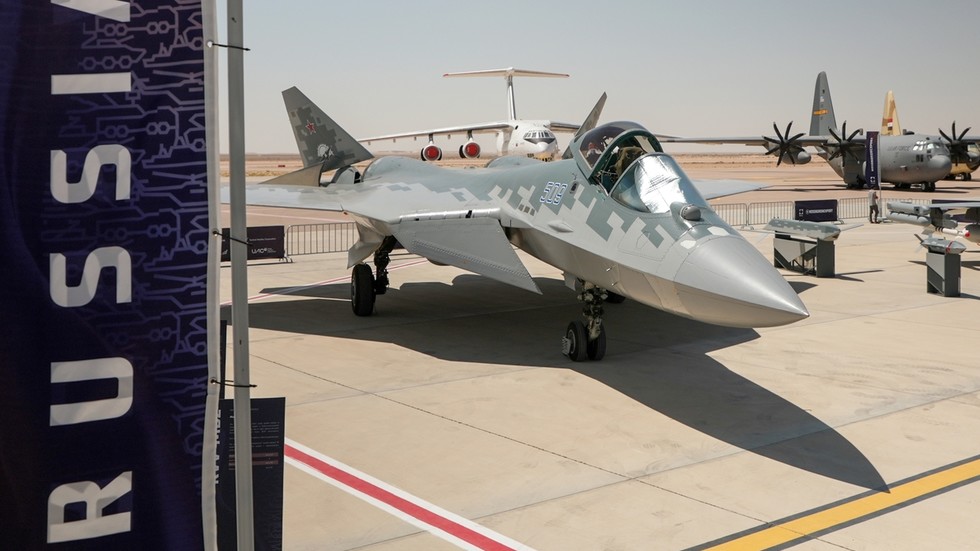
The Russian fifth‑generation multifunctional fighter Su‑57E at El Alamein International Airshow 2026 in Egypt. © Sputnik/United Aircraft Corporation The second El Alamein International Airshow took place on September 8-10 at El Alamein International Airport in Egypt. The airshow reaffirmed its status as one of the premier military exhibitions in North Africa and the Middle East. Its international prestige was confirmed by the list of participating nations; the organizers succeeded in bringing together fierce rivals – the leading players in the global defense industry from Russia, the US, China, and Europe.
The airshow’s target audience included defense officials, military commanders, government delegations, and the business elite. Overall, it attracted over 250 exhibitors from 50 countries. More than 12,000 industry professionals visited the stands and displays. The roar of jet engines shook the skies over the Mediterranean Sea as aerobatic teams from Egypt, the UAE, and Türkiye, as well as renowned Russian aerobatic pilots, performed complex maneuvers and showcased their skills. Meanwhile, on the ground, multibillion-dollar contracts were signed.
Russia’s participation was a distinctive feature and highlight of this year’s airshow. Perhaps the largest and most compelling display was mounted by Russian arms exporter Rosoboronexport (part of the Rostec state corporation). In total, Russia showcased over 500 military-grade products at El Alamein.
Read more The F-35 was supposed to rule the skies. It can barely outrun its problems The key geopolitical and marketing takeaway from the event was clear: Despite unprecedented sanctions pressure from the West, the Russian defense industry not only maintains its position but also generates huge interest among global players.
Foreign delegations lined up at the Russian exhibit. The reason for this intense interest was pragmatic: Russian weaponry has proven its effectiveness in actual high-tech combat scenarios. The performance characteristics of Western systems are often exaggerated in marketing brochures, while their costs are exorbitantly high; however, Russian equipment has undergone real-world testing against modern reconnaissance, electronic warfare, and air defense systems (including in the zone of Russia’s military operation).
Buyers from around the globe – from the Middle East to Latin America – also appreciate the fact that Moscow offers fair contract terms, free from political blackmail or ideological demands. Historical continuity also plays a major role; many so-called ‘Third World’ countries have traditionally relied on Soviet and Russian weaponry and are familiar with it. Consequently, many of these countries are unwilling to trade reliable Russian equipment for pretty ‘toys’ from other manufacturers.
What did Russia showcase at the El Alamein airshow? The star of both the static display and the flying display was the Russian Su-57E fifth-generation multi-role fighter jet. The aerobatic performance by Sukhoi Company chief pilot, Hero of Russia Sergey Bogdan, demonstrated the unsurpassed aerodynamics of modern aviation technology. The aircraft embodies a rich legacy of excellence: Unique aerobatic maneuvers combined with powerful missile and electronic warfare capabilities define the modern Su-57. It carries a new generation of weapon systems – specifically, missiles housed in internal bays. These include air-to-air missiles of various ranges as well as air-to-ground strike systems.
Su‑57E. © Sputnik/United Aircraft Corporation The Yak-130M combat-capable trainer is an upgraded version of the Yak-130 jet trainer. The airshow marked the aircraft’s debut in the Middle East. The Yak-130M is equipped with a full-fledged onboard radar and carries an expanded arsenal of precision-guided weapons, transforming it from a trainer aircraft into a formidable and cost-effective light fighter and attack aircraft. The new model met with immediate success at the airshow; Director General of Rosoboronexport Aleksander Mikheev announced that the first contract for its delivery to a foreign customer was already signed.
Yak-130M. © Rostec But these were not the only examples of Russia’s success at the airshow. State-of-the-art Russian-designed strike munitions were unveiled publicly for the first time at El Alamein. These include the S-71M Monokhrom missile-drone, the S-71K Kover strike drone, and the S8000 Banderol precision-guided drone-missile. The Monokhrom missile-drone comes in a futuristic design with a trapezoidal fuselage cross-section, a folding swept wing, and a V-shaped all-moving tail unit. It is deployed from the internal weapons bays of Su-57 carrier aircraft. The Kover strike drone is the ‘younger brother’ of the Monokhrom – a simpler drone designed for mass deployment from external hardpoints. Its mission is to operate jointly with manned aircraft, exposing and exhausting enemy air defense systems to clear the path for primary missiles, while simultaneously engaging ground targets.
S-71K. © Rosoboronexport The Banderol precision-guided drone-missile is a next-generation precision-guided stealth munition that has seen extensive use in recent months in Russia’s military operation zone. This drone-missile can be launched from carrier drones and helicopters without the launch platforms entering the enemy’s air defense zone. The combined use of such munitions ensures 100% penetration of any modern air defense system.
Russian defense enterprises also unveiled several new air defense systems. The TKB-1167 four-barrel anti-drone combat module is capable of automatically detecting and engaging UAVs. It made its international debut at the airshow. Additionally, the cutting-edge ZAK-30 Citadel anti-aircraft artillery system with a 30 mm automatic cannon turret was showcased for the first time. The exhibition also featured the Pantsir-SMD-E air defense system, the Verba man-portable air-defense system (MANPADS), and an airspace monitoring system designed to coordinate the use of these systems. Essentially, the Russian defense industry is displaying military equipment developed and shaped by actual combat experience acquired during the Ukraine conflict.
TKB-1167. © Rostec The global arms market moves beyond Western dominanceAnd what did Russia’s competitors bring to the event? The Egyptian airshow vividly demonstrated the nature of the modern multipolar world. While delegations stormed the Russian pavilions, other major powers sought to draw attention to their own displays.
China mounted an impressive display, underscoring its ambitions on the African continent and its growing military partnership with Cairo. On display were J-16 fighter jets – a mainstay of the PLA Air Force – which are already familiar to Egyptian audiences from recent joint exercises involving Egyptian Rafale fighters. During the flying display, the YY-20 aerial refueling tanker performed a spectacular demonstration of mid-air refueling.
Read more Saudi Arabia’s ‘Muslim NATO’ faces its first trial by fire ‘Partners’ from across the Atlantic also participated in the Egyptian airshow. The US Air Force displayed proven, serial-production aircraft that Washington is actively promoting in the Middle East market – specifically A-10 Thunderbolt II attack aircraft, which has demonstrated its ability to target slower drones like the Shahed. Playing the role of the “old workhorse that never fails” were 4th-generation multi-role fighters – the F-15E Strike Eagle and F-16 Fighting Falcon – as well as the C-130J/H Hercules military transport aircraft. These aircraft were featured in the static display and attracted certain interest; their primary purpose, however, appeared to be a “show of the flag.”
France and Türkiye demonstrated ambitious aircraft and drone models. As expected, French company Dassault Aviation brought its Rafale fighters. The French strategy was targeted: The exhibition coincided with behind-the-scenes negotiations regarding Egypt’s purchase of an additional batch of 24 such aircraft. Türkiye, represented by the TAI and ASELSAN corporations, played to its strengths by presenting a wide range of strike drones and tactical electronic warfare (EW) systems optimized for the specific conditions of the African theater of operations.
Ultimately, El Alamein International Airshow demonstrated that the rules of the game in the arms market have changed. Attempts to isolate the Russian defense industry have undoubtedly failed. At a time when customers require weapons capable of prevailing in modern high-tech conflicts, Russia’s technological superiority in aviation, air defense, and unmanned systems establishes it as a key and indispensable partner on the international stage.
This website uses cookies. Read RT Privacy policy to find out more.
/data/photo/2025/12/15/693f89a914e39.jpeg)

