Saint, sinner or feminist icon: How Mary Magdalene's image evolved through time
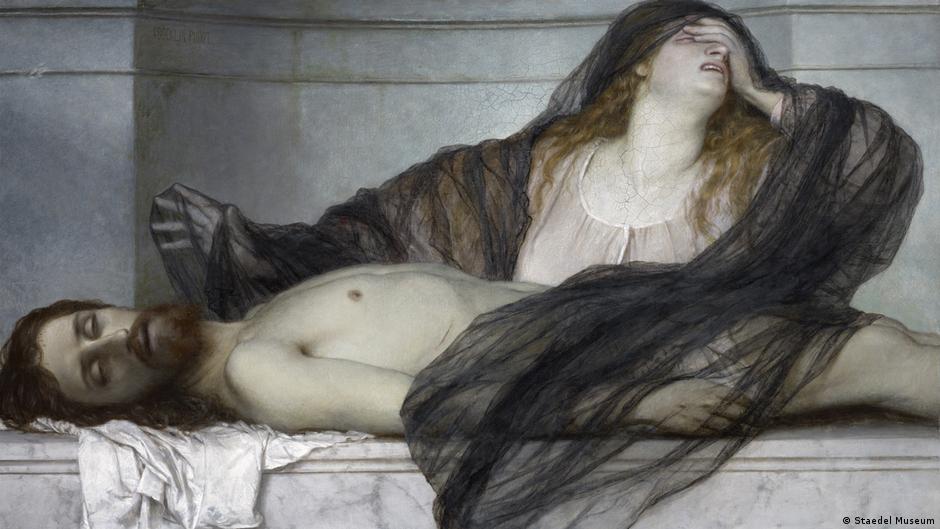
'Mary Magdalene Mourns at the Body of Christ' by Arnold Böcklin (1867), currently on view at the Städel Museum in FrankfurtImage: Staedel MuseumAdvertisementApostle, prostitute, penitent and confidante of Jesus — just a few of the roles assigned to Mary Magdalene since the early days of Christianity.
Artists from the Renaissance to the Baroque period, including Titian, El Greco and Georges de la Tour, depicted her in the 16th and 17th centuries as a repentant penitent; Rembrandt portrayed her as a witness to Christ's resurrection; and Max Beckmann, a representative of the New Objectivity movement, depicted her as a sinner in 1917.
Nearly a century later, she was portrayed by Lady Gaga in a music video.
"Mary Magdalene is probably the most multifaceted and enigmatic figure in the Bible, and also one of the most enigmatic in European cultural history," says Bastian Eclercy, curator of the exhibition "Mary Magdalene: Sin. Pray. Love" at the Städel Museum in Frankfurt. "She appears countless times in art history."
Very little is known about Mary Magdalene from the Bible, yet she plays an important role in the New Testament.
The Gospels recount that Jesus delivered her from seven demons, and that she accompanied Jesus and witnessed his crucifixion and burial. On Easter morning, she discovered the empty tomb and became the first witness to the Resurrection. She then proclaimed the message of the risen Christ to Jesus' disciples: "She is then referred to as the Apostula Apostulorum, that is, the Apostle of the Apostles," explains Bastian Eclercy. "This gives her a very central role in the history of salvation."
Around 600 AD, Pope Gregory the Great permanently distorted the image of Mary Magdalene by merging her with two other women mentioned in the Bible: an unnamed woman, the "sinner" mentioned in the Gospel of Luke who washed Christ's feet, and Mary of Bethany (who also washed his feet). The Pope claimed that the seven demons cast out of Mary Magdalene by Jesus represented the seven deadly sins. His sermon played a decisive role in shaping Mary Magdalene's reputation as a repentant prostitute — something for which there is absolutely no evidence in the Bible.
In the High Middle Ages, a legend emerged to the effect that Mary Magdalene, together with Lazarus and a group of companions, had been cast adrift in a boat on the Mediterranean; with divine help, she is said to have reached the coast of Provence in France, where she first preached the Gospel and then lived in a cave for some 30 years, doing penance.
Even today, two French towns claim to hold her remains: Vezelay in Burgundy and Saint-Maximin-la-Sainte-Baume in Provence.
In the 16th century, finally, the Reformation and Renaissance humanism brought about a change in thinking and opposition to the conflation of the three women into one.
However, it was not until the Second Vatican Council (1962 to 1965), which adopted far-reaching reforms to the Roman Catholic liturgy, that the identification of Mary Magdalene with the anonymous sinner was officially revoked.
"This very broad range of roles, which have been attributed to her throughout history and which are in a certain state of tension with one another, has evidently held a particular fascination for artists of all eras and genres time and again, whilst also presenting them with a challenge," explains Bastian Eclercy.
With the rediscovery of the Gospel of Mary in modern times, the image of Mary Magdalene got something of a makeover.
This text, not included in the biblical canon, portrays her as a particularly close confidante of Jesus and has given fresh impetus to discussions about her role.
Today, she is regarded as one of the most influential women of early Christianity and a key figure in feminist theology. "In recent decades in particular, she has thus become a role model for women — that is, for female observers — but also, and especially, for contemporary female artists, who see in her the qualities of a woman who lives on her own terms," says Eclercy.
Lady Gaga portrayed Mary Magdalene in her 2011 video for "Judas" — "the most exciting artistic moment of my career," as she wrote on Twitter at the time.
The most recent portrait in the Frankfurt exhibition — which features more than 100 depictions of Mary Magdalene — is by the Spanish artist Nieves Gonzalez and was completed in 2025: "La Sfida" (The Challenge) deconstructs virtually all the traditional attributes ascribed to Mary Magdalene by artists of earlier centuries.
Where she once gazed penitently towards the heavens, the painting depicts the female apostle looking down at the viewer with a self-assured gaze. Where her hair would otherwise have hung loose — alluding to the figure's sinful past — here it lies carefully brushed around her neck like a scarf. And where much bare skin would normally be visible, her body is now wrapped in a thick red down coat. In her hands, the disciple holds an equally (blood-) red skull — for centuries a symbol of transience — a gesture that clearly expresses her power.
Mary Magdalene has now also been officially recognized as an equal within the Catholic Church: In 2016, Pope Francis elevated her liturgical celebration on July 22 from a Memorial to a Feast, thereby aligning her legal and ritual status with that of male apostles within the faith. It's yet another chapter in the illustrious life story of Mary Magdalene, and unlikely to be the last.
The exhibition "Mary Magdalene: Sin. Pray. Love." runs at the Städel Museum in Frankfurt from September 17 through January 17, 2027.
This article was originally written in German.