
SASCO at 35: Building on a legacy of equality and transformation - IOL
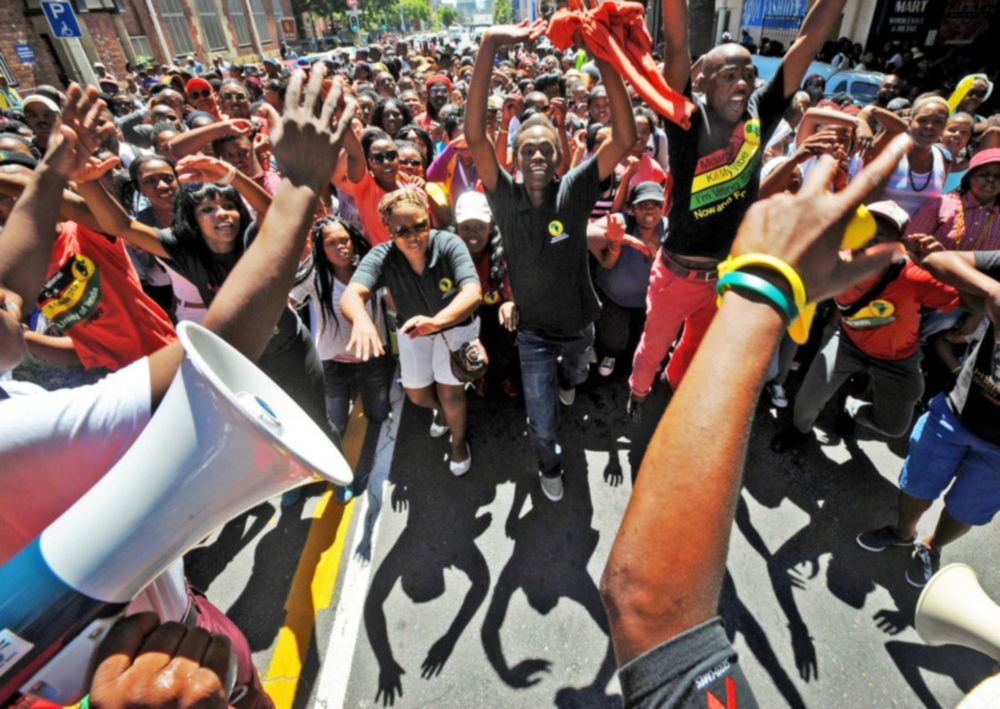
The South African Students’ Congress (SASCO) is celebrating its 35th anniversary since its founding at Rhodes University in September 1991. In this file picture, SASCO members march to Parliament to hand over a memorandum. The writer argues that SASCO remains as relevant today as it was at its founding.
In the first week of September 1991, at the height of a fragmented, racist and exclusionary higher education system, 600 Black and white students from 129 universities, technikons and colleges gathered on the grounds of Rhodes University to launch the South African Students Congress (SASCO). That historic moment represented the emergence of a unified, non-racial student movement dedicated to the broader pursuit of social justice, equality and democracy in South Africa.
The establishment of SASCO must also be seen in the light of the rich history of student activism in our country. During the late 1960s and 1970s, the Black Student Movement, under the leadership of Steve Biko and the South African Students’ Organisation (SASO), promoted Black Consciousness as a potent tool for psychological liberation and the reclamation of Black dignity.
As political conditions evolved during the 1980s, organisations such as the Congress of South African Students (COSAS) and the Azanian Students Organisation (AZASO), later SANSCO, increasingly embraced a non-racial outlook rooted in the values of the Freedom Charter. In this context, the merger of SANSCO and the National Union of South African Students (NUSAS) to create SASCO demonstrated that a unified progressive student movement could break down the racial barriers that apartheid had put in place.
SASCO has been a key component of the Mass Democratic Movement from the beginning. It carried on the struggle for change from the time of liberation to the time of democracy. It was not limited to campus politics. It was an essential voice for students and young people, shaping debates on education, social justice and nation-building. SASCO’s activism confronted the structural inequalities inherited from apartheid and lobbied for an accessible, inclusive and responsive higher education system to meet the developmental needs of South Africa.
This commitment to transformation has been the hallmark of the organisation during the democratic era. SASCO has always been a bastion of student rights, fighting for affordable and quality education, institutional transformation, curriculum reform and greater representation of historically disadvantaged groups in leadership structures. In doing so, it has made a significant contribution to the ongoing project of transforming higher education into a sector that reflects the democratic values of our Constitution.
In addition to the issues of access and representation, SASCO has also played a significant role in shaping policy discussions on student funding, accommodation, governance and academic support. The organisation has been a loud advocate for more financial aid through the National Student Financial Aid Scheme (NSFAS) and has mobilised thousands of students around issues of affordability and exclusion. These campaigns helped bring the challenges faced by poor and working-class students to national attention and resulted in policy interventions to increase access to higher education.
SASCO has also played an important role in leadership development. Over the last three and a half decades, the organisation has been a training ground for leaders who have made substantial contributions to government, Parliament, organised labour, academia, business and civil society. The legacy of SASCO extends beyond campuses, significantly influencing a generation of leaders dedicated to public service, transformation and democratic governance.
Throughout its existence, SASCO has been committed to non-racialism, non-sexism, democracy and social justice. It has taken a stand against racism, student hunger, gender-based violence, financial exclusion and all forms of discrimination that erode the dignity and aspirations of young people. In this connection, SASCO has not only represented students’ interests but has also been a champion of wider societal struggles for equality and human dignity.
It is precisely because of this rich history that SASCO remains relevant today. Young people continue to bear the brunt of inequality, poverty and unemployment in South Africa. These challenges are amplified by digital exclusion, skills shortages and the continuing pressures on the post-school education and training sector. The mission SASCO was founded on in 1991 is just as relevant today.
The organisation’s long-standing call for fee-free, quality and non-racial higher education resonates strongly with the Government’s push to expand educational opportunities through NSFAS and wider reforms in the higher education sector. But access will not be enough. Success is measured by the extent to which we support students to complete their studies, graduate successfully and participate meaningfully in the economy. Achieving this goal requires sustained investment in academic support programmes, digital infrastructure, research capacity, student accommodation and teaching and learning resources.
At the same time, more needs to be done to address youth unemployment. As an organisation grounded in the aspirations of the youth, SASCO has an important role to play in supporting initiatives that create pathways to employment and skills development. Practical mechanisms such as the Presidential Employment Stimulus, the Youth Employment Service (YES) and expanded Technical and Vocational Education and Training (TVET) opportunities are in place to equip more young South Africans with work experience and relevant skills, and enhance their chances of securing sustainable employment.
SASCO’s reflection on its journey also needs to consider the broader context of strengthening democratic institutions as a call for organisational renewal. Student activism must remain rooted in the lived experience of the poor and working class so that we are united in our purposeful struggle against inequality. Equally, former SASCO leaders who now occupy positions of influence have a responsibility to demonstrate ethical leadership, integrity and a commitment to building capable institutions that serve the public interest.
Therefore, preserving SASCO’s legacy is more than simply celebrating past accomplishments. It is about drawing on that history to meet the challenges of the present and shape the future.
The organisation’s enduring relevance lies in its ability to adapt to evolving circumstances while remaining true to its founding principles of justice, equality and transformation.
As SASCO celebrates its 35th anniversary, it should evoke a renewed commitment to combating poverty, inequality and unemployment in South Africa.
Current and former leaders are urged to prioritise education to alleviate poverty, promote youth employment, and uphold integrity and social justice through activism. This dedication is essential for SASCO’s legacy to inspire future generations and influence policies for a more inclusive and prosperous South Africa.
Long live the struggle for equality, dignity and opportunity!
(Mbada is a former student leader and former chairperson of the ANC Mzala Branch in Greater Johannesburg. His views do not necessarily reflect those of the National Media Group or IOL and its affiliates brands)
Mduduzi Banda, former student leader and chairperson of the ANC Mzala Branch in Greater Johannesburg.

