“School Empowers, Social Media Conditions”: France’s High School Phone Ban Is a First Step Toward Limiting Digital Influence - Le Figaro
Pour sauvegarder un article vous devez être connecté, vous pourrez ainsi les consulter sur tous vos appareils.
Starting this school year, French high school students have to hand over their phones before entering the classroom. A measure banning social media for those under 15, however, has not yet been implemented.
Mobile phones are banned this year in French high schools, following a ban in middle schools in 2018. As the new school year begins, this is the change generating the most buzz. Yet it does nothing to address the much broader issue of excessive screen use among children and teenagers. In line with the promises made in December 2025 by President Emmanuel Macron, who was eager to leave his mark on the issue, a law was intended to ban both social media for those under 15 and smartphones from high schools.
The first part, aimed at establishing a “digital age of majority,” was ultimately rejected by the Constitutional Council on August 14. The court deemed it “a disproportionate infringement” on freedom of expression. Only the second part of the law was therefore enacted on August 24. On September 1, the first day of school, Macron chose to visit a high school in the Lozère department to discuss this ban — which he personally championed — with students and teachers.
“This is good news. For the first time, French students will have a full school day without phones,” Education Minister Édouard Geffray said during a press conference on August 25. “I know that at first, this ban may be difficult for some to follow. But there is no serious argument to support the idea that a phone is essential in class, when screens fragment attention, disrupt sleep, and undermine social relationships,” he said.
The SNPDEN-UNSA, the main union of school principals, agrees with the minister on this point. “But we are not starting from scratch. Phones were already banned in classrooms,” said Bruno Bobkiewicz, its secretary general. “So we are really just talking about a small portion of the school day: the hallways, recess and the cafeteria.”
A small portion, certainly, but places where students compulsively reach for their phones. “The problem is that the ban came on July 2, which did not give us time to discuss the matter with the high school students affected by this ban. We are going to have to negotiate,” Bobkiewicz said. “A school is not a decentralized government agency. It has established channels for dialogue with parents and students.”
As the new school year begins, high schools must incorporate the measure into their school rules and use lockers and other storage solutions to enforce it. The law prohibits “the use of a mobile phone or any other electronic communications device,” with exceptions to be determined by these rules. At Buffon middle and high school in Paris’ 15th arrondissement, which Bobkiewicz led until last year, phones have been banned everywhere except in the schoolyard, to prevent crowds from gathering in front of the school during breaks.
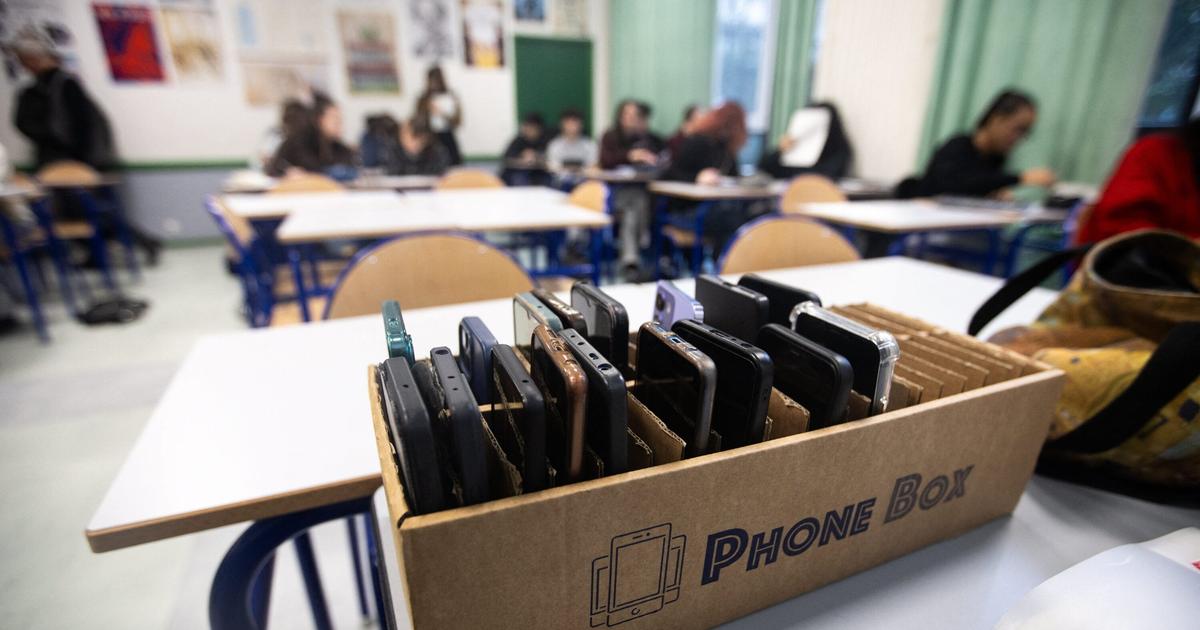
All classrooms, meanwhile, will be equipped with “phone boxes,” and each teacher will decide whether or not to use them. Will students try to get around the ban? Certainly. “For teachers, the main problem today is cheating with AI, cell phones hidden under the desk,” Bobkiewicz said. “I dream of a jammer that would allow a teacher proctoring a written exam to simply press a button.”
The SNES-FSU, the largest teachers’ union in middle and high schools, is quick to point out the hypocrisy of an institution where digital technology shapes the lives of students, teachers and staff. This includes the “digitization of homework logs, report cards, communications with families — even the elimination of the communication notebook — and administrative procedures,” according to the union, which urges the ministry to adopt a “prevention policy” with “screen-free” spaces and times. Caught up in the digital whirlwind, the school seems to be patching things up, much like the famous “digital break” conceived by Élisabeth Borne when she was education minister. This measure bans updates on the school management software — which includes grades, teacher absences and other information — between 8 p.m. and 7 a.m., to encourage students to disconnect.
The group Parents United Against Smartphones, a pioneer on the issue since 2019 and now boasting 23,000 members, welcomes the current awareness. “The government has finally taken up the issue. Society has evolved. We are seeing more and more cell-phone-free summer camps,” they observe. But the results are “mixed,” because seven years after the group was founded, children are getting their first smartphones as early as third grade, no longer in sixth grade.
“Parents are still just as crazy. And we have to stop, under the guise of political correctness, saying that they are doing the best they can,” said Alice, a member of the group, who chose to send her two children to high schools that ban phone use. She has also upheld a “no cell phone before age 15” rule for her son and daughter. “When my son got his phone, he immediately went looking for pornographic websites,” she says. “I saw it in his browsing history. But he landed on a black screen because I had entered his age.” For this mother, while the ban at high school is a good thing, it does not solve all problems — far from it. “I had to forbid my son from watching ‘shorts’ on YouTube. He would stay there for five hours,” said Alice, who calls for “child protection,” citing a jumble of “bullying, porn videos and decapitation scenes” that can be found on social media.
Does banning phones at school have positive effects? According to a U.S. study by the National Bureau of Economic Research, published on May 4, which examined schools that had implemented strict bans — such as “lockable” cases that block access to mobile phones throughout the day — the expected gains in grades, concentration, behavior or mental health are minimal. These findings align with those of a study conducted in England by the University of Birmingham, published in February 2025 in the journal The Lancet: The underlying problem lies in overall screen time and usage outside of school, which a school ban alone affects only marginally. Deprived of their phones on school grounds, children and teens also tend to compensate when they are outside, engaging in even more frenzied screen use.
“They should not be on their phones all night in their bedrooms. That is what is ruining our lives,” Bobkiewicz said. “When students have not slept, they are incapable of following a lesson.”
The Minister of Education is well aware of the total amount of time teenagers spend on screens. “On average, 4 hours and 40 minutes a day, more than they spend in class,” Geffray said on August 25. “We are facing a massive process of cognitive destruction. Not to mention that the content shared on social media often promotes degrading portrayals of women and medieval views of relationships between men and women,” he said. However, “Schools cannot do everything; they cannot do it all on their own. They are not society’s cleanup crew,” he said, calling on parents and policymakers to address the issue. “Schools empower; certain social media platforms condition. We cannot remain inactive in the face of platforms that degrade young minds, reduce their attention span to less than two minutes, and in some cases are fueled by misinformation or AI-generated videos,” he said.
But for now, the provision of the law aimed at banning social media for those under 15 has been struck down by the Constitutional Council. The ban provided for in the bill applied indiscriminately to all social media platforms. Not only did it constitute “a disproportionate infringement on freedom of expression and communication,” but it was also “likely to apply to online communication services for which the risks to the health and safety of minors have not been established,” the court said.
Finally, it noted that, while the ban was supposed to apply only to minors, age verification would affect all users. The bill sparked debate among lawmakers and the general public, as it effectively places the burden on young people rather than on the platforms. “We need to understand the reasons that drive young people toward reckless and excessive use,” said Emmanuel Garot, president of PEEP, the second-largest parents’ association. “The main responsibility lies with social media platforms, which create addictions through algorithms tailored to our tastes, and no one is imposing any restrictions on them.”
That view is shared by Grégoire Borst, a member of the screen time committee, which submitted a report to the president in April 2024 aimed at protecting minors from the risks of excessive digital exposure. “Private companies have designed algorithms to keep children and teens connected for as long as possible. In this way, they build loyalty among future users. And they make no secret of it, for that matter,” he said, before discussing the harmful effects. While the question of “addiction” to social media remains scientifically unresolved, the latest Agency for Food, Environmental and Occupational Health & Safety (ANSES) report, released in January 2026, shows that “when a teen is unwell, social media is a triggering or aggravating factor,” Borst said.
That approach has recently been adopted in the United States. On August 26, Meta reached an agreement with 48 of the 50 U.S. states to settle a landmark lawsuit. The parent company of Facebook and Instagram agreed to restrict minors’ access to its platforms in the United States and to pay several billion dollars.
In France, Macron has tasked the prime minister with drafting a new bill to ban minors under 15 from using social media. But Australia’s experience gives reason to pause. While the ban on users under 16 was set to take effect in late 2025, 85% of the young people affected have already found ways to circumvent the rule, according to a study by the University of Newcastle.
“The ban on mobile phones in high school was not among the screen time committee’s recommendations,” Borst added. “Today, young people are aware that they have difficulty managing their screen time. They expect something from adults. Their real request is: ‘Help us, but do not ban them,’” the neuroscientist said.