Scott Reef: My journey to a reef on the abyss (if gas drillers get their way), by Tim Winton
You have reached your maximum number of saved items.
Remove items from your saved list to add more.
When you finally reach Scott Reef, way offshore from the Kimberley, it’s like arriving at an oasis. You can feel the atoll’s influence before it’s even visible. The sea state changes. More fish and dolphins in the water, more birds overhead. Then it rises from the ocean deep, in scalloping white lines of surf over shoals, suddenly too vast to take in.
But when you reach the shining calm of the lagoon you see just what a refuge this is. Everywhere you look, startled turtles pop up, manta rays roll and swirl, their black shapes sharp against the rippled white sand below. You haven’t even got into the water yet, and you’re counting off species like the sea-nerd you are.
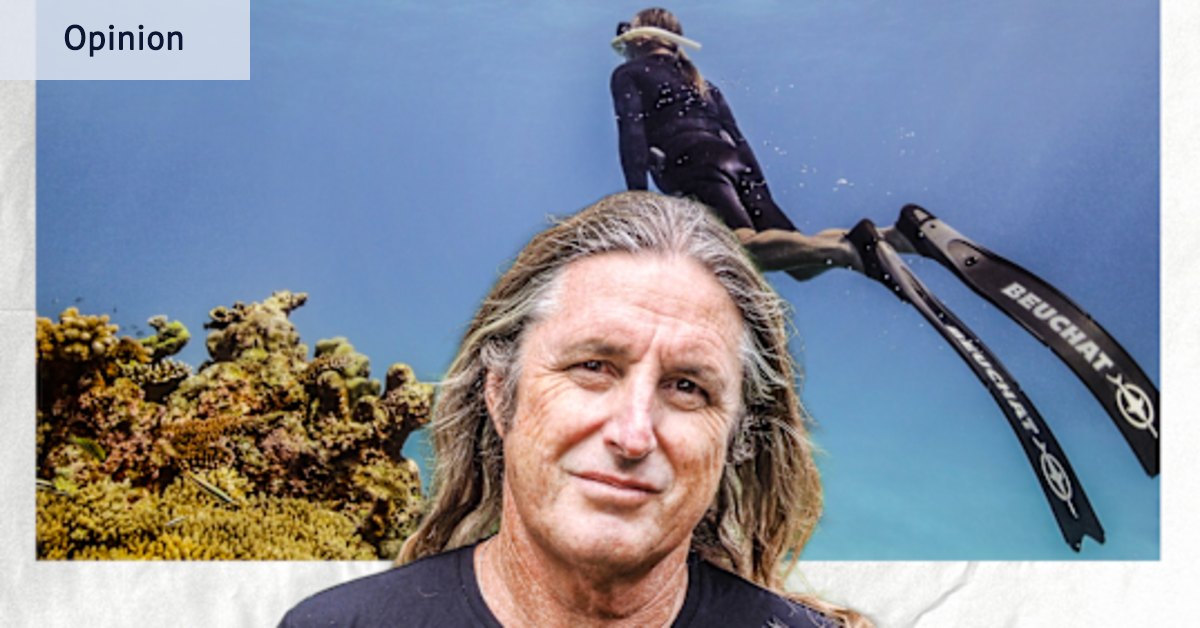
“The riot of colour, the intensity of life” … Tim Winton diving on Scott Reef.Andre RerekuraLike any oasis or billabong, Scott Reef is a magnet for biodiversity. It draws life to itself and creates more in return, and the sight of all that vigour erupting at the surface, so far from land, makes your blood fizz.
Just beyond the reef wall, everything falls away to the purple abyss. Because you’re quite literally at the peak of a seamount. And when you finally dive in, you know you’re experiencing a mountaintop moment.
You’ve swum in many coral gardens, but this is next level: the riot of colour, the intensity of life, the overwhelming remoteness, the sheer scale of it all. But like it or not, every sight and sensation is loaded with jeopardy. Because you know what this place is facing. If Woodside and BP have their way. If federal Environment Minister Murray Watt and Prime Minister Anthony Albanese – and yes, Western Australian Premier Roger Cook – put the reef’s fate in the hands of the fossil giants.
Scott Reef, home to endangered species such as the dusky sea snake – and potentially Woodside’s gas-extraction ambitions. Nush FreedmanYou’re one of the lucky ones: you’ve lived long enough and were born early enough to see more than your share of marine wonders. But your grandkids and their kids won’t see a fraction of what you have. And the injustice of that kills you.
The world’s coral reefs are dying. This is no longer a dire prediction – it’s something we’re experiencing together in real time. They’re being cooked by climate breakdown.
And it’s not as if we weren’t warned. We had a generation to forestall the worst of this disaster, but we were duped by corporate lies, bewildered by propaganda designed to confuse us, and year upon year, as the evidence mounted and our pleas for urgent action grew more desperate, too little was done, and the best of our opportunities were pissed away.
Where did the effort go? Who got the attention during those crucial decades for climate action? Where did the taxpayer subsidies go? Who had the ear of our leaders? Who did and spent more to shape consequential policy during the years that counted? Big Gas, that’s who. Outfits like Woodside, Chevron, BP and Shell. Our most protected species.
It’s hard to think of an industry so enriched from the ruination of Australian places and futures as the gas export industry. Few enterprises have been so costly to our commonwealth, our natural wonders, our health, our shared prospects. Few will leave such a toxic legacy. And for all that, can you think of an enterprise so lightly and scandalously taxed? Even beer is taxed harder than dirty old gas.
And now here we are. So late in the game. In triage mode. Forced to protect whatever can still be saved.
That’s why everyone’s talking about Scott Reef right now. Because one of Australia’s last healthy oceanic atolls isn’t just a lonely peak in the middle of the sea. It’s much more than a mountaintop experience for those fortunate enough to reach it. It’s a sentinel for the future of all corals.
Woodside wants to drill around and under Scott Reef. Surround it with 50 wells. To unleash the carbon and methane bomb in the Browse Basin, a reservoir of gas so vast and polluting it could be one of the final nails in the coffin of our climate struggle. Globally, “virtually all” coral reefs will be lost with 2 degrees of warming, and just this month the United Nations released a report saying warming could reach 2.6 degrees by the end of the century if governments continue with current climate policies. If we lose Scott Reef to Big Gas, we may seal the fate of all our coral reefs.
Saying no to Browse should be a simple decision. On behalf of our children. And for our common wealth. But Big Gas has spent a lot of time and money to make itself seem both indispensable and inevitable. When the fact is, it’s neither. And despite all logic, an easy choice has been rendered excruciatingly difficult. Testament to the sector’s political and cultural power.
West Australian conservation groups are fighting against Woodside’s Browse Gas plans. Bianca HallAdvertisementStill, this is where we find ourselves. Poised at the brink. With our representatives nervous-to-terrified about denying Big Gas its last shot at the spoils. Quite a moment. An opportunity for political and moral courage. Or the very opposite. The ultimate decision will define this government. And probably our generation.
Woodside needs Browse. Desperately. It’s betting the farm on it. To prop up its ageing operations in the Pilbara and keep those low-tax export super-profits rolling in.
But Australians? We don’t need Browse. It’s a gamble we can’t win and don’t even need to take. It’s not vital to the transition to renewables as gas shills insist. We already have sufficient gas to run the turbines whenever wind and solar need back-up. And we certainly can’t afford gas as dirty as the stuff from Browse. If anything, Browse is an impediment to the transition to clean energy.
And Browse is not geared for domestic supply. It was never about us. It’s mostly for export. The gas export industry does not serve us – that much we know – for when it comes to the taxing of gas, every political base in the country is in furious agreement. Gas is a burden. We are expected to bear it. All we are left with are the costs.
The consequences of unleashing Browse are enormous, disproportionate and unacceptable. Being expected to underwrite a mess like this with our tax dollars – that’s an outrage.
Floating through the lagoon at Scott Reef, as you ride the outgoing tide with a thousand neon fish, and twist through a valley of corals – purple, pink and blue – it’s never quite possible to submit to unbridled delight. Which is sad. For each moment of joy is undercut by something sombre, urgent, elegiac. And in those moments of conflicted distraction, before you can even feel it, the current has gathered strength and begun to drag you sideways. Away from the boat. And your comrades. Toward the reef edge. And the dark oceanic chasm beyond the safety of the lagoon.
Perhaps it’s the heat. Or fatigue. Maybe it’s all this colour and movement. But the lure of the abyss is palpable. The downward suck of it feels inevitable, almost druggy. It would be so easy to surrender to it and let yourself be carried on the current. As if you’re flotsam, not a creature with agency. This is no small thing to catch yourself thinking. But you are tired. Of swimming against the flow. And it would be nice to just drift along a little while longer.
For a few perilous seconds you entertain that yawing thought. Then you snap free of its spell. Turn for the boat and the safety of your comrades. Kick hard against the current, your mind sharpened by the effort of resistance.
Later you think about that swim, how emblematic it is, the way it encapsulates the national inflection point we find ourselves on the cusp of. For aren’t we all beleaguered by treacherous crosscurrents, swimming at the edge of a precipice we can hardly bear to contemplate, from which there may be no return? That’s our climate moment now. This is what the Browse decision signifies.
Nearly two years after that trip to Scott Reef, one memory remains most vivid. It’s the moment you finally saw the boat’s hull. There it was, large as a village, festooned with fish. You reached for the ladder and took hold. Safe again, surrounded by glory, with the muffled, happy voices of your friends and colleagues overhead.
That instant of relief endures. The sense of urgency, too. And the burning determination to resist the abyss. Today, thinking on our shared moment of decision, you hope we all still have strength enough to swim to safety, that we retain the moral clarity to identify where our greater safety lies.
Author Tim Winton is the patron of the Australian Marine Conservation Society.
You have reached your maximum number of saved items.
Remove items from your saved list to add more.