Six alleged Black Axe members face US fraud charges after Cape Town extradition - IOL
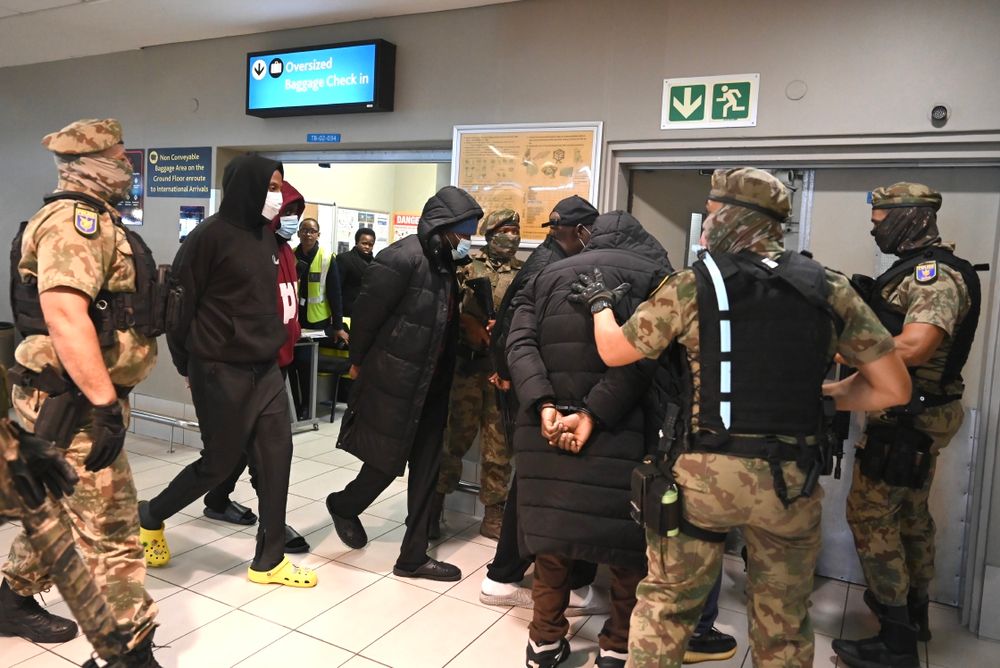
Six Nigerian nationals arrested in South Africa in 2021 have been extradited to the United States to face allegations of wire fraud and money laundering linked to organised romance scams.
More than 100 women were allegedly conned out of about R100 million through online relationships in a romance scam now at the centre of the extradition of six alleged Black Axe members from Cape Town to the United States.
Six of the accused have now been extradited from Cape Town to the United States, where they face charges of wire fraud and money laundering.
The men were arrested in South Africa in 2021 and flown out of Cape Town International Airport on Friday, 11 September 2026, following a lengthy extradition battle.
Experts also said artificial-intelligence technology, including facial-recognition manipulation and distortion, could be used to deceive unsuspecting victims.
The extradition was facilitated by the Directorate for Priority Crime Investigation, commonly known as the Hawks, in collaboration with Interpol South Africa.
The six men were transported from a correctional facility in Cape Town to Cape Town International Airport (CTIA), where they were handed over to officials from the Federal Bureau of Investigation and the US Secret Service.
At CTIA, heavily armed South African National Defence Force (SANDF) teams escorted the accused, together with supporting law-enforcement teams.
Handcuffed and wearing black jackets with hoodies, the accused were moved quickly towards the aircraft while trucks secured the perimeter.
According to Hawks spokesperson Colonel Katlego Mogale, the extradition forms part of ongoing efforts to combat cybercrime and organised criminal networks.
The suspects are alleged to have targeted more than 100 women in the United States, allegedly defrauding them of more than R100 million.
“The six men are alleged to be members of the Black Axe organised criminal network and are wanted by US authorities in connection with charges of wire fraud and money laundering.
Mogale confimed the six men as Perry Osagiede, Collins Owhofsa Otughwor, Osariemen Eric Clement, Musa Mudashiri, Franklyn Edosa Osagiede and Prince Ibeabuchi Mark.
“The suspects are alleged to have targeted more than 100 women in the United States, allegedly defrauding them of more than R100 million through online romance or love scams.
“Among the alleged victims were pensioners and businesspeople who were reportedly targeted through sophisticated online relationships used to defraud them of their money.”
Mogale said the extradition process had taken nearly five years.
“The six Nigerian nationals were arrested in South Africa in 2021, following a major takedown operation conducted by the Hawks,” she said.
The six were initially part of eight Nigerian nationals who appealed against their extradition to the US. Mogale said Enorense Izevbiege and Toriseju Gabriel Otubu did not proceed with their appeals.
The Cape Town Magistrate’s Court formally ruled that the alleged members could be extradited to the US. Izevbiege was extradited to the US and Otubu was granted R210 000 bail with conditions.
She said the men would be handed over to FBI and US Secret Service officials.
“This extradition demonstrates the continued co-operation between South African law-enforcement agencies and international law-enforcement partners in disrupting transnational organised crime and ensuring that suspects wanted in other jurisdictions face due legal process,” she said.
The Cape Town Magistrates’ Court in 2024 found that there was sufficient evidence for the extradition proceedings to continue. In April, the Western Cape High Court dismissed an appeal against extradition by the accused.
The Institute for Security Studies has reported that South Africa has the highest number of identified Black Axe zones in Africa.
In its report, The Black Axe Puzzle in South Africa: Layers of Criminal Culpability, the ISS identified six zones in Cape Town, Durban, Ekurhuleni, western and northern Gauteng, Johannesburg and Pretoria.
The report said members were predominantly Nigerian, with some having lived in South Africa for between five and 30 years. It noted, however, that information about the recruitment of non-Nigerians remained unconfirmed.
The report detailed formal zonal structures began emerging in South Africa in the early 2000s as the Nigerian diaspora grew. One of the earliest zones, the South Africa Zone, was reportedly established around 2003.
Cybercrime expert and specialist investigator Mike Bolhuis welcomed the extradition but said there was a long road ahead.
“Romance scams have been on the rise all across the world, but this again shows that South Africa has become a crime hub for those who wish to commit crime and want to get away with it,” he said.
“Fortunately, law enforcement has sharpened its skills when it comes to cybercrime. Although we have a long road ahead, progress is happening.
“Romance scams involve extreme manipulation of the victim. They are combined with social engineering to perform a scam that not only steals the victim’s money but also damages their trust and self-worth.
“The public needs to understand that cybercrime is a serious global threat. They must be vigilant when communicating online with strangers and be aware of the information they share and post, especially before giving money to someone they have met online.
“Always conduct a thorough investigation and risk analysis before paying money to strangers, and practise positive paranoia, especially when interacting online through social media.”
Bolhuis said people should be careful with their smartphones.
“You must know your smartphone like the palm of your hand, or like your gun if you are a gun owner. This is not something to play with. It can cost you your life, your privacy and your money, and threaten anything and everything regarding your existence as a human being,” he said.
Emma Sadleir, a social-media law expert and founder of the Digital Law Centre, advised people to remain skeptical when communicating online.
“You always have to presume that people are not who they say they are,” she said.
“If you meet someone online, video-call the person.
“With character-swap technology, there are ways to use filters to change your race, gender and age.
“Look out for the usual red flags. Anyone asking you for money is part of the Tinder Swindler-type behaviour.”
Celeste Louw, general manager of operations at the Tears Foundation, said romance scams were not simply the result of people being naïve, but were often sophisticated and organised crimes.
“Perpetrators deliberately study a person’s emotional needs, build trust over time and create a relationship that feels completely real,” she said.