Spain grows fruit and vegetables for Europe — but it's running out of water
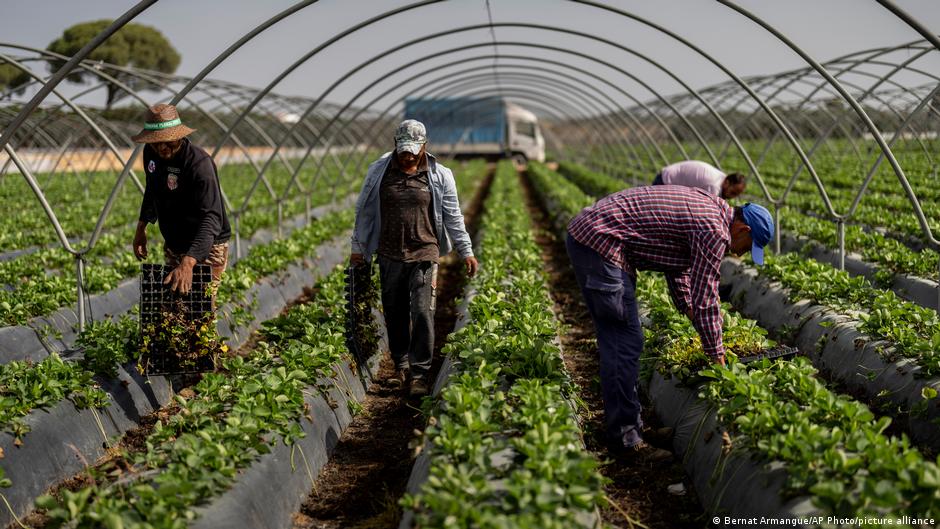
Spain's southern coast grows one-quarter of Europe's fruit and vegetablesImage: Bernat Armangue/AP Photo/picture allianceAdvertisementDonana National Park in southwestern Spain — one of Europe's most important wetlands, home to millions of migratory birds and threatened species like the Iberian lynx — is running dry. But rising temperatures and drought caused by climate change are only part of the problem.
The UNESCO-protected region on the Atlantic coast relies on an underground aquifer that's been tapped by hundreds of illegal wells. The reason: Europe's fruit and vegetable supply. Spain provides one-quarter of Europe's fresh produce, supplying colder parts of the continent with fruit and vegetables year-round.
The scale of water extraction in Spain is staggering: In 2016, WWF Spain estimated that the Donana wetland was home to over 1,000 illegal wells and more than 1,700 ponds illegally irrigating an area as big as 4,200 football fields.
"It's gotten hotter every year. And the water dries up so quickly," one local resident in the town of El Rocio, just north of the wetlands, told DW.
"For me, day to day, the main issue is my animals," said another, hitching his horse up to a tourist carriage. "I have to draw water for them, but the well doesn't have enough water to provide it all at once."
The Donana area used to be royal hunting grounds, consisting of marshes and ponds. In the early 20th century, parts began to be used for dryland farming, agriculture in arid regions that relies heavily on rainwater.
But in 1971, Spain — still under the dictatorship of General Francisco Franco — declared the region's irrigation to be of national interest. The Almonte-Marismas Plan, named after the aquifer it tapped into, was part of a massive, state-sponsored effort to increase food production.
Authorities decided to bet on strawberries, which they called "red gold." According to calculations based on FAO data, strawberries can yield up to €150,000 (about $170,000) in gross revenue per hectare per year, compared to roughly €20,000 for potatoes or €15,000 for grapes.
But growing strawberries at scale also meant using a lot more water. Authorities handed out generous quotas and allotments, seemingly without considering how much extraction the aquifer could handle. Even those legal quotas weren't enough for the ever-expanding fields.
Farmers turned to illegal wells and reservoirs to make up the difference. They built them to stockpile water, draining supplies from local residents and the UNESCO World Heritage Site next door.
"There was extreme drought and lack of attention from the administration," said Pedro Banez, of the Condado Water Users' Association. "And we found ourselves with a number of farms — or parts of farms — that fell outside the land classified as irrigable agricultural land."
The turning point came in 2019 when, following numerous reports of unlawful wells, a 2-year-old fell into deep, reportedly illegal borehole on farmland near Malaga and died. In the aftermath, Spain's Civil Guard police force created dedicated units focused on water theft.
Two years after that, in 2021, the Court of Justice of the European Union ruled that Spain had failed to protect the Donana aquifer, finding the country in violation of EU law.
Today, police and NGOs like WWF Spain track illegal extraction — near Donana, and other overtaxed agricultural regions across the country — using a mix of old and new tools. They start with satellite images of the region, comparing them against land rights maps to flag areas that appear greener than their legal status allows. Drones follow, giving investigators a closer look at where the water is actually coming from.
Some wells are completely illegal. Others are legal but extract more than they're allowed, which requires closer, on-site inspection to prove.
Investigators check the flow meters that measure how much water a well is pulling. Tampering is common, often using a powerful magnet which disrupts the internal mechanism of the flow meter, allowing water to pass through unrecorded.
Farmers caught extracting illegally can be charged with crimes against the environment and fraud. Most face fines, but sentences can run up to five years in prison.
In a bid to undo decades of overuse, local and national authorities have negotiated a €1.4 billion joint plan. The government has continued shutting down illegal wells, sealing almost 300 in the Donana region alone.
Officials have also started buying up farmland, rewilding it and turning it into protected areas, while setting up funds to create jobs in other sectors like tourism and renewable energy.
Farmers, meanwhile, have had to change how they water their crops.
Many have switched to drip irrigation systems, where each plant gets its own individual dripper, paired with moisture sensors that report exactly how much water a plant needs. That cuts down on the overuse of both water and fertilizer.
Farmers have also begun planting less water-intensive crops and shifting their growing season to colder months.
Spain isn't alone in confronting this problem. As economies mature, fruit and vegetable production starts being outsourced to places with cheaper labor, fewer restrictions and more sun.
Mexico, Brazil and Colombia grow food for parts of the US, while countries in southeast Asia export a lot of produce to China or Japan. Some countries in northern Africa, including Morocco and Egypt, also supply fresh fruits and vegetables to their European neighbors to the north. But, as in Spain, intensive agriculture has strained local water supplies.
Morocco has tried to turn the tide by using satellite comparisons to monitor irrigation and offering subsidies for farmers who switch to drip irrigation. In India, the government is trying to move farmers toward less water-intensive crops.
And in California, the US state has paid farmers to halt certain types of irrigation and introduced legislation to monitor and allocate water more sustainably.
Securing water, no longer seen as an unlimited resource, will increasingly be a challenge as the effects of climate change intensify. Addressing overextraction will take a coordinated effort from governments, farmers and the industries that depend on their water.
Additional research by Nicole Ris. Edited by: Martin Kuebler, Sarah Steffen