
SPD governor campaigns as one-woman bulwark against AfD
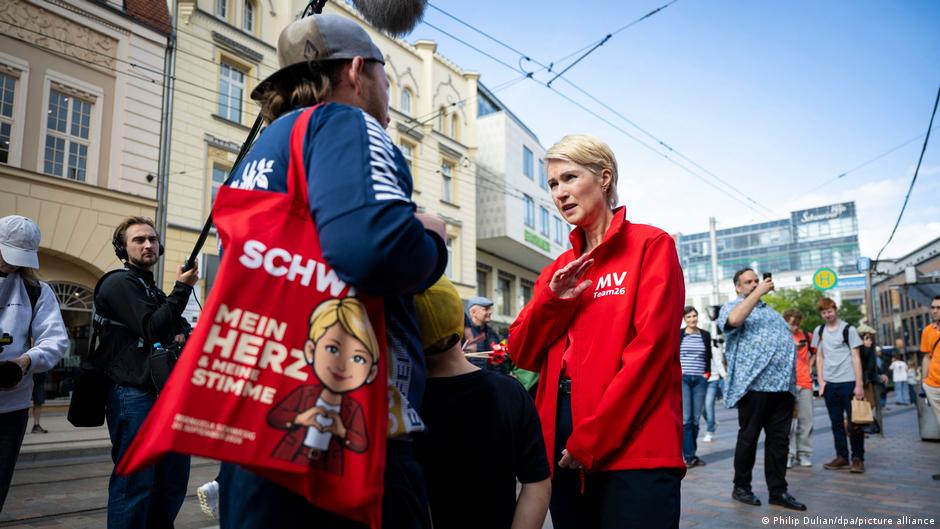
Manuela Schwesig has made a point of meeting as many voters personally as she canImage: Philip Dulian/dpa/picture allianceAdvertisementThe late-summer warmth is lingering in the countryside of Mecklenburg-Western Pomerania. Lavender-infused cocktails and savory onion cakes are being served on the spacious terrace of Hasenwinkel Castle, an old country house turned conference hotel not far from the Baltic coast. The largest business association in this northeastern German state has invited members and guests from the political world to a convivial gathering. State Premier Manuela Schwesig, of the Social Democratic Party (SPD), is also in attendance.
It could be a relaxed evening, were it not for the upcoming state election on September 20. "We live in politically turbulent times," says association president Lars Schwarz in his welcoming remarks. But the evening is also meant to serve as an opportunity to "recharge," he says. Days before the election, the far-right Alternative for Germany (AfD) is leading in the polls with around 37%. But the SPD is not far behind, with 33%, and has narrowed the gap in recent weeks. The conservative Christian Democratic Union (CDU), which leads the federal government with the SPD under Chancellor Friedrich Merz, is far behind and hoping to remain above the 5% threshold to enter parliament.
The term "remigration" is playing a major role in the AfD's campaign. But as far as the state's business leaders are concerned, sending people of immigrant background out of Germany would be a disaster for the economy.
Mecklenburg-Western Pomerania has a significantly older population than most other German states. It's also less densely populated and more severely affected by demographic change. "International skilled workers and laborers have long been an important part of our economic future," said Schwarz. "Openness to the world is not an abstract political formula, but a concrete prerequisite for ensuring that businesses in our state can continue to produce, offer services, train employees, and grow."
In a brief speech at the event, Schwesig recounted encounters she had during the election campaign. She speaks of a conversation with a baker who is concerned not only about high energy prices but also about her employees. "She said, 'Ms. Schwesig, I have employees with immigrant backgrounds working here, and I'm very worried that I'll lose them — because I value them, and because I care about them as people.'"
The head of a planning firm approached the state premier and explained that his Moroccan employee wanted to leave the country. "Because when he goes to the café at the market in Stralsund and waits for his German friends, the people sitting near him either make snide remarks or move to another table." Who, Schwesig asks, would want to live in such a climate?
Preventing the AfD's victory — that is what the 52-year-old Schwesig has made her stated goal. In the final stretch of the campaign, her posters feature just her face on a red background — no name — above the slogan "The Woman Against Blue" — a reference to the AfD's party color.
"The situation is serious," Schwesig told DW. "The AfD would harm our economy; they would harm our social cohesion. Their crude way of speaking, their hate and incitement, is tearing our society apart; there's a renewed propensity for violence, and that will affect us women in particular."
Anyone who doesn't want those things must support her, she says. "To do that, you have to go to the polls and vote for the SPD — and that's why I'm the woman against blue."
Perhaps tellingly, the SPD isn't mentioned on most of her campaign posters, however. Only Schwesig herself is visible, dressed in red. The SPD's party color must suffice as a reference. Schwesig is the driving force: She represents the political comeback of the past twelve months. In September 2025, the SPD in Mecklenburg-Western Pomerania was languishing at just 19% in opinion polls, while the AfD stood at 38%.
Manuela Schwesig managed to close the gap, in part, by trying to stay closely connected to the people of Mecklenburg-Western Pomerania, seeking direct dialogue with voters as often as possible. She is friendly and approachable, yet also firm. Schwesig listens, answers questions with confidence, marshals the facts, and engages in discussions where she attempts to demonstrate that she is well-informed about everything happening in the state.
Above all, however, she scored points by maintaining maximum distance from the federal government — and thus from her own party too. In Berlin, the SPD governs as the junior partner in a coalition with the conservative bloc of Christian Democratic Union and Christian Social Union (CDU/CSU) parties, and the government is more unpopular than any before it. As Schwesig has gained ground, the SPD's support at the federal level has plummeted to 12%.
Schwesig believes much of what is decided in Berlin is wrong — and she says so. "I expect the chancellor and the entire federal government to chart a new political course,” she demanded following the AfD's victory in Saxony-Anhalt in early September.
She has long believed that the reform of the social welfare systems planned by the CDU/CSU and the SPD is heading in the wrong direction. "I expect that the reforms will ensure that those who have worked their entire lives and made contributions are not the ones who bear the heaviest burdens," she says regarding the plans to eliminate the retirement age of 63 for people who have contributed to the pension fund for a particularly long time. "And I'm glad that my criticism is now receiving a lot of support."
She also receives support from within her own party. Discontent is growing within the federal SPD over the two co-chairs, Lars Klingbeil and Bärbel Bas. There is open speculation about whether Manuela Schwesig should replace them at the party's helm. Amid the SPD's crisis, there are strong arguments for making one of the last Social Democrats who is popular with voters the party leader.
A woman who entered politics relatively late in life. Born in Brandenburg, she was already nearly 30 years old when she joined the SPD in 2003. Prior to that, she had studied public finance and worked as a tax official.
Her political rise was rapid: Local politics in the state capital of Schwerin, Social Affairs Minister in Mecklenburg-Western Pomerania, and finally, in 2013, Federal Family Affairs Minister under former Chancellor Angela Merkel. By then, she had become well-known nationwide.
Her opponents often underestimated her, especially men. A CDU politician once derisively called her the "coastal Barbie." "Young, blonde, East German" was the headline when she became a federal minister.
Perhaps this was also because Schwesig never came across as a classic power-seeking politician. Her strengths, say her supporters, lie in her calm perseverance, fighting spirit, and pragmatism.
This tenacity nearly proved to be her undoing in the dispute over the Nord Stream 2 gas pipeline. In 2017, Schwesig returned to Mecklenburg-Western Pomerania to succeed State Premier Erwin Sellering, who was seriously ill at the time. Sellering had maintained very good relations with Russia, and Schwesig continued his policies.
This included defending the construction of the Baltic Sea pipeline — which was intended to transport even more Russian gas to Germany — in the face of criticism from Eastern Europe, the US, and some in Germany. When the US threatened sanctions in 2021, Schwesig even attempted to secure the completion of Nord Stream 2 by establishing a "climate foundation" funded by Moscow.
After the Russian invasion of Ukraine in 2022, her stance became a political liability. Schwesig made a political about-face and admitted to mistakes. To this day, however, she defends the logic behind her decisions at the time.
This has not caused her any lasting damage. Currently, in a direct election, 60% of voters in Mecklenburg-Western Pomerania would vote for Schwesig as head of government.
The current state government, made up of the SPD and the socialist Left Party, is also performing well in polls. But it remains to be seen whether this will be enough to secure another term.
This article was translated from German.
.jpg?width=1200&auto=webp&trim=0%2C0%2C0%2C0)