State held liable for unlawful arrest and three-month detention of mentally disabled teen in adult prison - IOL
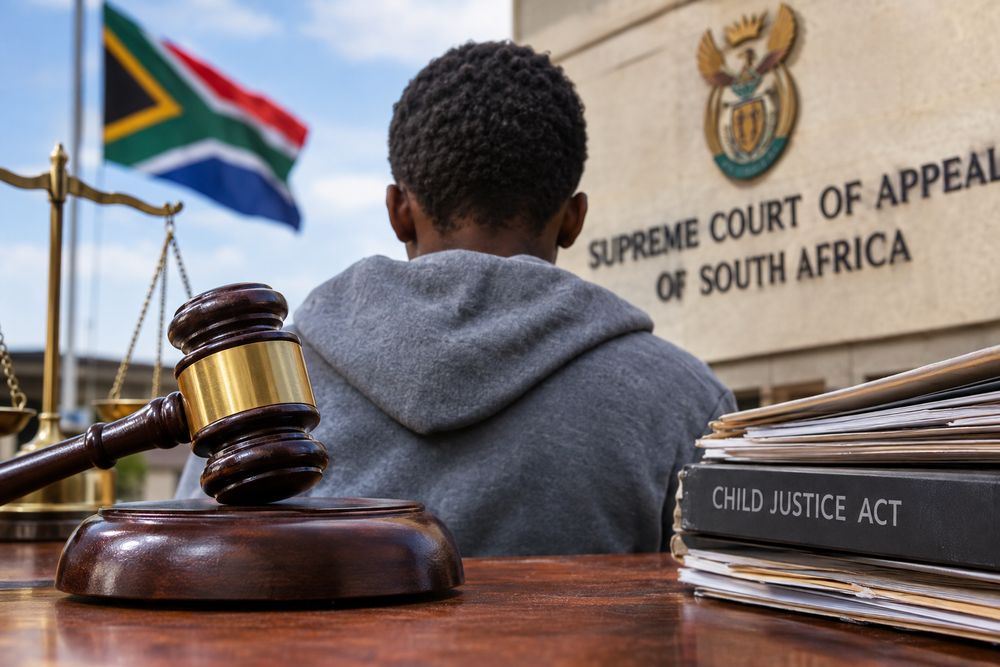
SCA finds state liable after intellectually disabled teenager was detained in adult prison.
The Supreme Court of Appeal (SCA) has ordered the state to compensate a mentally disabled 17-year-old who was unlawfully arrested and detained as an adult for almost three months, finding that the entire criminal justice system had failed him.
The court found that the teenager, S Nene, was arrested on February 12, 2013, after being suspected of attempting to rob a woman of her handbag in Montana, Pretoria.
He was only released on May 3, 2013, after his aunt produced his birth certificate confirming that he was a minor.
During that period, Nene was detained in adult correctional facilities, despite clear indications that he had severely impaired mental capacity and was not fit to stand trial.
The SCA overturned a High Court judgment that had dismissed the damages claim brought by Lizelle Schreuder, an advocate appointed as Nene's curator ad litem.
The appeal court also ordered the state to pay the costs of the proceedings on an attorney-and-client scale.
Nene lived with his aunt and guardian, Nonhlahla Motala, in Atteridgeville. He had left for Zodwa School for Mentally Handicapped Learners on February 8, 2013, but never returned home.
Four days later, Nene was arrested in Montana, about 50km from where he lived, after a security officer apprehended two men in connection with a handbag theft.
The SCA found that there were several warning signs that should have prompted the police to investigate Nene's identity and circumstances more carefully.
Different names and ages were recorded for him. One police record reflected his date of birth as June 6, 1985, which would have made him 27, while another recorded his age as 18.
He was unable to provide a proper address, could not sign certain documents and used a thumbprint instead of a signature on one statement.
The court also noted that Nene was visibly immature and had difficulty communicating.
Despite these discrepancies, he was processed as an adult.
The SCA found that the police could not simply rely on their claim that they did not know he was a child.
Nene appeared in court on February 14, two days after his arrest.
The magistrate immediately noticed that he did not appear to be of sound mind and ordered that he undergo an assessment by a district surgeon.
He was subsequently sent for assessment, with the possibility of being placed under mental observation at Weskoppies Hospital.
The district surgeon's report, dated February 18, found that Nene was not orientated, spoke irrelevantly, had poor intelligence and could not understand the charges or the consequences of a conviction.
The report concluded that he was not fit to stand trial, could not give a statement or instruct counsel, and could not participate in trial proceedings.
Despite this, the criminal case continued.
The SCA found that the investigation officer, Detective Zulilwe Jack Thabethe, failed to follow up on instructions to obtain medical reports concerning Nene's condition.
Prosecutors also failed to properly interrogate the information contained in the police docket or the medical findings.
The appeal court found that the Child Justice Act required safeguards that were never applied because Nene was incorrectly treated as an adult.
These included an assessment by a probation officer and notification of his parent or guardian.
The SCA rejected the argument that the arrest and detention were lawful simply because officials did not know that Nene was a minor.
The court said the police had failed to take reasonable steps to establish his age and identity despite the obvious discrepancies.
It also found that Nene's severely impaired mental capacity made the information he provided about himself unreliable.
His aunt eventually discovered that he was incarcerated after a former inmate told her where he was.
When she found him at Weskoppies on April 28, he had swollen hands and was drooling.
She approached the prosecution on April 30 and told officials that Nene was a minor and severely mentally disabled.
However, he was not released until May 3, when his aunt produced his birth certificate.
The charges against him were eventually withdrawn in July 2013.
The SCA found that Nene's detention was unlawful from the time of his arrest until his release.
The court rejected the state's argument that subsequent court orders remanding him in custody automatically made his detention lawful.
It said a court's remand order did not, by itself, mean that detention was not arbitrary or without just cause.
The Child Justice Act strictly limits the circumstances in which children may be detained in prison, and the SCA found that those requirements had not been met.
The court was particularly critical of the Department of Correctional Services' handling of Nene after he was admitted to prison.
He was placed in an ordinary cell despite his mental illness.
His medical records documented a serious deterioration in his condition, including episodes involving faeces, wetting his bed, incoherent behaviour, psychosis and instability.
He required assistance with showering and eating.
The SCA also found that he had been assaulted while in detention and that injuries were consistent with the possibility of sexual assault. The issue of whether he had been raped was reserved for determination in the second part of the trial.
The SCA found that the failures of the police, prosecution and correctional authorities were interconnected and contributed to Nene's unlawful detention.
It ordered the Minister of Police to pay all proven damages arising from Nene's unlawful arrest on February 12, 2013, and his detention from that date until May 3.
The Minister of Police, Minister of Justice and Correctional Services and National Director of Public Prosecutions were held jointly and severally liable for all proven damages arising from his unlawful detention from February 14 to May 3.
The court said the responsibilities of the various state departments could not be separated because their combined failures resulted in Nene remaining unlawfully detained.
Although the SCA criticised Detective Thabethe's conduct, it did not hold him personally liable for the damages.
The SCA also upheld the punitive costs order, finding that the conduct of the officials justified costs on an attorney-and-client scale.
The court said the authorities had shown no proper regard for Nene's individual needs or dignity and had failed to apologise for what happened to him.
Instead, the court found that they had “closed ranks and tried to defend the indefensible”.
“The whole criminal justice system failed him,” the SCA found, placing ultimate responsibility on the executive heads of the departments involved.
The appeal was upheld, with the High Court's order replaced by an order requiring the state to compensate Nene for his proven damages and to pay the legal costs of the action to date on an attorney-and-client scale.