Stocks advance after Bessent says talks with China were successful before Trump-Xi meeting - Toronto Star
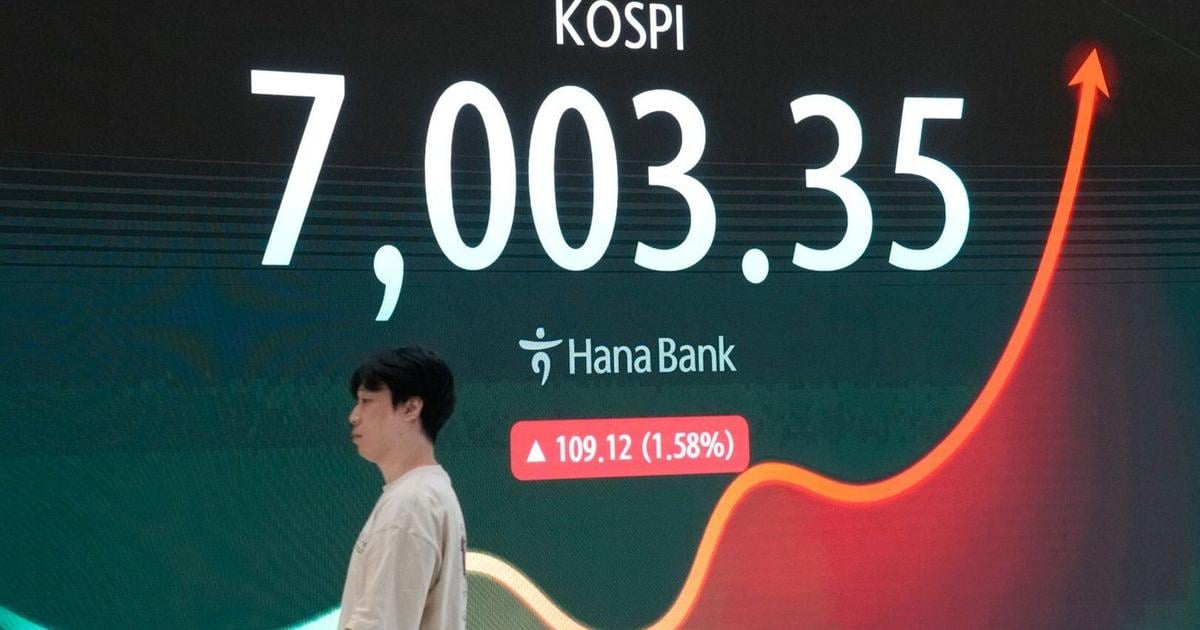
A screen shows the Korea Composite Stock Price Index (KOSPI) in the foreign exchange dealing room at the Hana Bank headquarters in Seoul, South Korea, Monday, Sept. 21, 2026. (AP Photo/Ahn Young-joon)
HONG KONG (AP) — Global shares advanced Monday ahead of the expected meeting between U.S. President Donald Trump and Chinese leader Xi Jinping this week in Washington, which could cover trade, artificial intelligence and geopolitics.
U.S. futures were higher after Treasury Secretary Scott Bessent told reporters following talks Sunday with Chinese Vice Premier He Lifeng in New York that the U.S. had “a very successful engagement” with the Chinese side.
In early European trading, Britain’s FTSE 100 added 0.9% to 10,750.57. France’s CAC 40 rose 1% to 8,142.41. Germany’s DAX was up 1.1% to 25,572.45.
Technology stocks in Asia also moved higher on the AI boom even as American tech leaders called for a slowdown in AI development over safety concerns. South Korea’s Kospi rose 1.7% to 7,007.72. Samsung Electronics jumped 5%, while memory chipmaker SK Hynix climbed 0.6%.
Taiwan’s Taiex was up 1.1%, with its leading AI chipmaker Taiwan Semiconductor Manufacturing Co., or TSMC, adding 0.8%.
Hong Kong’s Hang Seng advanced 1.2% to 25,042.71. The Shanghai Composite index gained 1% to 3,949.91.
Markets in Japan were closed Monday and will remain closed through Wednesday for holidays.
Australia’s S&P/ASX 200 was almost unchanged at 8,731.90.
On Sunday, Bessent said talks with China touched on trade and AI. China and the United States have been discussing reciprocal tariff reductions on $30 billion worth of goods from each side.
In Beijing, China’s Foreign Ministry on Monday confirmed that Xi will pay a state visit to the U.S. between Sept. 23 and 25. Experts and policymakers believe trade, tariffs, AI safety, among other items, are likely to be on the agenda. The war in Iran and developments in the Middle East and ties between China and Iran could also be discussed.
Oil prices fell more than 2% early Monday as vessel traffic and energy flows through the Strait of Hormuz picked up, although the Strait has remained largely closed and uncertainty persisted over U.S.-Iran tensions. Tensions between Saudi Arabia and the Iran-backed Houthis and Saudi Arabia’s closure of a key oil pipeline also continued to add pressure to global oil supplies.
Brent crude, the international standard, fell 2.5% to $101.31 per barrel. It was at roughly $72 a barrel in late February, before the start of the war in Iran.
Benchmark U.S. crude lost 2.6% to $93.57 per barrel.
Oil supply concerns remain elevated, ING commodities strategists Ewa Manthey and Warren Patterson wrote in a commentary Monday. However, they said profit-taking by investors after the recent jump in oil prices, together with hopes for constructive discussions at this week’s U.N. General Assembly and at the Trump-Xi meeting, helped improve market sentiment.
The U.S. dollar rose to 157.24 Japanese yen from 156.81 yen. The euro was trading at $1.1481, down from $1.1483.
Wall Street’s benchmark S&P 500 added 0.2% on Friday. The Dow Jones Industrial Average edged down 0.2%, and the technology-heavy Nasdaq composite gained 0.4%.
Investors are also watching the bond market as the yield on the U.S. 10-year Treasury hit 5% and the Federal Reserve last week decided to raise rates for the first time in three years. The yield on the U.S. 10-year Treasury was at around 4.96% early Monday. The Bank of Japan last week also raised rates to a 31-year high.
Government bond yields have been elevated since the war also because of growing inflationary pressure from the war-driven energy shock as well as concerns about rising U.S. national debt.