Sudan Between Chemical Weapons and the Convergence of Regional Support for the War - IOL
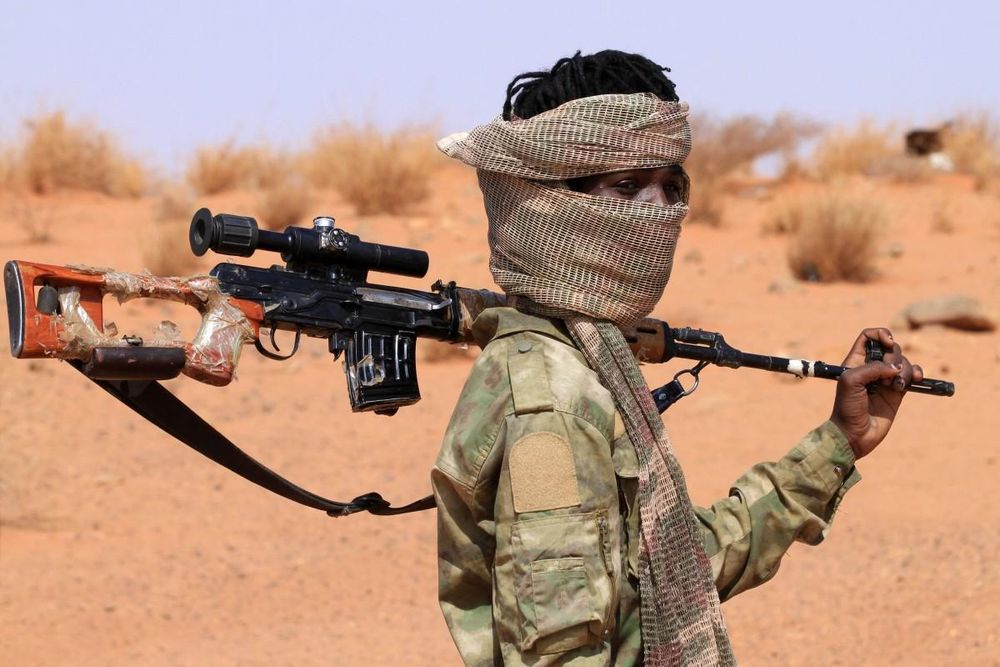
An armed defector from the paramilitary Rapid Support Forces (RSF) arrives as he is believed to be surrendering to the Sudanese military, in the west of Omdurman on August 19, 2026. Since April 2023, Sudan has been ravaged by a war between the Sudanese military, led by its chief Abdel Fattah al-Burhan, and the paramilitary Rapid Support Forces, commanded by Burhan's former deputy Mohamed Hamdan Daglo.
How Do War Crimes Become a Negotiating File?
The war in Sudan is no longer merely an internal conflict between the Sudanese army and the Rapid Support Forces; as it has stretched beyond three years, it has evolved into an arena where regional and international interests intersect with one of the world’s largest humanitarian catastrophes.
At a time when the United Nations speaks of more than 14 million people who have been forced to flee their homes since the war erupted in April 2023, and of serious violations committed by both sides of the conflict, regional and international powers continue to deal with Sudan’s military leaders as indispensable parties to security and negotiating arrangements, even as allegations concerning attacks on civilians and the use of prohibited weapons continue to mount.
The issue of chemical weapons use stands out as one of the most serious files that has not received public and independent international pressure commensurate with its gravity. In April 2025, the United States announced that it had concluded that the Sudanese government had used chemical weapons during 2024, and subsequently imposed additional sanctions on Sudan after saying that the conditions for lifting the sanctions had not been met.
Then, in September 2026, new journalistic investigations and evidence heightened the gravity of the allegations. The Washington Post published documents, messages, and images that it said revealed the existence of a secret program to develop and store chemical weapons within the Sudanese military establishment, including tests of bombs believed to contain chlorine. Here, the more difficult question emerges: if evidence of chemical weapons use in a war for which civilians are paying the price has accumulated, why has this issue not become an urgent international priority for accountability and an independent investigation?
Sudan has been a state party to the Chemical Weapons Convention since 1999, and therefore the use of toxic chemicals as weapons constitutes a violation of Sudan’s international obligations. The United States officially confirmed in 2025 that it had concluded that the Sudanese government had used chemical weapons, and Washington reiterated its allegations before the Organisation for the Prohibition of Chemical Weapons in 2026, calling on Sudan to comply with its obligations and allow independent verification.
What is striking, however, is that the independent international investigation has remained limited compared with the gravity of the allegation. The Organisation for the Prohibition of Chemical Weapons is the specialized international body capable of conducting technical verification operations, while Washington says Sudan has not adequately complied with its obligations. Meanwhile, the Sudanese government presented a national investigation that concluded that no evidence proving the use of chemical weapons had been found. The United States rejected the notion that the national mechanism could serve as a substitute for independent international verification.
In September 2026, new journalistic investigations added an even more serious layer to the file. The Washington Post reported on documents and internal materials indicating the storage of hundreds of chemical bombs, tests conducted in desert areas, and attempts to conceal traces of the program. Sources told the newspaper that messages also linked Sudanese military officials to the program. This makes these findings raise a legitimate question as to why the matter has not been turned into a transparent and independent international investigation whose results are made public. Chemical weapons are not merely another weapon in the war; their prohibition represents one of the most firmly established rules of international humanitarian law.
The most evident paradox appears in the position of Sudanese army chief Abdel Fattah al-Burhan himself. In January 2025, the United States imposed sanctions on him, accusing the Sudanese Armed Forces under his command of committing violations of international humanitarian law, targeting civilians and infrastructure, carrying out killings, and obstructing the delivery of humanitarian aid. At the same time, al-Burhan remained a key participant in international diplomatic contacts concerning Sudan and continued to represent Sudan at the United Nations.
In September 2026, he was scheduled to deliver an address before the United Nations General Assembly, before a crisis emerged over his US entry visa. Reuters reported that Washington was withholding the visa amid US efforts to tie his attendance to acceptance of a proposed ceasefire.
This episode exposes the contradiction surrounding the international approach to Sudan’s military leadership: the man whom Washington has sanctioned over allegations involving grave violations remains, at the same time, a partner in the international diplomatic process and an interlocutor with the United Nations. Herein lies one of the crises of the international system in Sudan: legal accountability proceeds along one track, while political and security interests proceed along another.
Egypt is one of the most important regional actors linked to the Sudanese army. The European Union Agency for Asylum points to reports and allegations that Egypt provided the Sudanese Armed Forces with air support, ammunition, training, and intelligence, while Egyptian President Abdel Fattah el-Sisi publicly announced his continued support for the Sudanese Armed Forces during a meeting with al-Burhan in November 2024.
In February 2026, Reuters reported the deployment of a Turkish Bayraktar Akıncı drone at an Egyptian base near the Sudanese border, amid an intensifying regional military role in the war.
These strategic calculations raise a legal and political question: to what extent can a regional state support a military institution in a country engulfed in civil war while documented allegations of violations by forces under its command exist? The practical answer should not be to ignore violations, but rather to tie any political or military support to clear guarantees for the protection of civilians and the investigation of crimes.
Saudi Arabia’s role, as it seeks to play the role of mediator, has been more complex. It hosted the Jeddah talks between the two sides of the war, while maintaining close relations with al-Burhan and seeking to protect its interests in the Red Sea, as numerous European sources have indicated.
But in April 2026, Reuters revealed that Saudi Arabia had mediated a Pakistani arms deal for the Sudanese army worth approximately $1.5 billion, then requested that Riyadh cancel the deal and informed Islamabad that it would not finance it.
This episode is significant because it shows that Saudi Arabia’s relationship with al-Burhan is not merely one of entirely neutral mediation, while at the same time it does not permit Riyadh to be described without qualification as currently supplying him with weapons directly.
More accurately, Saudi Arabia is using its political, financial, and diplomatic weight to influence the dynamics of the war, with a clear inclination toward preserving the Sudanese army’s position as a central player, alongside its publicly stated mediation efforts.
Here, too, the contradiction emerges: a mediator seeking to end the war needs to maintain channels with the parties, but maintaining those channels should not turn into political protection from accountability.
The Turkish case is more direct than the Saudi case in terms of published evidence concerning military equipment. In an extensive investigation, The Washington Post cited documents, communications, commercial records, and flight data that it said documented the arrival of Turkish-made weapons and drones to the Sudanese army.
According to the investigation, the Sudanese Defence Industries System signed a contract worth approximately $120 million with Turkish company Baykar to provide drones and munitions. The shipments reached Sudan in 2024, with Turkish technicians present to assist in operating the equipment. Ankara, for its part, denied providing military support to either side in the war.
The issue assumes greater significance because drones have become one of the most important weapons in the Sudanese war. A report issued by the United Nations Fact-Finding Mission in September 2026 said that more than 1,000 people had been killed in drone strikes during the first five months of the year, and that both sides had used advanced capabilities to strike areas far from the front lines, including hospitals, schools, markets, and sites hosting displaced people.
Accordingly, the question concerns not only the source of the weapons, but also responsibility for how they are used. A state that exports weapons to a party in a civil war bears a political, moral, and legal responsibility to exercise due diligence to prevent their use in grave violations, particularly when the risks of attacks on civilians are known.
Perhaps the most important point in the Sudanese landscape is that the international community does not deal with the war according to a single standard. While documented allegations exist against the Sudanese Armed Forces, there are also extremely serious allegations against the Rapid Support Forces, including crimes committed in Darfur.
In September 2026, the United Nations Fact-Finding Mission said that both sides of the war had committed serious violations of international law, and that some drone operations could amount to war crimes. The UN Secretary-General also called for states that provide weapons to the parties to be held accountable when those weapons are used against civilians.
Therefore, the issue should not turn into a defence of one side against the other, but rather into a question of consistency in applying the principle of accountability. If the crimes of the Rapid Support Forces warrant investigation and prosecution, then the violations attributed to the Sudanese Armed Forces warrant the same.
And if the international community calls for an end to the flow of weapons to one party because it uses them against civilians, the same principle should apply to all parties and their sources of armament. The presumed standard is not the identity of the ally, nor its proximity to a regional state, nor its position in the geopolitical conflict, but the conduct of the armed force toward civilians and international law.
* Bayethe Msimang is an independent writer, analyst and political commentator.
** The views expressed do not necessarily reflect the views of IOL.