Supreme Court Refuses to Hear ‘Let’s Go Brandon’ Apparel School Ban Case - Newsweek
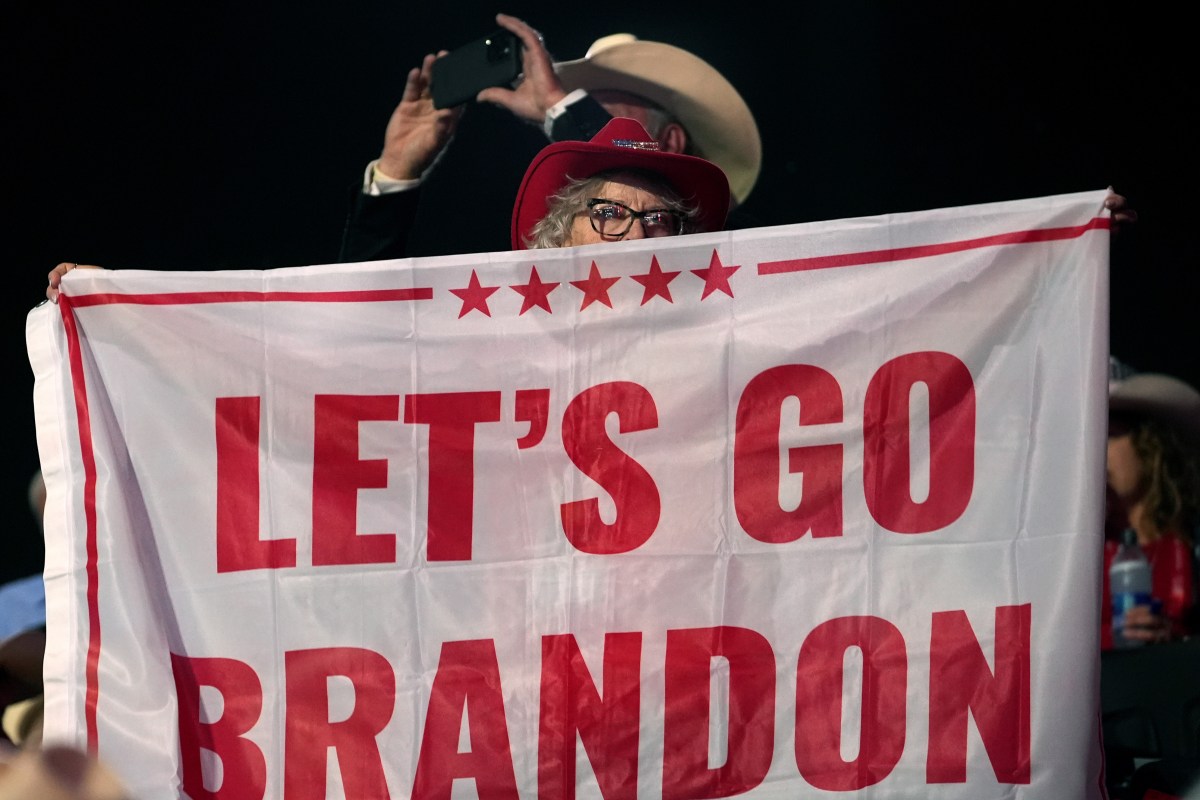
Two students and their mother wanted the Supreme Court to weigh in on whether public schools can censor "nondisruptive" political speech after they were forced to take off pro-Trump sweatshirts.
On Monday, the Supreme Court issued its first decisions of the new term and declined to hear D.A. v Tri County Area Schools. The case involves two students who wore "Let's Go Brandon" sweatshirts to school and were forced to take them off because the slogan's origins were in profanity.
"The decision below poses a stark threat to the First Amendment rights of millions of public school students. It licenses individual teachers and administrators to banish nondisruptive political speech containing sanitized expressions if it clashes with their personal notion of 'vulgarity,'” the petition argued.
In October 2021, a NASCAR reporter mistakenly thought a crowd was chanting "Let's Go Brandon," when they were actually chanting "f--- Joe Biden." The slogan became a mantra for anti-Biden and pro-Trump crowds and quickly appeared in memes and merchandise being sold online.
Even politicians, including Representatives Bill Posey, Mary Miller and Doug LaMalfa, started using the saying and including it in speeches they gave on the House floor.
"The American people are not going to sit back and take it much longer. They have had enough. They want us to help put America back where you found it and leave it the hell alone. Let's go, Brandon!," Posey said shortly after the NASCAR event.
For Christmas that year, the two boys, in sixth and eighth grade at the time, at the center of the Supreme Court case got sweatshirts with the slogan on them. They wore them to school and were told to take them off because assistant principal Andrew Buikema and teacher Wendy Bradford deemed them a violation of the school's profanity policy.
In the case, the students and their mother argue this violates their First Amendment rights and relates wearing the "Let's Go Brandon" slogan to students wearing black armbands to oppose the Vietnam War. They also argued that wearing the sweatshirts didn't cause a disruption, falling in line with the ruling in Tinker v. Des Moines, when the Supreme Court decided a school can't censor students' free speech unless it interferes with school operations or discipline.
Lower courts, however, argued that the school was able to require the students to take the sweatshirts off because of the Fraser ruling. In that case, the Supreme Court ruled that public school officials could discipline students for using lewd or profane language. Since "Let's Go Brandon" originated from a profane statement, the school argued they were within their legal rights to censor the sweatshirt and lower courts agreed.
One justice, Judge John Bush, dissented from the Sixth Circuit ruling, arguing that allowing schools to interpret what is profane, there's a risk that there's a new justification for censoring political comments that someone disagrees with.
The school, however, argued that it wasn't a matter of censoring political opinions and said in a brief to the Supreme Court that they've allowed people to wear other pro-Trump, MAGA and Biden apparel. They argued that most profanity is conveyed through euphemisms, slang and coded language, like the "Let's Go Brandon" slogan. If students need to be wearing explicitly profane attire to satisfy the profanity policy, the school argued they could have endless apparel with sexually suggestive or profane coded expressions and the school couldn't stop the students from wearing it.
The petitioners called the case a "perfect opportunity" to clarify Fraser for "the nation's 50 million K-12 public school students." However, the Supreme Court seemed to disagree and refused to hear the case. None of the justices publicly dissented from the denial of the writ of certiorari.
Newsweek’s reporters and editors used Martyn, our AI assistant, to produce this story. Learn more about Martyn here. Contact Newsweek editors on this story: Jason Lemon and Gray R. Thomas