Susan Collins Warns Trump on NIH Grant Plan as Polls Show Tight Maine Race - Newsweek
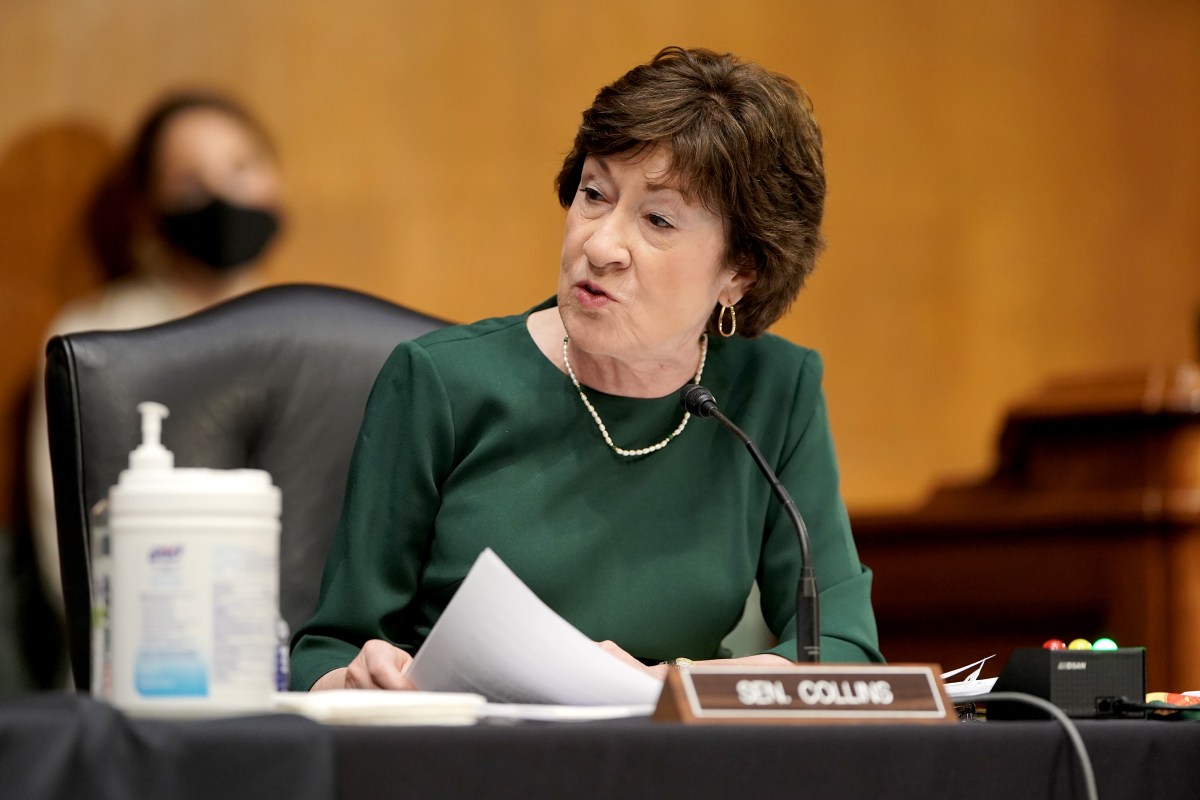
Senator Susan Collins is warning the Trump administration against what she describes as an effort to politicize federal health research funding, escalating a dispute over control of National Institutes of Health (NIH) grants as she faces a reelection race that recent polling suggests could be one of the most competitive of her career.
The Maine Republican's criticism comes as recent polling shows Democrat Troy Jackson holding a narrow edge in the race for Collins' Senate seat. A CNN/SSRS poll released earlier this month found Jackson leading Collins 48 percent to 45 percent, while other recent surveys have also pointed to a highly competitive contest. The race is rated a toss-up by major election forecasters.
The dispute erupted after The Washington Post reported Friday that President Donald Trump is considering an executive order that would create a commission to review NIH grants, potentially giving political appointees a role in determining how the agency distributes nearly $50 billion in biomedical research funding. The Post reported that White House budget chief Russell Vought led criticism of the NIH, arguing the agency had funded "woke" initiatives that conflicted with Trump's priorities and should face additional scrutiny.
Newsweek reached out to the White House, NIH, Office of Management and Budget (OMB) and Collins' office for comment on Monday afternoon.
In a statement posted Monday, Collins argued that the Trump administration would be crossing a line if it moved forward with the proposal.
"The Office of Management and Budget (OMB) should not be involved in agency decisions on the awards of grants," Collins wrote on X.
She added that "any attempt to politicize grantmaking at the National Institutes of Health (NIH), or any other agency, by another means, whether an Executive Order or guidance, is contrary to congressional intent."
Collins further warned that political review of grants already vetted by scientists would undermine the existing process.
"Imposing a political review on awards that have already been selected through a rigorous scientific and merit-based process undermines the long-standing principle that the government funds awards based on scientific need and merit, rather than political ideology."
Her statement came after congressional leaders from both parties raised concerns about the reported effort. The Washington Post reported Monday that Collins, Senate Appropriations Committee Vice Chair Patty Murray and House Appropriations Committee ranking member Rosa DeLauro all warned against giving the White House additional control over NIH grant decisions.
Collins' opposition to the latest proposal did not begin this month.
In a July 6 letter to Vought, the Senate Appropriations Committee chair urged OMB to withdraw portions of a proposed government-wide grant-making rule and extend its comment period. Collins argued that parts of the proposal would undermine scientific and biomedical research, create burdens for small communities and conflict with Congress' authority over federal spending.
At the center of her concerns was a provision that would have required senior political appointees to conduct an additional review of grants after they had already completed scientific and merit-based evaluation. The proposal directed appointees to consider whether awards "demonstrably advance the President's policy priorities" and use their "independent judgment" when reviewing funding decisions.
Collins warned at the time that political review could shift decisions away from scientific merit and toward ideological considerations.
She also objected to provisions allowing federal agencies to terminate discretionary grants if officials determined they no longer aligned with agency priorities or the national interest.
In her July letter, Collins warned that abruptly ending federal awards could have serious consequences for long-term medical studies and patients participating in research.
"For example, the termination of clinical trials would leave patients without treatment and could well result in significant scientific and financial losses to both the recipient and the Federal government," she wrote.
She added that uncertainty over potential grant cancellations could discourage researchers and institutions from pursuing multiyear federally funded studies.
That history helps explain why Collins viewed the reported executive-order effort as a continuation of the same grant-making fight she had been waging against OMB for months.
The controversy intensified after reports of a tense Oval Office meeting involving Trump, Vought and NIH Director Jay Bhattacharya, who leads the nation's largest single funder of biomedical research.
According to The Washington Post, Vought argued that NIH continued funding projects that conflicted with Trump's agenda and proposed additional oversight of grant-making. Bhattacharya reportedly defended the agency's current review process during the meeting.
In comments reported by The New York Times, NIH spokesman Joshua Pradko declined to discuss details of the meeting but said the agency remained committed to funding biomedical research. Pradko also pushed back on suggestions that NIH grant funding could be pulled back, saying: "There will be no rescissions to NIH grant monies. All NIH grant monies will be spent." The comments suggested NIH leaders are continuing to resist efforts to pull back congressionally approved research funding.
The Times subsequently reported that administration officials were drafting an order that could establish an outside committee empowered to review or potentially veto grants viewed as inconsistent with administration priorities.
The reported proposal follows months of friction between OMB and NIH. Vought has repeatedly criticized grants he considers "woke" and has argued political officials should have greater authority to review federal spending decisions. Bhattacharya, while supporting efforts to eliminate what he considers ideologically driven research, has also publicly pledged that NIH would spend the funding appropriated by Congress.
Congress included language in a continuing resolution signed into law earlier this month that temporarily blocks implementation of OMB's proposed grant-making rule through December 11. In Monday's statement, Collins argued that any attempt to achieve a similar outcome through "an Executive Order or guidance" would be contrary to congressional intent.
Lawmakers from both parties criticized the reported proposal.
"Whether lifesaving medical research gets funded or not should be determined by experts at the NIH, not a panel of lackeys chosen by Donald Trump and Russ Vought," Murray said in a statement shared with Newsweek.
She warned that "a single political appointee could kill a cancer study or an Alzheimer's trial with no scientific reason at all."
Murray also accused Trump of attempting to use scientific funding decisions to advance political goals.
"Only one question should decide which research gets funded: is this good science that could save lives? Trump wants to answer a different question: does this help me settle a score?"
She called on Republicans to oppose any effort to politicize medical research funding, "whether that's an OMB rule or a new executive order."
The NIH dispute arrives as Collins navigates a difficult political environment.
Recent polling has consistently pointed to a competitive race between Collins and Jackson. The CNN/SSRS survey found Collins with a 41 percent favorable rating and a 51 percent unfavorable rating, while Jackson registered a 36 percent favorable rating and a 42 percent unfavorable rating. The same survey found that 67 percent of Mainers disapprove of Trump, compared with 31 percent who approve.
A Fox News survey found Jackson ahead by 2 points, while a University of New Hampshire poll showed him leading by 3 points. An Abacus Data poll found Jackson ahead 52 percent to 43 percent among likely voters, although Collins held a narrow 46 percent to 45 percent edge among all registered voters.
Those figures underscore the challenge Republicans face in Maine, a state won by former Vice President Kamala Harris by 7 points in 2024.
Still, Collins has repeatedly proved resilient. In 2020, she won reelection despite trailing Democrat Sara Gideon in most public polling and Maine's backing of the Democratic presidential nominee.
For questions about this story, contact Newsweek editor Edward T. Cummins.