Tata-Mistry verdict explained: Why Tata Trusts’ voting rights are central to the Tata Sons power struggle - The Indian Express
The Supreme Court’s judgment in the Tata-Cyrus Mistry dispute in 2021 has assumed fresh significance amid the escalating battle over the control and governance of Tata Sons. Senior advocate Abhishek Manu Singhvi, appointed by Tata Trusts, referred to the judgment on Sunday, arguing that the court had “clearly given Tata Trusts the primacy” in their relationship with Tata Sons. The Court’s decision to uphold the special Articles of Association governing the Trusts’ rights, as well as its observations on their fiduciary obligations, was highlighted by Singhvi.
The observation comes at a particularly sensitive juncture. Tata Trusts, which collectively own about 66% of Tata Sons, are challenging the validity of the September 17 board decision to reappoint N Chandrasekaran as executive chairman for another five-year term.
Their contention is that the Articles require the affirmative support of the Trusts’ nominee directors for certain decisions, and that neither a general board majority nor the chairman’s casting vote can override that requirement. The legal question is not whether the 2021 judgment directly decided the Chandrasekaran dispute. Rather, it is whether the principles and provisions upheld by the Supreme Court in the Cyrus Mistry case have a bearing on the interpretation of the present Articles of Association.
The dispute began after Cyrus Mistry was removed as executive chairman of Tata Sons in October 2016. The Mistry family and the Shapoorji Pallonji Group, which held about 18.37% of Tata Sons, subsequently challenged his removal and alleged oppression and mismanagement. The litigation eventually reached the Supreme Court after the National Company Law Appellate Tribunal (NCLAT), in December 2019, had ordered Mistry’s reinstatement as executive chairman and granted other reliefs to the Mistry group.
In March 2021, a three-judge Supreme Court Bench headed by then Chief Justice S A Bobde overturned the NCLAT verdict and ruled in favour of Tata Sons. The 282-page judgment dealt with several issues, including Mistry’s removal, minority shareholder rights, Article 75 of Tata Sons’ Articles and the special voting rights of Tata Trusts’ nominee directors. The Supreme Court held that the mere removal of a person from the position of chairman could not by itself amount to oppression or prejudice. It also rejected NCLAT’s order reinstating Mistry and its restrictions on Tata Sons’ use of Article 75.
In the present Tata Sons confrontation, one part of the judgment is particularly important — the Court upheld the affirmative voting rights of the nominee directors of the Tata Trusts.
The Tata Sons Articles of Association gave the two principal Tata Trusts — Sir Ratan Tata Trust and Sir Dorabji Tata Trust — special rights, including the ability to nominate directors. The Mistry side had challenged the special voting powers available to the Trust nominees, arguing that these rights were oppressive and prejudicial. The NCLAT had accepted this argument and sought to curtail those powers.
However, the Supreme Court reversed that finding. The Court held that the directors nominated by the two Trusts had the right to affirmative voting because, in addition to their responsibilities in relation to the companies they represented, they had duties towards the beneficiaries of the Trusts. These affirmative voting rights effectively gave the Trust nominees veto powers on specified matters. The Court upheld their validity. That is the portion of the 2021 judgment now being invoked by Tata Trusts.
Why is this relevant to the current power struggle?
The present dispute turns on the interpretation of the same basic governance architecture. Article 104B gives the Tata Trusts the right to nominate one-third of the Tata Sons board while they hold the prescribed shareholding. More importantly, Article 121 requires matters decided by a majority of directors to also receive the affirmative vote of a majority of Trust-nominated directors. That provision has become central to the Chandrasekaran controversy.
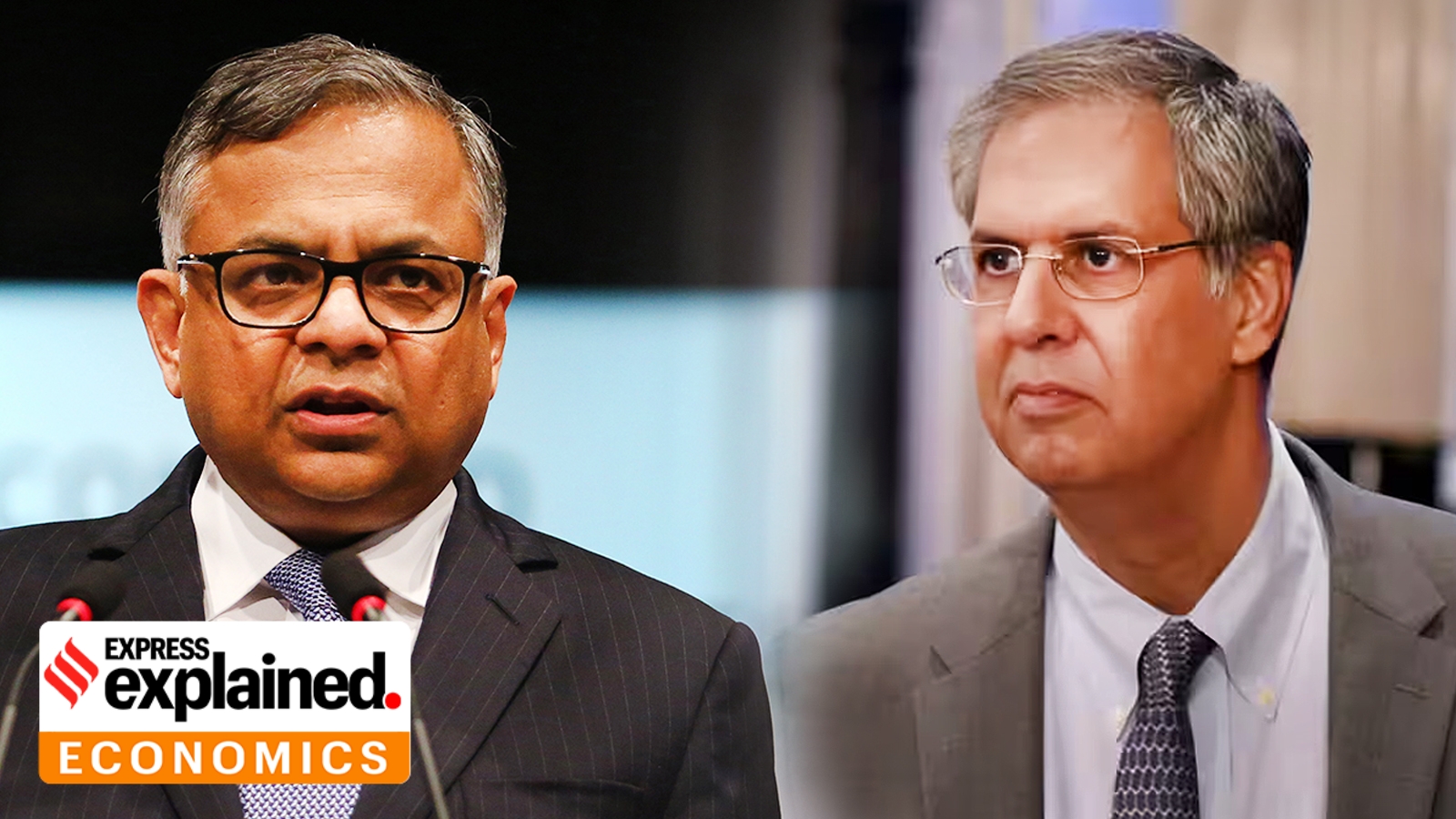
There are currently two Tata Trusts nominees on the Tata Sons board — Noel Tata and Venu Srinivasan. On September 17, Srinivasan supported Chandrasekaran’s reappointment, while Noel Tata opposed it. Four other directors voted in favour. Tata Sons treated the result as a valid majority decision. Tata Trusts disagreed and questioned the validity of the chairman’s casting vote, which happened after the split verdict.
Their argument is that where the Articles prescribe an additional condition — affirmative support from the required number of Trust nominees — that condition has to be satisfied independently of the overall board arithmetic.
In its statement on Sunday, Tata Trusts said that “majority amongst two is two and not one” and argued that the chairman’s casting vote could operate only in case of equality of votes at the overall board level. It could not, in the Trusts’ interpretation, substitute for the affirmative support required from the Trust nominees.
Did the Supreme Court give Tata Trusts a ‘veto’?
The 2021 judgment did not create a new veto for Tata Trusts. Rather, the Supreme Court upheld the validity of special rights already contained in Tata Sons’ Articles. The Court was examining whether the special rights enjoyed by the Trust nominees were oppressive or prejudicial to the minority shareholder. It rejected the challenge and upheld the affirmative voting rights.
Article 121 gave the Trust nominees, in effect, a veto over specified matters which include areas such as strategic plans, major investments, capital structure and changes affecting the Trusts’ shareholding. The present dispute is therefore about how those rights operate when the two Trust nominees themselves disagree. That question was not the central issue before the Supreme Court in the Mistry case.
What exactly is Tata Trusts’ argument today?
The Trusts say Tata Sons cannot rely on the Articles selectively. In their September 20 statement, they pointed out that Tata Sons had defended the affirmative voting provisions before the Supreme Court when the Mistry group sought to have them deleted or restricted. The company had argued then that these provisions were legitimate protections for the majority shareholder.
The Supreme Court accepted that position and rejected the NCLAT’s finding that the rights were oppressive. The Trusts’ present argument is consequently straightforward: if Tata Sons successfully defended these provisions before the Supreme Court, it cannot now disregard the same provisions when they become inconvenient. This is the legal and constitutional foundation of Singhvi’s reference to “primacy”.
But “primacy” should not be read as meaning that the Supreme Court has declared Tata Trusts supreme over every decision of Tata Sons. The judgment upheld particular rights contained in the Articles and recognised the position of the Trust nominees in the governance structure. The precise application of those provisions to the September 17 vote remains a matter for legal interpretation.
What was the impact of the 2021 judgment?
The immediate impact was decisive. Cyrus Mistry was not reinstated and the NCLAT judgment was overturned. The judgment also settled several important questions concerning private-company governance. One was minority representation. The Supreme Court held that a minority shareholder does not automatically have a statutory right to proportional representation on the board of a private company. The Mistry family’s 18.37% stake therefore did not, by itself, create such a right.
Another was the importance of the Articles of Association. The Court held that the Articles, as they existed, were binding and could not simply be rewritten through proceedings before the tribunal. And, crucially for today’s dispute, the Court upheld the special affirmative voting rights of the Tata Trusts’ nominees. The judgment thus strengthened the legal significance of the constitutional arrangements through which Tata Trusts exercised influence over Tata Sons.
What does the judgment mean for the Chandrasekaran dispute?
The 2021 verdict does not automatically invalidate or validate the September 17 resolution. It provides an important legal backdrop. The Supreme Court has already examined the Tata Sons Articles in the context of the Mistry dispute and upheld the legitimacy of the Trusts’ special affirmative voting rights. Tata Trusts are now relying on that history to argue that those rights cannot be diluted through an alternative interpretation of the same Articles.
The other side of the argument is likely to focus on the precise wording of the relevant provisions, the distinction between a board majority and a separate affirmative-vote requirement, and the circumstances in which a chairman’s casting vote can operate.
Former Chief Justice D Y Chandrachud has separately given a legal opinion sought by Noel Tata stating that a casting vote cannot substitute for the affirmative support of the Trust nominees. The dispute is therefore moving beyond a personality clash between Noel Tata and Chandrasekaran. It is becoming a test of the Tata Sons constitutional structure itself.
George Mathew is an Associate Editor with The Indian Express, based in Mumbai. A veteran of financial journalism with nearly three decades of experience, he is one of the country’s most authoritative voices on banking, regulation, and the corporate sector. Expertise & Focus Areas Mathew’s reporting covers the nerve center of India’s economy. His specialized beats include: The Reserve Bank of India (RBI): He has tracked the central bank's policy evolution through the tenures of multiple Governors, offering deep insights into monetary policy, repo rates, and banking regulation. Banking & Insurance: Extensive coverage of public and private sector banks, non-performing assets (NPAs), and key legislative reforms like the Insurance Amendment Bills. Corporate Affairs: Mathew frequently breaks major stories related to India's largest conglomerates, with a specific focus on the Tata Group, documenting boardroom shifts and strategic decisions. Financial Markets: Reporting on the complexities of Foreign Portfolio Investors (FPIs), IPOs, and currency fluctuations. Authoritativeness & Insight With a career dating back to the late 1990s, Mathew possesses a rare institutional memory of India’s financial liberalization and market crises. His work is not limited to daily news; he frequently contributes to the "Explained" section, where he decodes complex financial legislations and market trends for a broader audience. His rigorous reporting has also been featured in scholarly platforms like the Economic and Political Weekly (EPW). Find all stories by George Mathew here ... Read More