Teetotal Trump’s Strange Weakness for Whiskey - Newsweek
Shane Lowry holed a 30-foot birdie putt on the 18th at Doonbeg on Sunday and began stretching his arms out before the ball dropped, a fitting end to a week in which he won the Amgen Irish Open by a record 11 shots.
Donald Trump, president of the United States, who just so happens to own the golf resort, was watching from a box seat. He came down to present the trophy.
Then, cameras still running, Trump, as easy as swapping clubs, changed the subject from golf to tariffs.
People had been asking him about the 10 percent duty on Irish whiskey, Trump explained. The taoiseach, Micheál Martin, in Dublin the day before. Lowry too. More or less everyone.
"Everybody’s been bugging me," Trump said, and announced that on behalf of the U.S., he was taking it off. The crowd erupted. The famous luck of the Irish had paid off, or perhaps it was the charm. Choose your preferred cliché.
The Irish Whiskey Association puts the annual U.S. export value at roughly €450 million ($519 million). Trump gave no implementation date, so the Irish are on a promise. When he made the same about Scotch, it took nearly three months to take effect.
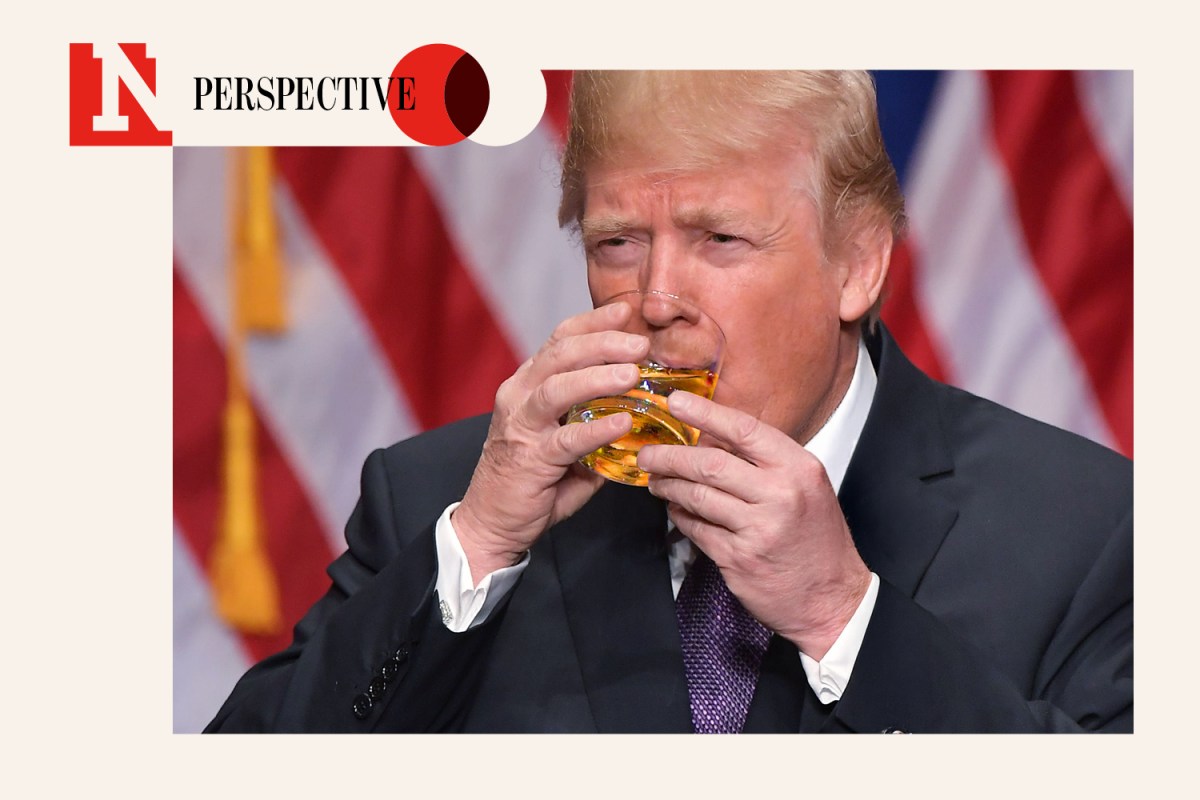
Interestingly, the man making it says he never drinks, citing the warnings of his late older brother, Fred, who died aged 42 of alcoholism. Still, alcohol has been a persistent fixture of this famous teetotaler's trade policy, used as tool to both reward and punish those with whom he is in dispute.
On April 30, the final day of King Charles III’s state visit, Trump said he would scrap the tariff on British whisky—“in honor of the King and Queen who just left," he told reporters, adding that they had got him to do something others had failed to.
The pledge took effect July 24, and Scotch, whose American market was worth £933 million ($1.25 billion) in 2025, now enters at zero.
Twice this year, then, Trump has publicly promised a whiskey carve-out after somebody he likes asked for one. Sláinte, lads!
The tempting conclusion is that he is a soft touch for whiskey. Flattered by monarchs, charmed by sportsmen, and sentimental about a drink he never tried.
Really, whiskey has become a recurring vehicle for personalized trade diplomacy, a category of product nationally branded and culturally significant in a way steel and semiconductors are not.
Whiskey, or whisky depending where you are and what you’re drinking, enjoy organized industries and famous champions, and is a small enough industry against a national trade balance that a crowd-pleasing carve-out need not reopen the wider tariff war.
But there is much more going on than a whispered appeal into Trump’s ear.
The U.K. government credits the Scotch exemption to sustained, government-led engagement with Trump. Scotland’s first minister gave a nod to the King, but also a wider campaign by Scottish ministers and the industry.
The Irish Whiskey Association had been pressing publicly for the same treatment since the day after the Scotch decision, pointing out that a single protected product was attracting two different U.S. tariffs depending on which side of the Irish border it was distilled.
And the Irish rate had already fallen: 15 percent under the 2025 regime, then 10 after a broad round of U.S. tariff action in July covering 60 trading partners. The line was moving before anyone teed off at Doonbeg.
Yet alcohol keeps surfacing in unusually public episodes of Trump’s trade diplomacy, good and bad.
In March 2025, when Brussels proposed a 50 percent tariff on American whiskey in retaliation for steel and aluminum duties, Trump threatened 200 percent on European wine and spirits unless it was dropped.
Eurostat put all EU alcoholic-beverage exports to the U.S. at €8.9 billion ($10.3 billion) in 2024. The French needed a very stiff drink when Trump dropped that particular bomb on their economy.
It isn’t just Europe whose booze industry thrives or survives by Trump’s bottle diplomacy.
After Canadian provinces pulled American drink from their state-run liquor systems, Trump, angry, reached for the bottle.
Or, more specifically, Section 338 of the Tariff Act of 1930—a dormant provision permitting retaliation against discriminatory treatment—and built a punitive regime on it.
His July 20 proclamation on alcohol, one of three issued that day alongside dairy and vehicles, found that U.S. alcohol exports to Canada had fallen from about $718 million to $137 million, roughly 81 percent.
Fifty percent duties followed, delayed three days while Ottawa talked, then imposed on August 22 after the White House said Canada had "reneged" on its commitment.
Canadian Prime Minister Mark Carney claims it was he who suspended the talks, saying late changes to the American terms were "unfair, uneconomic."
Trump went further on September 8, ordering specified Canadian alcoholic beverages excluded from importation from the end of the month. Five days later, he stood on a green in Clare and promised to lift the Irish duty.
What makes the category of product so useful in trade diplomacy is that its reciprocity is already physical.
Scottish distilleries buy around $270 million of used Kentucky bourbon barrels a year, and the Irish industry describes Ireland as the EU’s largest importer of American oak, with most Irish whiskey maturing in ex-bourbon casks.
Scotland’s first minister called the July outcome "zero-for-zero," an arrangement with an economic logic independent of royal access. But it has not always run this way. In Trump’s first term whiskey was collateral rather than favor.
After Washington won its WTO case over Airbus subsidies in 2019, single-malt Scotch and Scotch whisky liqueurs took 25 percent duties under countermeasures covering roughly $7.5 billion of EU goods.
In December 2020 certain nonsparkling wines, cognac and grape brandies from France and Germany were added. The president who once used European spirits as leverage in an aircraft dispute now publicly announces whiskey exemptions.
We still don’t know what instrument implements the Doonbeg pledge, or when it will arrive. Nor do we yet know if anything is moving the other way—an EU concession, or a separate Irish commitment in return, for example.
The EU does not let individual member nations negotiate bilateral trade agreements. So where does this leave the rest of the booze produced by EU member states? If it applies for Irish whiskey, why not French liquor?
Until those answers exist, what happened on the 18th green is a promise rather than a policy, and the pattern it belongs to is an open question rather than a closed conclusion.
A president who has never had a drink has now twice put whiskey at the front of a public trade announcement, at the request of people whose names everyone knows. Whether that is how policy is made or merely announced is not yet clear.
For now, it’s time for a drink. But Trump's is a Diet Coke.