Texas Republicans Face ‘Generational Wipeout’ Amid Disastrous Polls - Newsweek
Just one week after Republicans gathered in Dallas for a national midterm convention designed to energize the party, two new polls show Democrats leading or within striking distance in several of Texas' biggest races, as public infighting exposes growing divisions inside the state GOP.
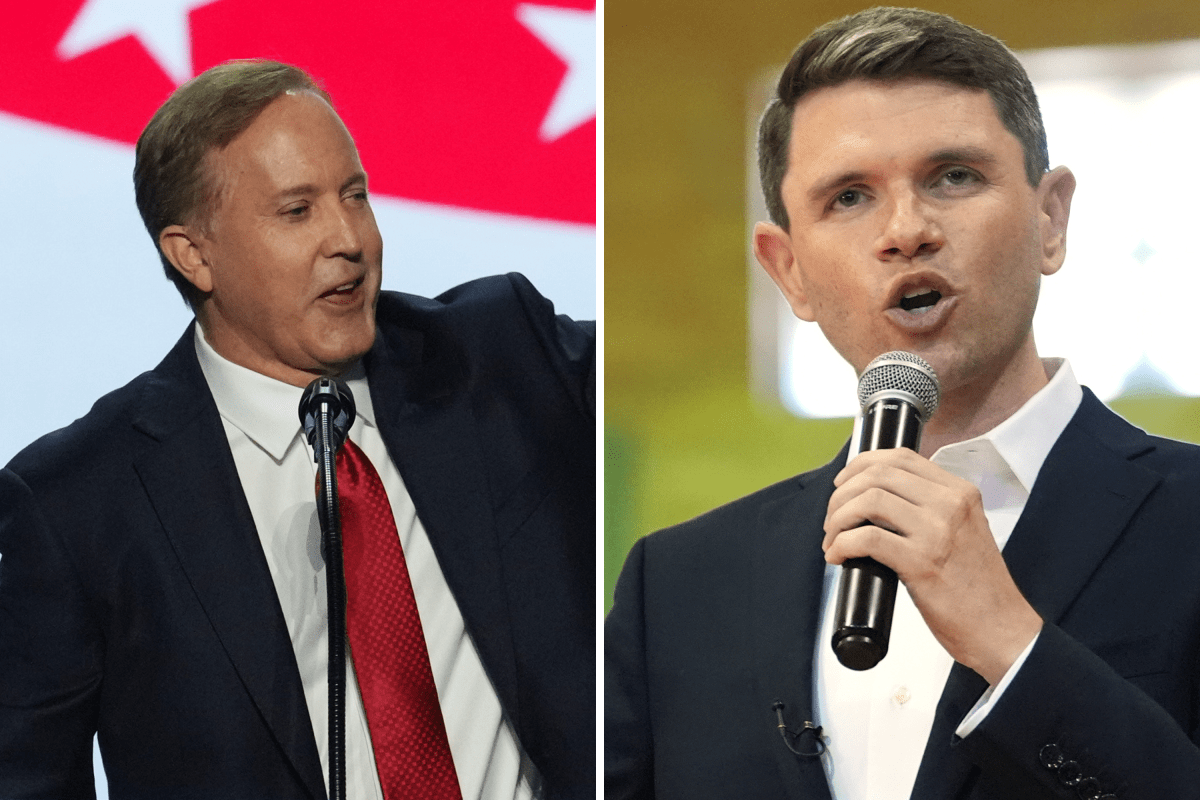
A new Siena College/ReconMR poll released Thursday has Democrat James Talarico leading Republican Ken Paxton 49 percent to 43 percent in the U.S. Senate race and Democratic state Representative Gina Hinojosa leading Republican Governor Greg Abbott 49 percent to 45 percent. A separate Emerson College Polling/Nexstar survey has the Senate race closer, with Talarico at 47 percent and Paxton at 46 percent, while Abbott leads Hinojosa 49 percent to 46 percent.
Political reporter Jacob Rubashkin described the new Siena/ReconMR numbers as “absolutely brutal for Republicans,” warning on X that they could produce a “generational wipeout” if the results ultimately came to pass.
The polling has also raised concern among Republicans.
Brendan Steinhauser, a Texas Republican strategist who managed John Cornyn’s 2014 reelection campaign, told Newsweek, “Right now the Texas GOP is working overtime to make sure that they don't suffer a historic loss.”
The results come amid an increasingly fractured Texas GOP. That division was laid bare this week after a convention photo posted by the Texas Republican Party sparked a wave of racist replies and a very public fight over the direction of the party, following a similar backlash to Republican Railroad Commission nominee Bo French's comments about University of Texas students.
Newsweek has reached out to French and the Texas GOP for comment.
The Siena College/ReconMR poll, conducted September 8-11 among 614 likely voters, puts Talarico ahead of Paxton 49 percent to 43 percent. That is up from a 47 percent to 43 percent Talarico advantage in July.
The governor's race has moved even more sharply in the new survey. Hinojosa leads Abbott 49 percent to 45 percent, after Abbott led 46 percent to 45 percent in July.
Steinhauser said that polls over the past eight weeks had consistently indicated that the Texas races would be competitive.
"Although Republicans still might win in the end, it could be very close. And it is at least a possibility that the Democrats could win," he told Newsweek. "That includes the race for railroad commissioner."
The survey also finds Democrats narrowly ahead in the lieutenant governor's race. Democratic state Representative Vikki Goodwin leads Republican incumbent Dan Patrick 47 percent to 46 percent. Republican state Senator Mayes Middleton leads Democratic state Senator Nathan Johnson 45 percent to 44 percent in the attorney general race.
The generic congressional ballot remains narrowly Republican, however, with 47 percent of voters saying they would vote for a Republican congressional candidate and 46 percent for a Democrat.
The most dramatic movement in the ReconMR survey comes from independent voters. Hinojosa leads Abbott among independents 65 percent to 27 percent, compared with 49 percent to 36 percent in July. Meanwhile, Talarico leads Paxton among independents 64 percent to 24 percent, compared with 53 percent to 30 percent in July.
The ReconMR survey has a margin of error of plus or minus 4.3 percentage points.
A separate Emerson College Polling/Nexstar survey, conducted September 12-14 among 1,000 likely voters, shows a much tighter Senate race. Talarico leads Paxton 47 percent to 46 percent, while Abbott leads Hinojosa 49 percent to 46 percent. Emerson's credibility interval is plus or minus three percentage points.
The difference between the two surveys is important. ReconMR shows a six-point Talarico lead, while Emerson, whose fieldwork began the day after ReconMR's survey ended, finds the candidates separated by one point. Both surveys nevertheless show the Senate contest within a relatively narrow range.
The Emerson survey also finds Talarico with a 48 percent favorable rating and 42 percent unfavorable rating. Paxton is at 40 percent favorable and 48 percent unfavorable. Abbott's rating is nearly evenly divided, with 46 percent viewing him favorably and 47 percent unfavorably.
Steinhauser attributed the competitive races partly to a challenging “national political climate,” including affordability and rising costs. He also pointed to Talarico, whom he described as a “dynamic candidate." "He's somebody that has certainly been able to run a good campaign in terms of energy and enthusiasm," he said, adding that independents and Hispanic voters are "overwhelmingly going for Talarico."
ReconMR finds Hinojosa with a 48 percent favorable rating and 27 percent unfavorable, while Abbott's rating is 45 percent favorable and 53 percent unfavorable.
On the issues, ReconMR finds voters saying Hinojosa would do better than Abbott on making prices more affordable, 51 percent to 44 percent, and managing the state's water supply, 49 percent to 43 percent. Abbott leads on securing the border with Mexico, 53 percent to 39 percent, and keeping Texans safe, 49 percent to 44 percent.
There is also a striking gap between vote preference and expectations in the ReconMR survey. While 49 percent said they would vote for Hinojosa and 45 percent for Abbott, 62 percent said they thought Abbott would ultimately win. In the Senate race, 49 percent support Talarico and 43 percent support Paxton, while 48 percent think Talarico will win and 45 percent think Paxton will.
The Emerson survey also finds the economy is by far the top issue for Texas voters, at 36 percent, followed by immigration at 14 percent, education at 12 percent, health care at 11 percent and threats to democracy at 11 percent.
The polling arrives as the Texas Republican Party is dealing with the fallout from French's highly controversial social media post, showing South Asian students celebrating after the University of Texas' football victory over Ohio State over the weekend.
“I heard UT graduation this year looked like this,” French captioned the photo. “I didn’t believe it. The problem is now obviously far worse than anyone imagined.”
“I weep for the families in Texas who can’t get into UT because they prioritize foreigners over Texans,” he added in a second post.
Texas Republicans, including Senator John Cornyn and Governor Greg Abbott, condemned the remarks.
“The Republican Party is better than this,” Senator Cornyn, who lost his re-election primary bid to Ken Paxton, wrote on X. “We should all condemn this bigotry directed at our fellow Texans or we will soon find ourselves a minority party.”
Deeply conservative governor Abbott also expressed his concerns, telling Politico that French’s statement “is not my message.”
“A selective picture of Longhorn fans celebrating our biggest home victory ever actually shows a way that Texans unite. We unite under the brand of Texas,” he added.
Republican state Senator Lacey Hull said the post “breaks my heart.”
“Please delete this,” she replied to French on X. “I see college kids cheering on their football team. I see Texans.”
The controversy was then echoed on the Texas GOP's own social media. The party posted a photograph from its convention showing several attendees of color with the caption “Convention photo.”
Replies quickly became focused on the racial makeup of the people pictured with commenters complaining that there were no white people in the photograph and questioning whether the people pictured were “American” or “Texan.” One reply invoked “ethnic White replacement.”
Republican state House candidate Sara McGee responded: “These comments are going very poorly for them. They’ve lost control of their own party.”
Former Southlake Mayor John Huffman, a Republican, blamed French for empowering online racists amid the wave of racist comments on the convention photo.
"This is on you, @bofrench,” he posted on X. “I don’t know the Texans in this picture, but they are getting savaged in the comments by the racists you have empowered—for no other reason than their skin color."
Huffman demanded French apologize to the Republican volunteers in the photo and remove himself from the ballot after the controversy.
Steinhauser described French as creating "extra headwinds that are unnecessary" just weeks ahead of the competitive midterm races.
“The picture posted at UT Austin, that caused all the controversy, that was just an unforced error," he said. "And, you know, also just inaccurate when 90 percent of the students, they're from the US... So like, what are you doing? You know, there's no sense in that.”
“Texas is a big place. It's a diverse place," he continued, "I think that there's still opportunity for the Republican Party to continue to grow. Which is why it's frustrating to see some of these comments. Because I think it hurts us.”
The French controversy is the latest in a series of public disputes that have exposed a broader split among Texas Republicans over the party's political identity and direction.
One of the clearest indications of the rupture in the party following French's controversy came from Karl Rove.
Rove, the longtime Republican strategist and former adviser to President George W. Bush, said he would vote for Democrat Jon Rosenthal, French's opponent in the Railroad Commission race. Rove made the declaration at a private lunch in Austin and called French a “bigot,” according to three attendees who spoke to The Texas Tribune.
Rove said the vote would break roughly 30 years in which he had supported only Republican candidates, with his previous Democratic vote coming for Texas Lieutenant Governor Bob Bullock in 1994.
Trump subsequently attacked Rove, calling him “bad” for Republicans and criticizing his record as a political strategist.
Another recent example of the party's division came in the Republican Senate primary, where Paxton defeated longtime Cornyn after a bruising campaign that pitted the party's Trump-aligned populist wing against one of its longtime establishment figures. The contest was the culmination of a broader struggle over the direction of the Texas GOP that had been playing out for years.
That divide dates back to Paxton's 2023 impeachment by the Republican-controlled Texas House, when Republican lawmakers accused the attorney general of misconduct. Paxton was ultimately acquitted by the state Senate, but the fight exposed deep divisions within the party that have continued to shape Texas politics.
At the party's national midterm convention in Dallas last week, Trump urged Republicans to treat the election as a referendum on his presidency. But Reuters reported that some Republicans at the convention questioned whether a Trump-centered strategy would be effective with the independent voters the party needs in competitive races. Five of 15 Republicans interviewed by Reuters expressed concerns about the approach.
The party is also divided over an issue that cuts across its traditional ideological lines: the rapid expansion of data centers in Texas. While Trump and Abbott have promoted Texas as a major center for artificial intelligence development, local opposition has been growing, with Texas Agriculture Commissioner Sid Miller, a Republican, warning that the backlash could cost Republicans statewide races.
That leaves the party navigating several competing pressures at once: maintaining the support of Trump's conservative base, appealing to independents and Hispanic voters, addressing economic concerns and keeping rural Republicans in the coalition.
That is unfolding alongside polling that shows the state's traditionally Republican statewide contests becoming more competitive.
“I think it's all just part of this broad collection of obstacles that Republicans have to overcome," Steinhauser said, adding that the Texas GOP favorability is also being affected by the national political climate, alongside "the big issues of affordability and rising costs and then data centers."
Steinhauser cautioned against drawing sweeping conclusions from the current polling, noting that Republicans have held every statewide elected office in Texas since 1994.
“I do think it's competitive. I do think it's within four or five or six points. But I’m not panicking," he said.
Newsweek’s reporters and editors used Martyn, our AI assistant, to produce this story. Learn more about Martyn here.
Contact Newsweek editors on this story: Samantha Beech and Gray R. Thomas