The fires we stopped counting
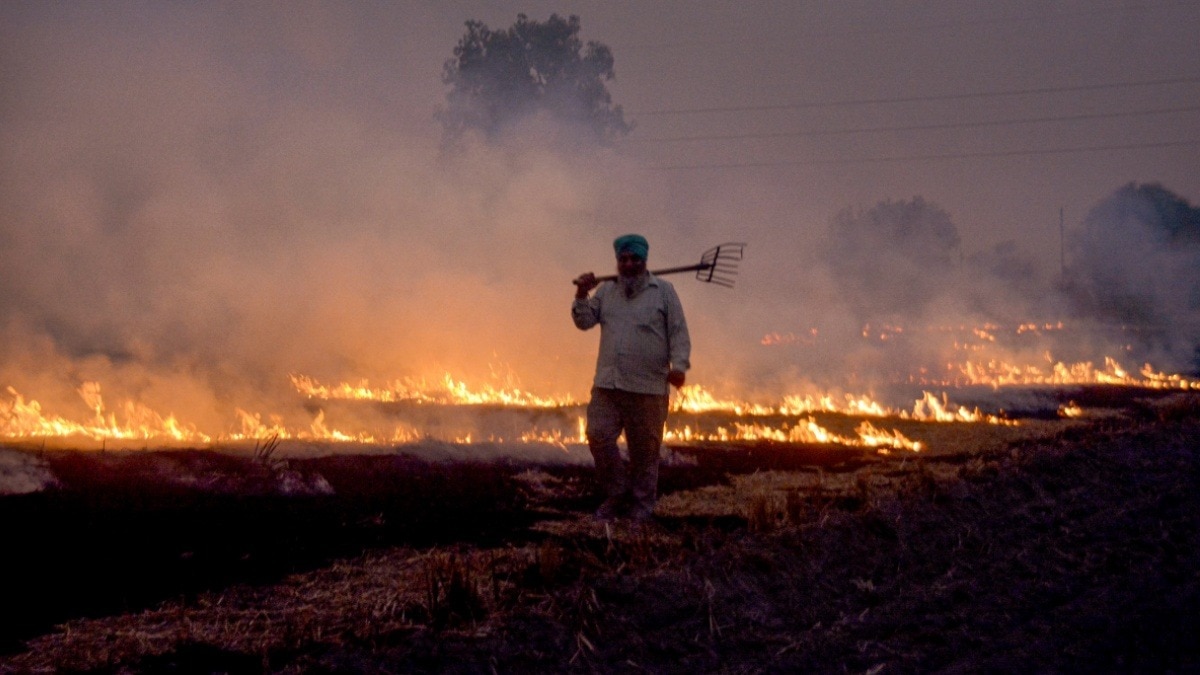
The satellite's eye opened at 13:59:35 on September 15, and in that second it saw three fires.
Two were in Tarn Taran, in Punjab's paddy belt, 161 metres apart. Whether that was two fields alight or one fire seen twice, the record cannot say. The third was 672 kilometres east, in Kannauj, Uttar Pradesh. Overnight it caught two more, in Ghaziabad and Sonbhadra.
Five fires. That is the whole of north India's official record for the opening day of the 2026 stubble-burning season, published by the Indian Agricultural Research Institute as Bulletin No. 01. In Delhi, 382 kilometres away, the air quality index read 98 that day. In November, in each of the last five seasons, it had averaged between 264 and 303.
Now look again at the three daytime fires. They share a timestamp — not roughly, but to the second. These are not three sightings; they are one: the moment the satellite was overhead.
There is no other time in this data. There never has been.
This is why a sentence at the back of that bulletin matters more than anything on its front. Below the study team's names sits a caveat no bulletin had carried in eight seasons of counting.
"It may be noted that all agricultural fires events at all time are not recorded by satellites," it reads, "due to: (a) fires taking place when satellite over-pass is not there, and (b) presence of thick cloud and smog at the time of pass."
In plain words: if nothing is overhead, the fire is not counted.
That count is what a decade of policy, court orders and election claims has rested on: the number behind the claim that Punjab's burning fell 93 per cent.
The caveat is new. But it is boilerplate. It says nothing about why the count dropped, but it concedes how the count can be wrong. We did not approach the institute for comment.TWO RECORDS, ONE SEASON
Between 2021 and 2025, satellites recorded Punjab's fires over October and November falling from 70,689 to 5,019, on the institute's daily bulletins. Across the very same weeks, the ground those same satellites mapped as burnt fell by only about half, from 17.6 lakh hectares to nine lakh, on NASA's record.
A detection means a satellite sees something hot as it passes. A burn scar is what the fire leaves behind, still there whenever the satellite next looks.
Burning has genuinely fallen. By how much, nobody can yet say. Three records disagree: NASA has the burnt ground down about half since 2021; the think tank iFOREST, using European satellites, puts the fall at about 37 per cent; Punjab's own agency shows none at all between 2023 and 2024. Somewhere between a third and a half, then, against 93 per cent.ONE CORNER OF THE STATE
The burning is not pan-Punjab. Last autumn it was packed into a belt across the centre and south. Sangrur district alone accounted for a quarter of the ground marked as burnt.
Eleven of Punjab's 117 Assembly seats hold 44 per cent of it. Fifty-one hold none.
That is farming geography: these are paddy seats. But it matters. A change in when farmers light their fields would not have to be statewide to move the national number. It would only have to happen here.WHERE THE MISSING FIRES WENT
They are being lit later in the day.
Using a European satellite that watches continuously rather than twice a day, researchers at ISRO's Space Applications Centre found the peak burning hour in Punjab and Haryana moved from about 1:30 pm in 2020 to about 5 pm in 2024, an adjustment, they wrote in Current Science, "to avoid detection by polar-orbiting sensors".
Over those years the twice-a-day count fell steeply. The continuous count, watching the same ground without blinking, rose.
The satellites behind the bulletins pass over Punjab in the morning and the early afternoon. A field lit at five has burnt out before the next one comes round. But it still leaves a scar. The ground is recorded even when the fire is not.THE CASE AGAINST
Not everyone accepts this. Ravindra Khaiwal of PGIMER, the medical institute in Chandigarh, has called the evasion claims unsubstantiated, arguing that "over 95 per cent of fires are detected in morning passes" and that the fall reflects enforcement and machinery.
Punjab's agriculture department offers a simpler explanation: a harvester leaves narrow lines of straw, and farmers burn the lines rather than whole fields, leaving fewer hotspots to catch and the same ground blackened. Last year's floods damaged 1.48 lakh hectares of standing crop; some missing fires were fields that were underwater.WHAT IS LEFT OF THE NUMBER
Punjab's own agencies have seen the gap twice. In 2022, the Pollution Control Board's figures showed 15.29 lakh hectares burnt against 15.47 lakh the year before, a gap of about one per cent. Fire incidents that year ran 26 per cent lower. "Though incidents of farm fires are recorded daily," an official said then, "the area burnt is calculated once every week."
It happened again, wider: 19.14 lakh hectares in 2023 against 19.17 lakh in 2024, while the count fell about 70 per cent, as The Hindu reported.
The claim is still being made at the top. Punjab Chief Minister Bhagwant Mann said this month that field fires "came down from 36,663 in 2023 to 10,909 in 2024 and further to 5,114 in 2025". Those are not the state's own figures but what the institute prints at the back of its final bulletin.
What can be said is that burning fell. What cannot be said is that it fell 93 per cent. In 2021, every thousand hectares that burnt in Punjab produced about 40 detections. In 2025, the same thousand hectares produced fewer than six.
The season that began on September 15 is the test. On September 5, a senior official of India's air regulator said it would start assessing the area burnt instead of counting fires. If that works, next February brings two numbers instead of one: the fires seen and the ground burnt.- EndsPublished By: Pathikrit SanyalPublished On: Sep 16, 2026 19:42 IST