The Girl Under the Broken Streetlight - IOL
Government collects without mercy, wastes without shame, and makes citizens buy privately what their taxes have already paid for.
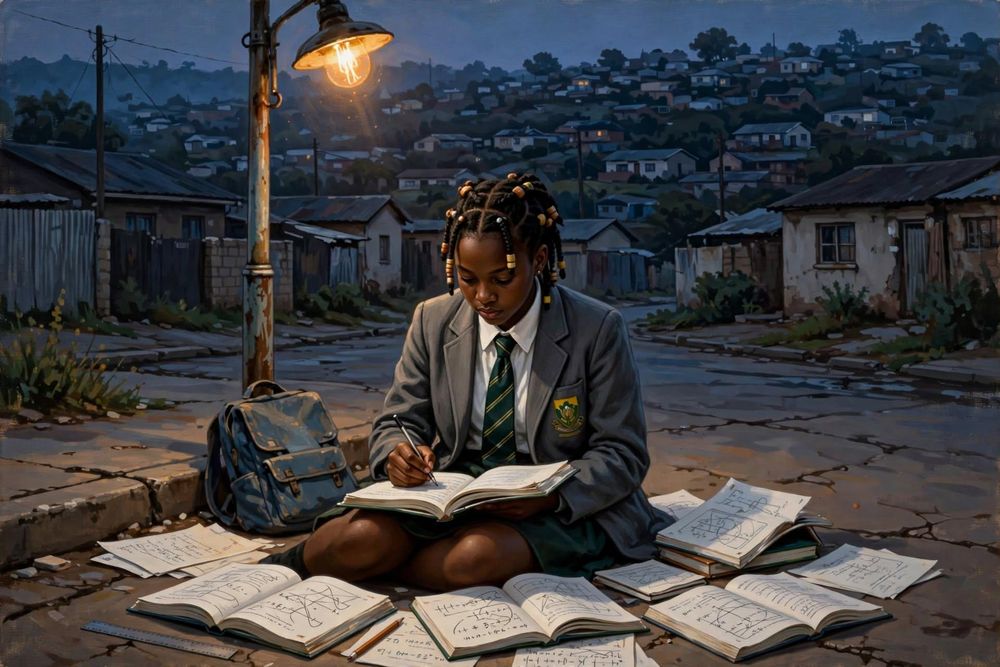
Thato Dlamini sits beneath a streetlight in Umlazi, KZN. Her Grade 12 textbooks are spread across the pavement, her future balanced on her knees. The light flickers. She pauses. It flickers again, then goes out. She does not look surprised. It has been doing this for six months.
At home, there is no dependable electricity. On the street, there is no dependable municipality. Yet somewhere inside a government office, somebody has approved another electricity increase.
Living in South Africa can be brutal. Receiving a higher electricity bill while sitting in the dark contains the entire national scandal in one envelope. Government bullies taxpayers into submission. It budgets for corruption and spends without discipline. It delivers almost nothing, then forces citizens to pay twice for services their taxes were meant to provide.
The girl beneath the dead streetlight is not merely struggling to finish her homework. She is studying under the wreckage of a broken social contract. Her family pays taxes, electricity tariffs, and municipal charges. Yet she must borrow light from the pole on the pavement to prepare for a future the state repeatedly tells her is important. This is no longer simply a cost-of-living crisis. It is the cost of surviving government failure.
The official numbers offer what economists call relief. Consumer inflation declined from 5% in June to 4.3% in July 2026. But inflation falling does not mean prices are falling, it means prices are rising more slowly. The distinction is clear to statisticians and useless to the mother whose grocery trolley grows emptier each month.
The rand strengthened to approximately R15.93 against the dollar on 25 August, considerably better than the R19.93 low recorded in April 2025. A stronger rand should restrain the cost of imported fuel, machinery, medicines, and food inputs. Yet relief takes the scenic route to the consumer. Increases arrive like express mail. Reductions travel by municipal post.
Fuel illustrates the absurdity. Petrol fell by 52 cents a litre in August, but diesel rose by as much as R1.38. Diesel moves South Africa. It powers trucks, farms, generators, and parts of the industrial economy. When diesel rises, it does not remain politely at the filling station, it enters the price of bread, vegetables, building materials, and almost everything transported by road.
South Africa imports much of its crude oil and refined fuel. The US-Iran conflict and disruption around the Strait of Hormuz sent energy costs sharply higher earlier in 2026. Global oil prices have since retreated, but volatility remains. The country is consequently running a sophisticated economy on an energy price largely determined elsewhere, transported through vulnerable supply routes, and magnified by domestic taxes, levies, and logistical failures.
Then comes the quieter theft: shrinkflation.
The bottle remains familiar. The label retains its cheerful colours. The price looks only slightly more offensive. But the contents have been reduced. A 750ml product becomes 600ml. A packet loses fifty grams. A roll becomes shorter. Consumers are not always charged more money, sometimes they are sold less reality.
Shrinkflation is not automatically dishonest if the quantity is clearly disclosed. Yet it exploits human habit: people recognise the package before reading the measurement. The law may be satisfied by small print while the spirit of fair dealing is buried beneath it.
Government should require prominent front-of-package notices whenever a product's quantity is reduced without a comparable price reduction. "NEW SIZE" should not be whispered near the barcode. It should be printed where the missing contents used to be. Yet groceries are merely the first layer of the burden.
South Africans pay tax and then purchase substitutes for government. They pay private security because policing is inadequate. They buy inverters because electricity is uncertain. They install water tanks because municipal supply cannot be trusted. They pay medical-aid contributions because the public health system frightens them. They repair vehicles damaged by roads financed through rates, fuel levies, and taxation.
This is taxation by duplication. The citizen pays once for the promise and again for the service.
Prime lending remains at 10.5%. For households carrying bonds, vehicle finance, credit cards, and personal loans, that rate is not an abstraction discussed by monetary-policy committees. It is the difference between remaining solvent and joining the growing congregation of people who are one emergency away from financial collapse.
Meanwhile, official unemployment reached 33.6% in the second quarter of 2026. Some 8.5 million people were unemployed. Among those aged 15 to 24, unemployment previously stood above 60%. South Africa is raising a generation for whom adulthood arrives before opportunity.
An unemployed young person does not merely lose income. He loses routine, confidence, professional formation, and often hope. Eventually the economy loses his productive years. A country cannot place millions of young people in history's waiting room and expect them to remain quiet forever.
Manufacturing should provide one of the exits. Instead, South Africa is allowing its industrial base to be slowly converted into a showroom for other nations.
Imported vehicles accounted for roughly 64% of domestic sales, while local automotive content remained near 39%, far below the 60% ambition. Twelve automotive businesses reportedly closed and more than 4,000 jobs disappeared over two years. Chinese brands are not the sole cause. India remains a major source of affordable imported cars, while weak demand, electricity costs, port inefficiency, labour instability, and American tariffs also wound the industry.
The answer is not crude isolationism. Consumers deserve affordable cars, and competition can force complacent local producers to improve. But market access must carry industrial obligations. A foreign manufacturer seeking a substantial share of the South African market should be required, over a reasonable period, to assemble locally, source components locally, train artisans, and establish serious after-sales support.
If you want South African customers, bring South African jobs. Other countries already practise versions of this bargain. India links market access and incentives to local production. Morocco built automotive industrial zones around ports, training, and supplier networks. Thailand used coherent industrial policy to become a regional vehicle-manufacturing centre. South Africa possesses workers, engineering experience, and access to African markets. What it lacks is patient coordination.
Trade unions must form part of that settlement. Organised labour remains essential in a country where workers can be exploited. But protection cannot become impunity. Where violence or destruction is proven, the perpetrators must be prosecuted. Where a union authorised, encouraged, or negligently failed to control unlawful action, liability should follow through established law and evidence. Collective bargaining is a democratic right. Burning infrastructure is not bargaining. It is economic self-harm wearing a political T-shirt.
Business conduct also requires reform. Too many South African transactions appear to end when the payment clears. Motor dealerships become charming before the sale and theological afterwards: they believe the problem will resolve itself through faith. Contractors vanish. Warranties acquire previously undiscovered exclusions. Insurers sometimes turn legitimate assessment into an obstacle course.
The National Financial Ombud recovered R442.9 million for consumers in 2025. Declined claims remain a leading source of complaints in parts of the insurance industry. This does not prove that every rejected claim is improper. It proves that the imbalance of power between institutions and individuals requires an accessible referee.
A consumer-protection state should publish complaint and resolution tables by company, impose enforceable repair deadlines, and penalise repeat offenders. Markets need trust. Without it, every transaction carries an unofficial anxiety tax.
Corruption imposes another tax. Money is stolen, investigators are appointed, commissions are convened, lawyers are briefed, prosecutions drag on, and the public pays at every stage. The original theft is followed by an expensive national performance about discovering who stole it. Justice delayed then becomes corruption's pension plan.
SARS stands out because it can still collect efficiently. It collected net revenue of approximately R1.855 trillion in 2024/25 and has maintained strong audit outcomes. Yet SARS is efficient at the entrance to the Treasury. The crisis occurs at the exits. Government knows how to collect money with digital precision and lose its value through analogue incompetence.
South Africa also has 18 parties represented in the National Assembly. Political variety is not itself a defect. Multiparty democracies can govern successfully when coalitions rest on enforceable agreements, fiscal discipline, and a limited common programme. South Africa's problem is the multiplication of political shops, each selling a fragment of salvation while the national roof collapses.
We do not need one lion ruling without restraint. Nor do we need a hundred rats consuming the pantry. We need institutions stronger than personalities.
The solution is not another summit, slogan, or commission. It is a national production compact: stable energy, functioning railways and ports, industrial zones, apprenticeships, localisation targets, conditional investment incentives, consumer protection, and swift commercial justice.
Without these reforms, the stronger rand will provide only temporary relief. Fuel may decline and rise again. Inflation may soften while families grow poorer. Imported goods will fill the shelves while local factories empty.
A nation does not become prosperous because its people can buy what other countries manufacture. It becomes prosperous when its people possess the skills, capital, and factories to make what the world wishes to buy.
South Africa is remarkably good at charging its citizens for survival. It must now learn the more difficult business of helping them live.
Reverend Lionel Jean Michel is a Johannesburg-based journalist, thought leader, and communications strategist.