The photocopywala who took on three global publishers, and won
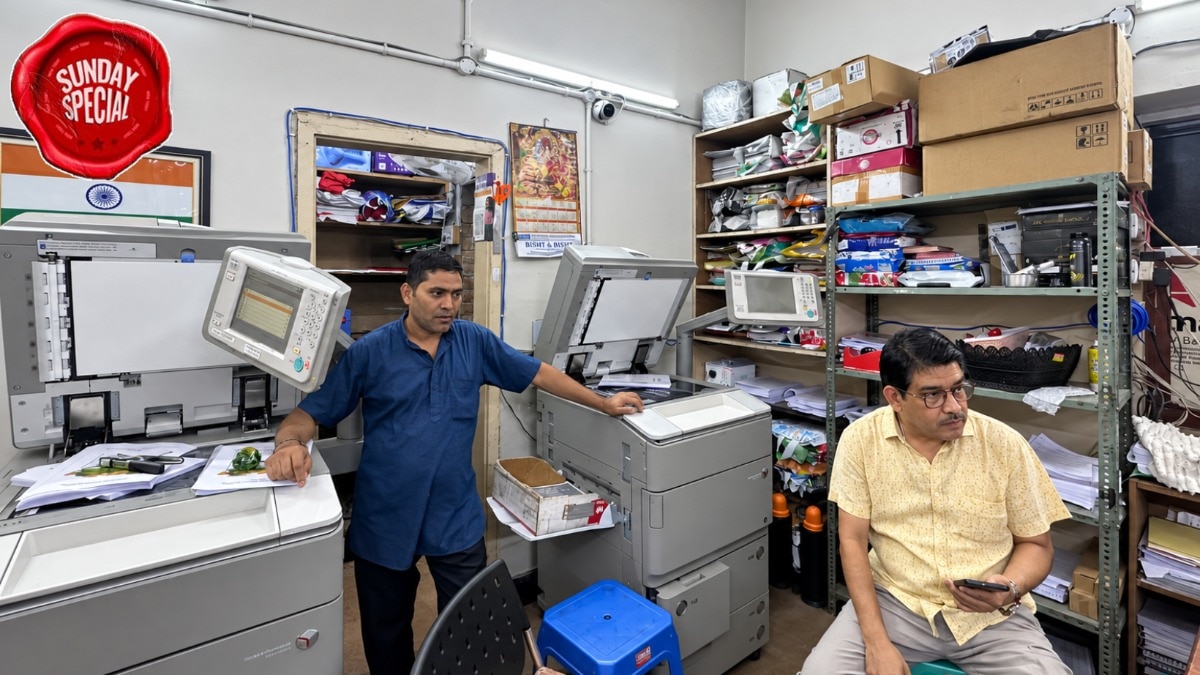
The machines are still running at Rameshwari Photocopy Service, tucked inside Delhi University's School of Economics. Students come in with reading lists, hand over their pages and wait for them to be copied and bound.
Behind the counter sits Dharampal Singh, who has spent most of his working life in this shop. It is a modest place, but it once became the centre of a four-year legal battle involving Oxford University Press, Cambridge University Press and Taylor & Francis.
Sitting in the same premises where lawyers and court-appointed commissioners arrived in 2012, Singh remembers the fear that followed. "There were many times when I felt that perhaps I might even have to go to jail," he tells us during the hour-long interaction.
He had never stepped inside a courtroom before the case. He worried about his children, his workers and the small business that paid his family’s bills. Singh had never imagined that photocopying academic material could bring three global publishing houses to his door.
What began as a dispute over course packs would force a small shopkeeper to confront a question much larger than his business: who gets to access knowledge when the books containing it cost thousands of rupees? Rameshwaram Photocopy Service at Delhi University. A decade ago, it was a small shop with a couple of photocopy machines. (Image: Author) IT STARTED WITH A SMALL SHOP AND A SIMPLE IDEARameshwari Photocopy Service wasn't established to challenge the publishing industry. Singh’s father started the shop in 1998, after working as a Delhi University employee. He gradually took over its operations, learning the rhythms of a business that depended on the university around it.
Students came in with documents, teachers brought reading lists, and the machines ran through the day. Then came the course packs.
Teachers would give the shop chapters or extracts from different books. Singh and his staff would locate the material, photocopy the required pages and bind them into a single volume. It was a practical solution to a practical problem.
Students did not have to keep returning to the shop for individual readings. Teachers could give them the materials required for an entire course in one bundle. At the time, Singh charged only a few paisa per photocopy. The price was deliberately modest. When the shop began making course packs, Singh said, it charged 30 paise per side. By the time the legal dispute began, the price had risen to 50 paise per copy.
For students, the shop soon became a dependable part of academic life at the Delhi School of Economics (DSE).
Rishi Kumar, who completed his MA in economics from DSE in 2017, remembers that the shop seemed to know what students would need even before they arrived.
"Back then, it was a small shop with two or three photocopying machines. The shop usually knew which readings were required for each semester," Kumar told India Today Digital. The shop would source books from the library and photocopy the required sections. Sometimes, professors would hand out the material just before morning classes, and students would rush to get it copied before the lecture.
The shop also drew students from across North Campus, particularly those studying economics honours. Kumar recalls that, at the time, such course material was difficult to find elsewhere. "Such material was only available either at the SRCC shop or at the one in the DSE," he said.
That early access to reading lists was perhaps what made the shop so central to student life. Kumar believes the economics curriculum for Delhi University colleges was largely shaped at DSE, with the head of its economics department chairing the meetings. "That might explain how the shop obtained the reading lists and book lists early, and why students expected the required material to be available there," he said.
For Kumar, the relationship with the shop was straightforward. "As an economics student, I had this idea that if I needed a book or reading, I would get it from the DSE photocopy shop."
For Singh, however, it was simply a small business keeping pace with a busy university. The machines ran, students queued up, course packs were assembled and handed over. Nothing about it suggested that the shop was about to become the centre of a legal battle involving three of the world's biggest academic publishers.
Then the lawyers arrived. Rameshwaram Photocopy Service today. Its owner, Dharampal Singh, fought a four-year legal battle against three big publishers. (Image: Author) 'WHY WOULD SUCH BIG PUBLISHERS RAID US?'
Singh remembers receiving a warning before the raid.
A lawyer friend at the Delhi High Court told him that some major publishers were planning action against the shop. His first reaction was disbelief. “I said, ‘Yaar, we are such small people. Why would such big publishers raid us?’”
Lawyers arrived with court-appointed commissioners and a court order. The shop was searched. Material alleged to infringe copyright was collected and placed into three sealed sacks.
For Singh, the shock was immediate. He had never imagined that photocopying academic material could put his business in the crosshairs of international publishing companies.
The following morning, the shop was almost empty.
Students stopped coming. Singh and his staff were afraid to provide the course material. “For about a week, there was no work in our shop,” he recalls.
For the first time since he had begun running the business, Singh did not know whether the shop would survive.THE RS 65 LAKH THREAT BY PUBLISHING GIANTS
The publishers had filed a case against his shop, seeking to stop the photocopying and distribution of copyrighted academic material. They also claimed losses of Rs 65 lakh.
For Singh, that figure was enormous. This was not a corporation absorbing a legal bill as a cost of doing business. This was the man whose income paid his family's bills.
His children were in school. His workers depended on the shop. During the four years that followed, he says there were times when he could not pay salaries on time.
"During those four years, the court expenses and the loss of business were major personal challenges for me," he says. "My children were also in school at the time, and our bread and butter depended on this work."
That mattered to Singh. The shop had become more than a workplace. It was the source of livelihood for several families.THE STUDENTS REFUSE TO STAY OUT OF IT
The legal battle might have remained a dispute between three publishers, a photocopy shop and a university.
But the students would not let it. For them, the course packs were not simply cheap alternatives to textbooks. They were often the only realistic way to complete their readings.
Some courses required material from dozens of books. Buying every title could cost tens of thousands of rupees. Libraries had limited copies, and some books were rare or difficult to obtain.
Students began organising around the case.
They approached lawyers. They sought to become parties to the proceedings. They appeared in court and stood behind the shop.
For Singh, who had entered the courtroom feeling like a complete outsider, their presence became a source of strength.
"During the court proceedings, students would come to show their support," he says. "Mentally and morally, they contributed a lot."
An unlikely support system had formed around the photocopy shop: students, lawyers, university representatives, workers and Singh's family.LEARNING TO LIVE IN THE COURTROOM
In the beginning, Singh found the court terrifying.
He had no experience of legal proceedings. He did not understand the language or the rituals of the courtroom. He would sit there wondering what would happen next.
"Going to court for the first time, especially for someone who had never even entered a courtroom, was a very big thing," he says. A friend would accompany him. Students would often be there too. Slowly, the courtroom became part of his routine.
The fear never completely disappeared, but Singh began to understand what was at stake. The publishers, he says, wanted the case to become a test case. If they succeeded, he feared it could make academic photocopying much harder across India.
That was when the case stopped being, in his mind, merely about his shop. He could have tried to settle the matter and walk away, but he chose not to.
"If we had accepted our mistake at that time or given in to their pressure, things would have become even worse for us," he says. Rameshwaram Photocopy Service fought the legal battle not just for survival, but for the right to academic photocopying in India. (Image: Author)
Singh is not a copyright lawyer. He is not an academic publisher. He does not speak the language of intellectual-property law with the ease of the lawyers who appeared before the court. But he understood the problem he saw every day at his counter. Students needed books. Many could not afford them. A single academic textbook could cost thousands of rupees. Some were available only in expensive hardback editions. Others were difficult to find.
And the students walking into his shop were not all from wealthy families. “A lot of students at the university also come from very disadvantaged backgrounds,” he says.
His argument was simple, if education required students to read material they could not realistically afford to buy, the course pack filled a gap.
That argument would eventually become central to the legal battle.FOUR YEARS LATER, THE SHOP STILL STANDS
On September 16, 2016, Justice Rajiv Sahai Endlaw dismissed the publishers’ suit. The publishers appealed. In December that year, a two-judge bench of the Delhi High Court upheld the educational-use principle at the heart of the dispute.
The publishers subsequently withdrew from the case. For Singh, there was no dramatic transformation afterwards. No sudden fame. No grand office. No corporate victory celebration.
There was simply his shop, the machines kept running, the workers remained, and most importantly, the students returned.THE PHOTOCOPYWALA ON CHANGING CAMPUS
More than a decade after the case began, students at the Delhi School of Economics still use course packs. Digital reading has changed how students access information, but physical copies remain important. For many, the economics have not changed enough.
One student describes original academic books costing thousands of rupees, while a course pack containing the required readings is priced at a few hundred. That price difference is why Singh's shop continues to have customers.
For Kamit, a second-year MA Economics student, the case is something he first encountered in a classroom. A professor mentioned it during a course on law and economics. But the reason the shop continues to matter to students is far more immediate: the cost of textbooks.
"Most students here buy course packs because the original books are simply too expensive," he says. A single reading can cost around Rs 10,000, while a course pack may draw from five books. "That could mean Rs 50,000 just for the original books. Photocopying makes the material affordable."
Even as digital copies have become more common, Kamit says, many students still prefer paper. "It is easier to annotate and make notes. I would say 99 per cent of students here rely on photocopied material."
But for students, the question goes beyond convenience to one of affordability — and who gets left out when study material becomes too expensive.
For Khushi, a final-year MA Economics student, the issue is also about the financial pressure on students and their families. She has been buying course packs from the shop since her undergraduate years.
"Many students here come from outside Delhi and already spend heavily on private hostels. Add the cost of textbooks and study material, and it becomes difficult even for middle-class families," she says. "I have often felt that I don't want to burden my parents further after they have paid my fees. Affordable photocopies make it possible for students from different economic backgrounds to access the same course material."
And perhaps that is the strangest part of his story. The man who once wondered why three publishing giants would bother with his tiny shop is still doing what he was doing before the lawyers arrived. Making copies, binding course packs, serving students, running a small business.
"I never set out to become a symbol," Singh tells us. He did not set out to fight the publishing industry. He did not start his shop to become a test case. He certainly did not expect to spend four years in court.
He was a shopkeeper whose father had started a business at Delhi University. Then one day, three publishing giants came after that business. He was scared. He worried about jail. He worried about his children's education. He struggled to pay his workers. He watched his business suffer.
And still, he went back to court. Perhaps that is what makes Singh's story larger than the copyright dispute itself.- EndsPublished By: vaishnavi parasharPublished On: Sep 13, 2026 07:00 IST