The Scandal review: Ji Chang-wook, Son Ye-jin and Nana thrive in the grey
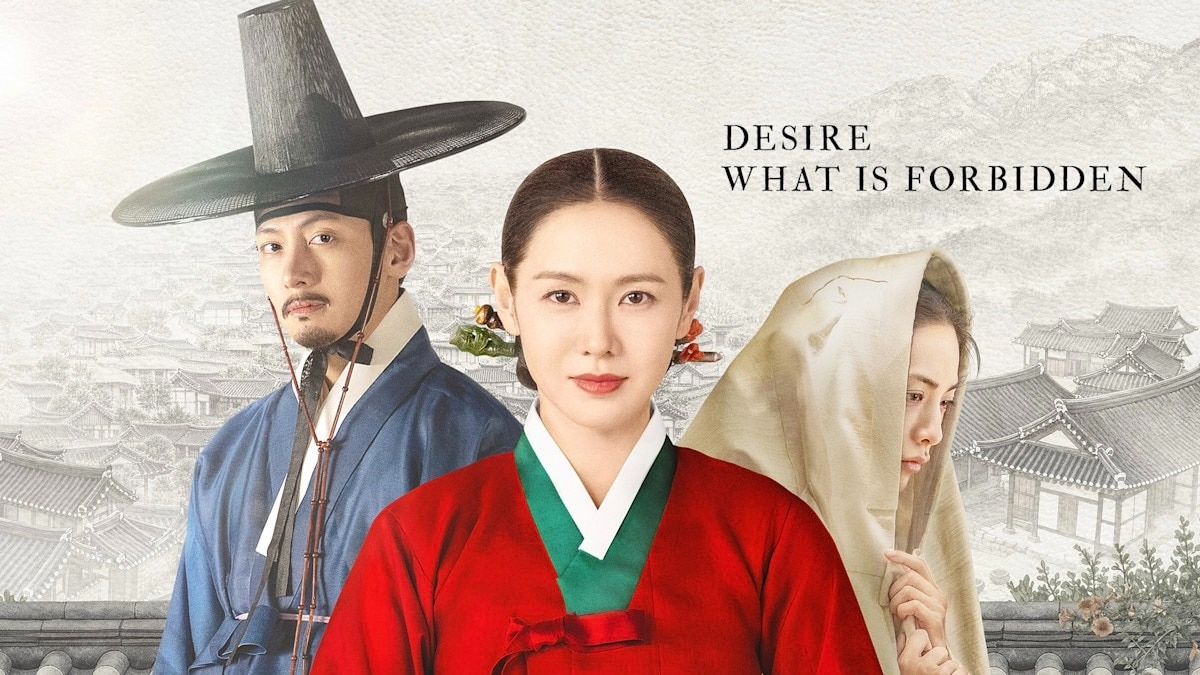
In Joseon, desire was rarely a private matter. What you wanted, whom you wanted and, more importantly, whether you were allowed to want at all could determine the course of your life. The Scandal takes that contradiction and turns it into an eight-episode game of seduction, manipulation and, eventually emotions catch up.
The eight-episode Netflix series follows Lady Cho (Son Ye-jin), an intelligent noblewoman frustrated by the restrictions placed on women, and Cho Won (Ji Chang-wook), a celebrated playboy who treats romance as sport. The two make a wager: Cho Won must seduce Hui-yeon (Nana), a young widow determined to remain chaste. What begins as a game of manipulation soon becomes considerably harder to control when feelings enter a situation designed to leave no room for them. Directed by Jung Ji-woo, the series is based on the 2003 Korean film Untold Scandal, itself inspired by Pierre Choderlos de Laclos’ Dangerous Liaisons.
For a period drama built around temptation, The Scandal is remarkably uninterested in making its Joseon setting feel like homework. The social restrictions matter, but they never become an excuse for the plot to drag itself through layers of historical exposition. The first episode establishes the wager, the stakes and the personalities involved, and from there the series largely trusts its central game to carry the story. There are occasional dips in tempo, but the eight-episode structure keeps the narrative focused and prevents the period setting from becoming unnecessarily cumbersome.
What makes the show particularly watchable is how well it understands its central trio.
Ji Chang-wook has always had a useful ability to move between genres without making the transition look like work, and Cho Won gives him another opportunity to demonstrate that range. He can be flirtatious one moment, almost boyishly charming the next, and then let desperation, anger or despair surface with barely a change in expression. Much of the character’s emotional turmoil happens in his eyes. There is a scene towards the end where his silence lingers longer than any dialogue could have, and it is a reminder of how much an actor can communicate by simply refusing to explain himself.
Son Ye-jin is equally compelling, particularly because Lady Cho is never allowed to settle comfortably into either victim or manipulator. She wants attention, validation and control, but she is also acutely aware of the limitations imposed on her. Son plays that contradiction beautifully. There is calculation in her gaze, but also loneliness. Her Lady Cho can manipulate a room without raising her voice, which makes her more interesting than the conventional schemer who announces every move.
Then there is Nana, who gives Hui-yeon a quiet vulnerability that prevents her from becoming merely the innocent pawn in someone else’s game. She is being toyed with, but Nana plays her as a woman with her own desires and emotional agency. The character’s gradual awakening is one of the show’s more affecting threads.
The chemistry between the three is where The Scandal finds its pulse. The relationship between Cho Won and Hui-yeon, in particular, carries an appealing push and pull: attraction mixed with distrust, curiosity mixed with the knowledge that something about the entire situation is fundamentally wrong.
Jung Ji-woo’s direction makes physicality another language. The camera pays attention to hands, glances, distance and touch, often allowing intimacy to exist without turning it into spectacle. Some of the show’s boldest sequences are also among its most carefully composed. Desire is not treated as inherently shameful; the scandal lies in the rules surrounding it.
And yet, for a show called The Scandal, one does occasionally wonder whether it could have been more scandalous. For all its sensuality, The Scandal occasionally feels as though it has carefully calculated the boundary it will not cross. Given the premise — and the source material’s reputation — there are moments when you expect the show to be considerably more reckless. Netflix plays it relatively safe when the title itself promises the opposite.
Yet that restraint does not diminish the central appeal. The show’s best trick is using the rigid social structure of Joseon to make its characters’ desires feel simultaneously dangerous and absurd. A bet that might seem merely mischievous in another setting becomes genuinely consequential when reputation, gender and social standing are all at stake.
The performances, particularly from its central trio, keep that question alive. The colours, production design and sensual visual grammar give the series an appropriately heightened world, while its refusal to lose sight of its three characters prevents the spectacle from taking over.
The Scandal may not be quite as outrageous as its title promises, but it is beautifully mounted, intelligently performed and anchored by three actors who understand exactly how much can be said without saying it.
The Scandal is streaming on Netflix.- EndsPublished By: Anurag BohraPublished On: Sep 19, 2026 00:00 IST