The Snowbirds are making their last flights over Toronto. Why the air show will be a bittersweet ‘ballet in the sky’ - Toronto Star
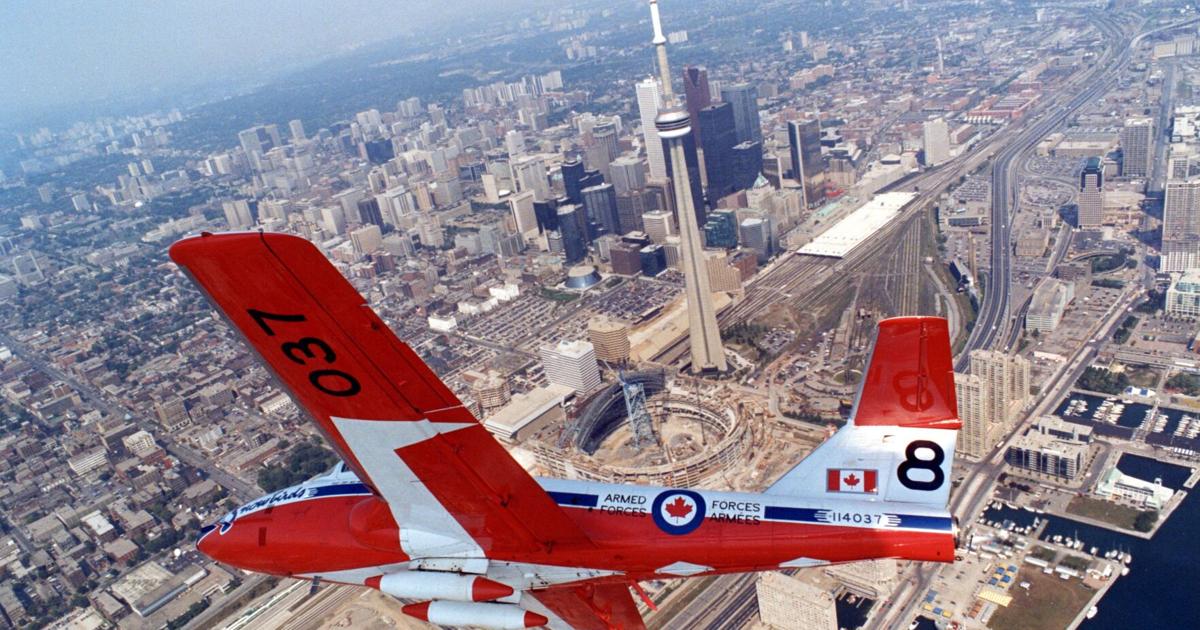
Labour Day weekend will be the last chance for GTA residents to catch this version of the Snowbirds, set to be grounded.
Sept. 1, 1988. The Snowbirds first appeared at the Toronto air show in 1971 — the same year they were formed — and have only missed one year since.
It starts with the twinkle of nine lights on the distant horizon. Then comes the staccato radio check-in by the pilots, one through nine.
“Smoke on,” commands the team lead.
For 55 years, the Snowbirds — Canada’s air demonstration team — have brought their graceful aerial performances to North American skies, some 2,700 air displays in all for more than 140 million people.
This Labour Day weekend, the team will once more headline the Canadian International Air Show along Toronto’s waterfront for a performance that promises to be memorable — and bittersweet.
That’s because the curtain is closing on the Snowbirds, at least this version of the team.
Time has caught up with the team’s aircraft, the venerable CT-114 Tutor jet, which is now approaching 60-plus years of service.
Despite the miracles worked by air force technicians, the federal government has decided it’s no longer feasible to keep the aging aircraft serviceable. It has declared that the Snowbirds will stop flying until a replacement aircraft is ready in the early 2030s.
Sept. 1, 1973. A rehearsal over the waterfront.
The grounding ends a remarkable run. The Snowbirds first appeared at the Toronto air show in 1971 — the same year they were formed — and have only missed one year since.
“They are absolutely what holds our show together,” Lori Duthie, executive director of the Canadian International Air Show, said in an interview. “Everybody looks forward to it.”
From their base in Moose Jaw, Sask., the Snowbirds — officially known as the 431 Air Demonstration Squadron — criss-cross the continent to perform at venues big and small, from mega-air shows to summer fairs, small-town displays and ceremonial fly-pasts. They dazzle spectators with their looping, rolling aerobatic display.
The U.S. demonstration teams Blue Angels and Thunderbirds, which fly front-line fighters, are impressive, but different. The Snowbirds’ Tutor jet is an older-generation trainer. It’s slower, even a little underpowered for its air show role.
But that’s a big part of what makes their performances so enjoyable. “The fact that they can go a little bit slower allows them to get closer,” Duthie said. “Having nine jets versus six certainly gives them a lot more variety than some of the faster jet teams.
“It looks like a ballet in the sky, something that you just can’t achieve with some of the other demo teams. It’s not just jets shooting across the sky from left to right.”
Sept. 6, 2009. The Snowbirds, a.k.a. 431 Squadron, fly their Canadair CT-114 Tutors at the air show.
Thirty years ago, I flew with Dan Robinson, Snowbird 4, the first line astern position. It was a memorable flight, with Snowbird jets filling the view on either side and ahead that at times were barely a metre away. Our formation of nine jets swooped over the Ontario landscape and made a dramatic pass above Niagara Falls.
I caught up with Robinson last week. He remembers the two seasons he spent with the Snowbirds as the highlight of his flying career.
“It was the first time I’d been all around Canada,” Robinson recalled. “To go and meet people all across the country, all the provinces, all the territories, that’s what stuck with me. To be a part of that is something that I treasure forever.”
From the ground, the formation flying appears effortless as nine planes fly as one.
In the cockpit though, it is hard work, demanding intense concentration as pilots constantly move the stick and throttle to maintain position, battling turbulent air and the wash from the jets around them.
June 13, 1996. Capt. Dan Robinson pilots his Snowbird jet over the GTA. Robinson remembers his two seasons on the team as the highlight of his flying career.
Yet Robinson said that by the time air show season began, flying in tight formation had become second nature, thanks to months of practice in Prairie skies.
“It’s building blocks,” he said. “You start flying wider formations, then you get in tighter. You don’t do the big formations until you’ve done the smaller formations.
“You never lose your edge, but at the same time what seems impossible to people on the ground is actually something that you’ve worked your way to. It’s not unsafe.”
But there have been sad reminders that it’s not without risk, including a dark day at the 1989 Toronto air show.
Thousands of spectators, including myself, watched in disbelief when two Snowbird jets collided during a manoeuvre. One piloted by Capt. Shane Antaya plunged straight into the lake. Team leader Maj. Dan Dempsey managed to eject from his aircraft before it, too, tumbled into the water.
Sept. 3, 1989. The pilot of this Snowbird ejected moments before it crashed in Lake Ontario.
Over the team’s history, eight Snowbird members along with a passenger have been killed in flying accidents and another Snowbird pilot was killed in a car accident following a show.
This day of reckoning for the Snowbirds was not unexpected. For years, questions have been raised about the age of the Tutor, which served as the jet trainer for the Air Force from 1963 to 2000, and the pressing need for a replacement aircraft.
But decisions were kicked down the road. And now, the federal government has decided to ground the team even though a replacement aircraft is still years away. While some $30 million was recently spent on avionics upgrades to the Tutor jets, the Defence Department says “engineering challenges” with the airframes, engines and escape systems pushed the decision.
Supporters aren’t letting the team go without a fight.
The Snowbirds Alumni Association has launched a “No Pause” campaign to press Ottawa to keep the team in the air.
It says the “meticulously monitored and maintained” Tutor jets are “perfectly capable” of flying until 2030. The association is recommending a reduced seven-plane formation for a “seamless transition” to the new aircraft — the Swiss-made CT-157 Siskin II turboprop aircraft — by 2031.
Cpl. Marc Belhumeur cleans one of the Tutor jets with Windex just after landing at Pearson in preparation for the show.
“In an era of political upheaval and discontent, the Snowbirds are more important than ever as symbols of Canadian pride and patriotism for the world to see,” the association said in a Facebook post.
Robinson himself appears in a video on social media for Alberta’s Bomber Command Museum of Canada, which has joined an advocacy campaign urging people to contact Prime Minister Mark Carney and federal politicians to keep the team flying.
In the video, he describes the Snowbirds as a “well-oiled, well-maintained championship team.
“Now, you don’t tell a Stanley Cup team, for example, to hang up the skates for five years and expect to come back and play playoff-level hockey ... just like nothing happened,” he said. “Same thing goes for the Snowbirds. Corporate knowledge is lost and safety is affected.”
For now the Snowbirds are counting down the final few shows. Currently, their last Canadian show is Sept. 18-20 in Gatineau, Que., and their final show of the season is Oct. 11 in Sacramento, Calif.
That means the upcoming Labour Day weekend shows are the last chance for Greater Toronto residents to catch this version of the Snowbirds.
For many, the team is a symbol of Canadian pride when flying in Canadian and American skies.
“It’s not just air shows,” Duthie said. “They don’t just appeal to aviation fans. I think they are one of our very few representations of Canada that bonds us all together.”
To honour that legacy, Toronto air show organizers are planning several tributes, including a Canadian Forces Heritage formation flight featuring a CF-18 fighter jet, a Spitfire and a Hurricane from the Second World War, and a Tutor.
But the Snowbirds’ final pass along the Toronto waterfront, smoke trails left hanging in the sky, will be poignant for many.
Aug. 30, 2003: Air show fans enjoy the day’s traditional closing act.
Bruce Campion-Smith is a former Toronto Star reporter and editor who held a commercial pilot licence and has flown with multiple air show performers, including the U.S. Air Force Thunderbirds and two rides with the Snowbirds.
The photo caption accompanying the two planes flying over Niagara Falls was updated to note that the file photo is from 1997.
Opinion articles are based on the author’s interpretations and judgments of facts, data and events. More details