
The story of the iconic 1,212-pillar temple corridor that framed the Modi-Xi handshake - The Indian Express
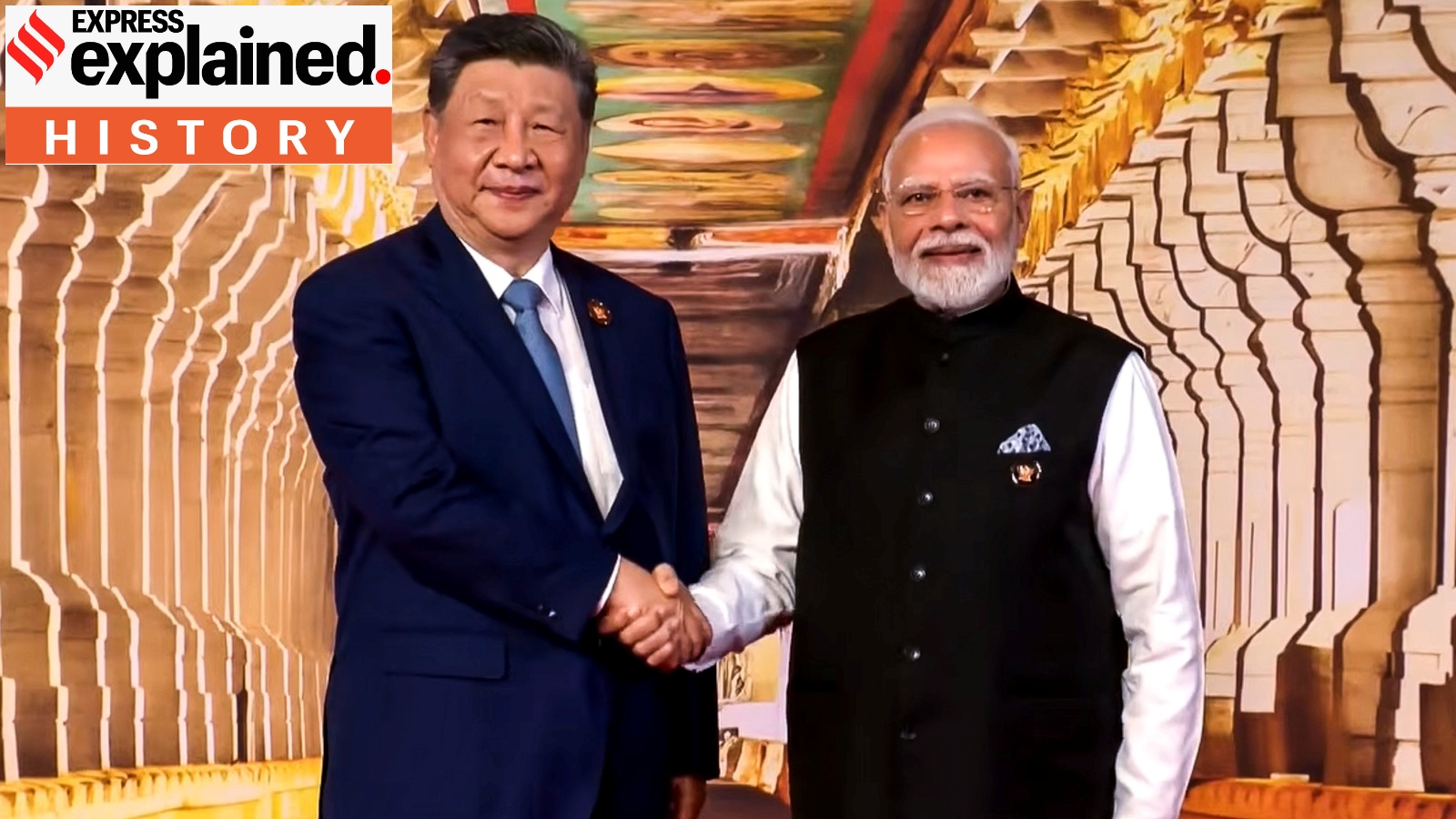
At the 2026 BRICS Summit, Prime Minister Narendra Modi and Chinese President Xi Jinping were seen shaking hands in front of a high-quality projection of the 1,212-pillar corridor from Tamil Nadu’s Ramanathswamy temple in Ramanathapuram district.
Tamil Nadu is also the state where Modi and Xi last met in India in October 2019. In one of their photographs from Saturday (September 12), Modi appears to be describing the corridor to Xi.
While it is unclear why the backdrop was chosen, the temple as well as its corridor hold deep significance. The corridor itself is an iconic motif, thanks to the visual depth it creates. Here’s what to know about both.
The Ramanthswamy temple is located in the town of Rameswaram on Pamban Island. Henry Hardy Cole (1843-1916), a superintendent for the Archaeological Survey of India, noted in an 1885 report that the temple in its current form was rebuilt in the 17th century after repeated sackings over the centuries before.
Traditionally, the temple is an important religious site and is counted among the 12 jyotirlingas — a series of shrines across the country dedicated to Shiva.
The temple’s history, however, is said to span back much farther than the 17th century.
Lord Ram is believed to have worshipped Lord Shiva at the site upon his return from Lanka. The Sethupathi rulers of Ramanathapuram were particularly important in shaping its present form.
The temple’s third (and outermost corridor) — the one with the thousand-plus pillars — was a feature added much later to the original structure.
The temple’s famous outer corridor is largely credited to the 18th-century ruler Muthuramalinga Sethupathi — the zamindar of the Ramnad estate. The corridor contains 1,212 pillars that rise to approximately 6.9 metres. The combined length of the temple’s corridors is commonly cited as about 3,850 feet, roughly 1.17 km. It is unclear why those exact number of pillars were decided upon.
The corridor is constructed as a sequence of stone columns that stand on raised platforms. These platforms support the beams and continuous roof of the structure. The pillars are not, however, simply a functional addition.
Each pillar is carved and ornamented individually. The sculptural detailing includes floral motifs — a pattern imprinted on a surface — as well as figures of mythical creatures.
The rows of pillars also present a striking visual as they appear to recede towards a single point in the distance. The similar-looking brown moves farther away and appears as if it is getting progressively smaller as their parallel lines converge in the distance.
Each pillar supports the beams and roof above it while also fitting into a carefully organised grid. The columns, capitals, brackets and beams had to work together structurally, while their ornamentation had to maintain the visual language of the temple.
Visually, the effect is straightforward yet mesmerising. Though the individual units are repetitive, they collectively lend a changing spatial view to the corridor. Functionally, it is also built as something that is meant to be walked in instead of being simply admired from a distance.
This is also why the image chosen for the BRICS backdrop is particularly recognisable. The repeated columns create immediate depth on a screen, while the enormous scale and distinctive Dravidian architecture identify the image.
The Ramanathaswamy Temple is not famous merely because it has 1,212 pillars. It represents the culmination of centuries of temple-building traditions.
Its religious association with Rama and Shiva gives the site its sacred importance while its corridors demonstrate how the sacred space was transformed into monumental architecture.
In the image of Modi and Xi, the corridor consequently places a diplomatic encounter against an architectural tradition in which scale, symmetry, repetition, and movement were used to turn stone into an experience of space.


