
The Villafuertes of CamSur: A tale of political survival and reinvention - Rappler
Already have Rappler+? Sign in to listen to groundbreaking journalism.
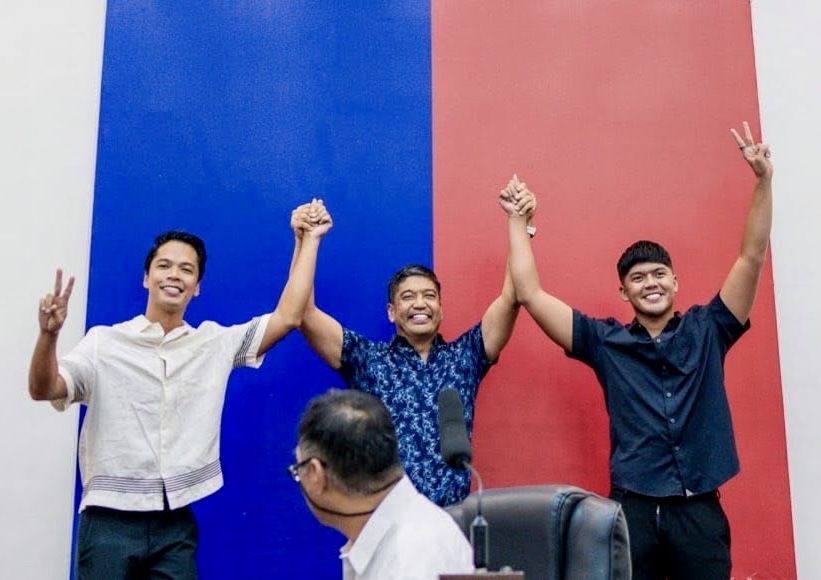
FAMILY DOMINATION. Migz (left), LRay (center), and Luigi Villafuerte (right) pose following their official proclamation in May 2025, securing a sweep in Camarines Sur during the 2025 midterm elections.
Photo courtesy of Luigi Villafuerte's Facebook page.
This is AI-generated. Read the article for full context. Report any errors.
Editor’s note: This is part of a Rappler series on Filipino families that have held political power for generations. The series traces how they built their influence, where it is strongest, and how it has endured over time. Each profile examines family ties, political networks, business interests, and roles in local and national government.
For nearly 40 years, the Villafuertes have kept a generational grip on Camarines Sur (CamSur) in Bicol.
“Ever since I was a child, the Villafuertes have been in control of CamSur, and now that I have a child of my own, they are still the ones in control,” said 28-year-old CamSur voter Adela, who chose not to reveal her real name.
This familiarity is not only because they rule the province. Buildings in their barangay and even relief goods during calamities would bear the family’s name, Adela recalled.
To many residents, CamSur is essentially a “Villafuerte province.”
It is also because clan members constantly make headlines. Over the years, they have figured in well-publicized teleserye-like dramas: from family feuds, celebrity marriages, to political wranglings, and shifting political alliances.
In the 2025 midterm local elections, the dynasty easily maintained its political dominance in the province. For the top executive post, family patriarch LRay Villafuerte reclaimed the gubernatorial seat.
It was definitely a closer fight than what they were used to, but he still beat Bong Rodriguez with a 93,032-vote lead after dominating the polls across four of five districts.
In District 5, his son Migz Villafuerte also swept the vote. Younger brother Luigi Villafuerte also secured a resounding victory in the 2nd District.
The political playing field in the province is so heavily tilted in the favor of the clan, that it would be difficult for anyone to challenge their machine, explained Mary Joyce Bulao, a researcher specializing in local politics. Bulao is also former lecturer and chairperson of the Social Sciences Department at Ateneo de Naga University.
“Villafuerte is at the center and at the top, they have been operating as a provincial political machine, maintaining a structured, hierarchical organization,” Bulao explained in Filipino.
This includes control over municipal mayors, she pointed out in an interview with Rappler. If a mayor is not aligned with them, Bulao said, it typically politicizes the distribution of resources and affects the development of the area.
It all began with Mariano Villafuerte, an orator who served two terms as congressman and became governor in 1942.
Mariano’s son, Luis Sr., who was also known as “gurang” or “old man” in Bikol, governed the province for 15 years across separate terms from 1986 to 1992 and 1995 to 2004.
The senior Luis, who was born in Naga City, used to serve as a Batasang Pambansa assemblyman and trade minister under the late president Ferdinand E. Marcos. However, by 1984 — before the 1986 EDSA People Power Revolution ousted the Marcos regime — he already shifted to the opposition.
Saysay Bikol — a civic organization of historians, educators, and cultural heritage advocates based in Naga City — described Luis Sr.’s political career as possessing “adaptability and patronage” that could “secure long-term power across shifting regimes.”
Under Corazon Aquino’s presidency, Luis Sr. became the secretary of government reorganization. He eventually served as governor of CamSur, initially from 1986–1992 and then from 1995 to 2004.
When he reached his three-term limit in 2004, he vied for and was elected representative of the 2nd District of Camarines Sur, which originally included Naga City.
The senior Luis initially encouraged his nephew, the late DILG secretary and Naga City mayor Jesse Robredo, to enter politics in 1989. But the two eventually had a bitter falling out.
In 1998, his son Luis Raymund (LRay) challenged Robredo for Naga City mayor but lost the contest. LRay eventually vied for the gubernatorial seat. He won and served in this capacity from 2004 to 2010.
Meanwhile, as district representative, Luis Sr. authored House Bill No. 4231 in the 14th Congress prior to the 2010 elections. This resulted in Republic Act No. 9716, which consolidated the municipalities of Libmanan, Minalabac, Pamplona, Pasacao, and San Fernando from the old 1st District with the towns of Gainza and Milaor from the previous 2nd District to create a new 2nd District.
The law increased the province’s districts from four to five.
It was a matter of political exigency. The 1st District was traditionally the domain of the Andaya clan. At the time the law was enacted, then-president Arroyo’s son, Dato Arroyo, was representing the 1st District. Andaya, who served as budget secretary under the Arroyo administration, was set to reclaim the seat.
Arroyo eventually vied for the newly-constituted 2nd District while Luis Sr. was elected congressman of the newly-formed 3rd District.
In the election that followed (2013), LRay ran for the second district, which was created by the law that his father authored. He lost to Dato Arroyo. His mother, Nelly Favis Villafuerte, vied for the same post for the third district also in 2013, and lost to Leni Robredo.
That marked the end of the Villafuerte family’s hold on the 3rd District.
Luis Sr. attempted to reclaim the seat in both the 2016 and 2019 elections, but lost both times to Gabriel Bordado Jr.
After serving three consecutive terms as governor, LRay also managed to secure the 2nd District in 2016, succeeding Dato Arroyo.
After LRay reached his term limit as governor in 2013, his son, Miguel Luis or Migz, entered the scene, taking over from 2013 to 2022. When Migz hit his term limit in 2022, Luigi succeeded him from 2022 to 2025.
By 2025, with their father LRay hitting his own three-term cap in the House, Luigi stepped down from the governorship to run for LRay’s congressional seat. This allowed his father to reclaim the gubernatorial seat and complete a seamless family relay in the political scene.
In the 2013 elections, members of the family figured in a high profile internal feud. Luis Sr. ran directly against his grandson, Migz, in the gubernatorial race.
Mirroring the political survival and alliance-shifting that defined his career, Luis Sr. broke away from his family and teamed up with other influential local political families.
Many locals suspected that the public fight was merely staged. After all, no matter who turned against whom, the position remained safely in the hands of their dynasty.
Beyond family drama, the brothers Migz and Luigi actively pursued controversy, celebrity, and high-profile relationships.
LRay himself has figured in numerous viral social media spats.
The book Patronage Democracy in the Philippines: Clans, Clients, and Competition in Local Elections noted that topless pictures of Migz used to circulate online, aiding his popularity among young voters.
His high profile courtship of singer-actress Sarah Geronimo — while he was still serving as CamSur governor — was the subject of gossip columns from 2011 to 2013.
Migz eventually married Miss Universe Philippines 2017 Rachel Peters.
His brother Luigi also recently became engaged to actress Yassi Pressman, who previously endorsed the clan-linked Bicol Saro partylist.
The Villafuertes are also known for actively shaping their own narratives.
LRay, in particular, frequently uses Facebook to defend the clan against criticism.
The Villafuertes also often prioritize highly visible developmental agendas where they can imprint their names, Bulao noted. “Kasi ‘pag nakikita ng tao, tatatak ‘yon, mas mabilis.” (When people see it, they remember, it’s much faster.)
Throughout the province, numerous projects and public buildings bear the dynasty’s name or distinct symbols. For voters like Adela, this is often all it takes. She explained how Luis Sr. made it possible for her barangay’s basketball court to be covered.
Furthermore, a sports complex in Pili is called “Ka Fuerte,” which connects to the family brand: “Serbisyong Ka Fuerte.” The same brand is reiterated in public services such as healthcare assistance programs, mobile clinics, and educational scholarships.
In 2024, during the onslaught of Typhoon Kristine, LRay and Migz were also documented distributing cash directly to residents while navigating flooded areas by boat.
It is a projection of power, Bulao noted. The message is: “Andito ako para tulungan kayo. Ako ‘yong malaking tao na tutulong sa maliit na tao.” (“I am here to help you.” I am the powerful man helping the poor.)
Whether or not that help is the one they need is beside the point. – with reports from Gemma Mendoza/Rappler.com


/file/attachments/orphans/Fikile_746198.jpg)