Thousands of stories of residential school survivors will soon be destroyed. This group is fighting to preserve them - Toronto Star
The 38,000 testimonies are set for destruction next year for privacy reasons. Many survivors are unaware the records are being destroyed.
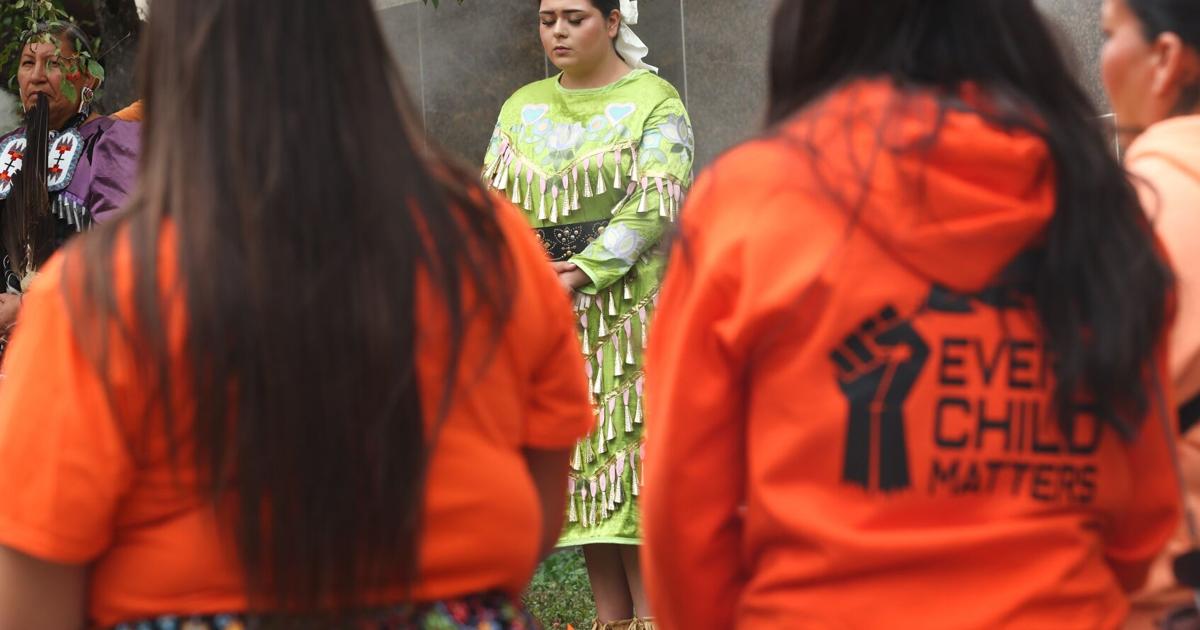
Dozens of students, staff and supporters held a silent memorial walk to mark orange shirt day on the TMU campus in Toronto Wednesday for the National Day for Truth and Reconciliation.
A Toronto-based advocacy group is working to preserve a trove of 38,000 testimonies from residential school survivors that documents some of the worst abuses of Indigenous children.
The Indian Residential School Records Project says it wants to return agency to survivors to decide the fate of their records, which are currently slated for destruction due to a Supreme Court ruling over privacy considerations.
“The records that are set for destruction in 2027 are the most comprehensive archive that exists,” Connie Walker, co-leader of the project, told the Star ahead of a Wednesday panel at Evergreen Brickworks with other leaders of the project. The panel discussion coincided with the National Day for Truth and Reconciliation.
Speaking at a panel Wednesday at Evergreen Brickworks, Connie Walker, co-lead of the Indian Residential School Records Project, talked about the significance of survivor testimony from residential schools.
“Survivors had to disclose in very detailed ways the abuse that they experienced at Indian residential schools,” said Walker, an award-winning investigative journalist and member of the Okanese First Nation in Saskatchewan.
More than 150,000 Indigenous children were taken from their families to attend the schools run by churches and the Canadian government, a scheme the Truth and Reconciliation Commission of Canada (TRC) called “a systematic, government-sponsored attempt to destroy” Indigenous culture and languages.
Operating for more than 150 years until 1997, residential schools were often underfunded, and thousands of children suffered physical and sexual abuse, according to the National Centre for Truth and Reconciliation. Records show 4,200 children died at the schools but incomplete and missing files indicate the total is likely higher.
“The right to truth belongs first to the survivors, their families and their communities,” said project co-lead Kimberly Murray.
Murray is a member of the Kanehsatà:ke Mohawk Nation and is an independent special interlocutor for missing children and unmarked graves and burial sites associated with residential schools.
“Survivors themselves must determine what happens to their testimony … we’re hearing that survivors don’t even know that these records are being destroyed in less than a year,” said Murray.
In the 1980s, ‘90s and 2000s, thousands of residential school survivors came forward and sued the government and churches for the abuse they experienced, Walker said.
The process resulted in the 2007 Indian Residential Schools Settlement Agreement, the largest class-action settlement in Canadian history that provided a base financial compensation of $10,000 to survivors, with an additional $3,000 for every year spent in school.
The out-of-court settlement also formed the TRC, which had a mandate to document the experiences of survivors and inform Canada.
However, speaking to the Independent Assessment Process (IAP) was the only way for survivors to pursue compensation for claims for sexual and serious physical abuse.
While the TRC collected around 6,000 voices, “more than five times that many survivors participated in the IAP,” Walker explained.
The IAP outlined that all documents, where survivors often had to detail abuses they experienced in graphic detail, would be treated as “highly confidential.”
The Supreme Court of Canada determined in 2017 the promise of confidentiality meant that the documents had to be destroyed after a retention period and a notice program to survivors.
People can opt-in until Sept. 19, 2027 to have their records preserved.
“We have concerns about the notice program to tell survivors about their options,” Murray said. “There’s an important difference between choosing destruction, and having the truth destroyed because you didn’t know you had a choice.”
Over the summer, the project began outreach efforts to raise awareness about next year’s looming deadline.
Drawing on public lawsuit records filed before the Indian Residential Schools Settlement Agreement, the group is also working to create a new archive of testimony, which can act as a resource to communities, Walker said.
“There are so many communities that have started doing their own research and are starting to try to get access to these records. And so we’re hoping that our research will be helpful for them,” Walker said.
Stephen Kakfwi, former premier of the Northwest Territories, shared his experience as a residential school survivor.
Stephen Kakfwi, a Dene leader and former premier of the Northwest Territories, shared some of his residential school experiences with the packed audience wearing orange shirts at Wednesday’s event.
He told of being abused at nine years old.
“It took years before I spoke of it,” Kakfwi said. “I spoke to the Commission when it was in Yellowknife, and to the adjudicator in a more graphic, ugly way of what it was like.”
For Kakfwi, it’s important to preserve the history for his children and future generations.
“To protect and keep secure the records of what happened to us, no matter how graphic or ugly it is … it’s important so that it’s not denied or belittled,” Kakfwi said.
Gabriel Hilty is a staff reporter with the Toronto Star. He can be reached at ghilty@thestar.ca.