‘Tomorrow I can be next’: South Africans unite over women’s killings - IOL
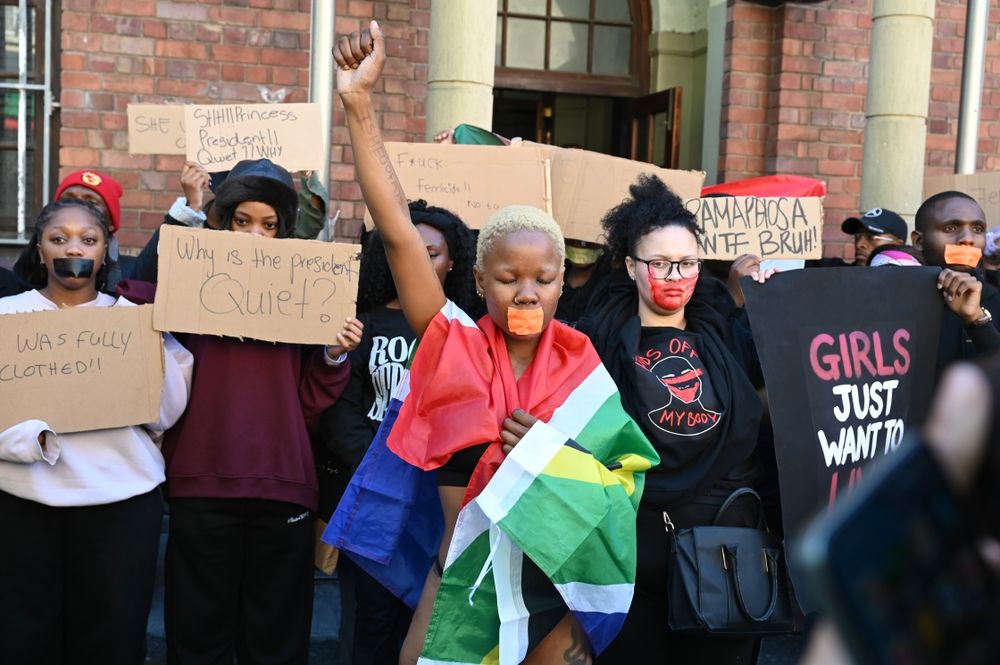
A silent protest against gender based violence took place at the Castle of Good Hope and infront of Cape Town Central Police Station.
As police prepare to “lockdown” Kempton Park and surrounding areas, South Africans took to the streets in silent marches and tribute runs, saying enough is enough after eight women’s bodies were found across Ekurhuleni.
The police operation, which will see Operation Shanela massively expanded, comes as communities from Gauteng to the Western Cape and KwaZulu-Natal unite in grief and fear, honouring the women who lost their lives and demanding action to prevent more from becoming victims.
Gauteng Premier Panyaza Lesufi revealed during a media briefing that the province had requested additional assistance as police prepared to intensify the operation and “lockdown” Kempton Park and surrounding areas.
However, Gauteng government spokesperson Elijah Mhlanga said he could not comment further while police investigations were under way.
Crime expert Yusuf Abramjee said the term “lockdown” should be understood as an intensified law-enforcement operation and not a blanket shutdown of Kempton Park.
He said residents should not expect schools, shopping centres, businesses, or workplaces to close, but should instead expect increased police visibility, patrols, intelligence gathering, stop-and-search operations where appropriate, and specialised units as part of the expanded Operation Shanela.
“The objective must be twofold: to prevent further attacks and, equally importantly, to gather the evidence needed to identify and arrest whoever is responsible for these horrific killings,” Abramjee said.
The police response comes as ordinary South Africans continue to call for greater safety beyond Kempton Park.
For activist Jessica Foord, founder of the Jes Foord Foundation, Elizabeth “Tsontso” Moselakgomo’s death has highlighted the fear women face while carrying out the most ordinary parts of their lives.
“The horrifying reality of violence against women in South Africa is the knowledge that it could be you next — not because you did something reckless, but while doing something as ordinary as going for a run in your own neighbourhood.
“We absolutely need to talk about practical safety, but we cannot keep making women responsible for preventing violence committed against them,” she said.
Foord said women in under-resourced communities also lived with fear during routine journeys, including walking to taxi ranks or travelling short distances to work.
In Cape Town, 24-year-old stylist and activist Jemina Madonna organised a silent march at the Castle of Good Hope yesterday after repeatedly seeing reports of women’s bodies being discovered in Gauteng.
Madonna said the killings could not be treated as a Gauteng problem simply because the bodies had been found there.
“We are not part of any association, any political party, or any organisation that deals with these certain things. But we are on social media so much that you can't even focus on the things that you want to do on social media because every second scroll is a dead body that's been found.”
In Gauteng, runners gathered on Tuesday morning to honour Moselakgomo, whose disappearance and death have shaken the running community.
Bethuel Mangena of the Stallion Running Club said the gathering was about making it clear that women should not have to choose between their safety and their passion for running.
“Tsontso embodies the collective experience of all women, including mothers, wives, and sisters,” Mangena said.
Runners in KwaZulu-Natal also took to the streets in memory of Moselakgomo and other runners.
The 5km run started at 5am from Florida Road, with runners dressed in black in solidarity with Moselakgomo and victims of gender-based violence and femicide (GBVF).
“For me, it's very important to come out today, first of all, because tomorrow I can be next,” Pulu said.
The running community has also continued to rally behind Moselakgomo’s family, with a BackaBuddy campaign launched to support her daughter and family. The community had raised more than R100 000 by yesterday, surpassing its initial R50 000 target.
A Change.org petition launched on September 14 is calling for the reinstatement of the death penalty for offenders convicted of femicide. The petition page says it has attracted more than 300 000 signatures.