
Trade deficit widens to $10.8b in first quarter
Direct Source Verification:
This story is aggregated from The Express Tribune (tribune.com.pk). Full reporting rights and copyright belong to the primary publisher.
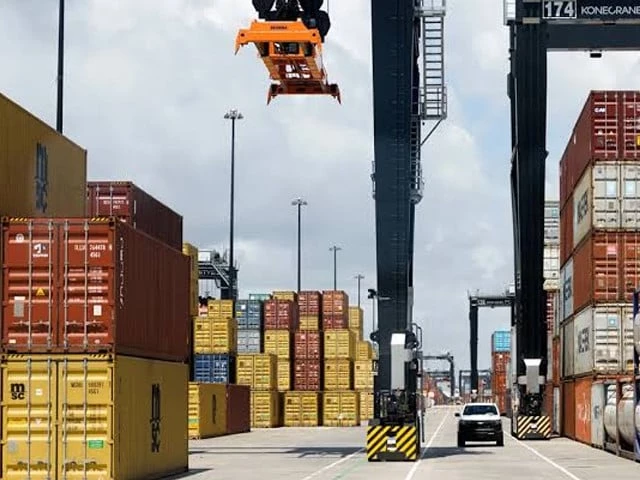
Import growth outpaces encouraging momentum in exports
Pakistan's trade deficit remained elevated at $10.8 billion during the first quarter of the current fiscal year, reflecting an increase of $1.4 billion, as import growth outpaced a good momentum in exports.
According to the Pakistan Bureau of Statistics (PBS), the gap between imports and exports was 15% higher during the July-September period of fiscal year 2026-27. In absolute terms, the gap was $1.4 billion more than the last fiscal year, which was higher than the $1.2 billion tranche Pakistan will receive from the International Monetary Fund (IMF) in November.
PBS said that cumulative exports during the first quarter increased to $8.4 billion, a surge of $824 million, or 10.8%, over the same period of the last year. The pace of increase in exports was better than the previous months. Data showed that imports jumped to $19.2 billion during the first quarter of FY27, higher by $2.2 billion, or 13.2%.
Early this week, the federal government apprised the IMF that the continuation of tariff rationalisation under the National Tariff Policy would lower production costs and enhance industrial competitiveness. It added that the allocation of Rs88 billion for concessional lending to exporters at 4.5% would improve liquidity, reduce financing costs and support export expansion.
However, it is not for the first time the government has doled out fiscal benefits to the exporters. They have availed themselves of these benefits without bringing any tangible improvement in non-debt creating receipts. Exports have traditionally stuck in the range of $2.5 billion to $3 billion a month. Even rupee devaluation of Rs100 per dollar could not give a major boost to exports.
The government has now projected that during the current fiscal year exports of goods will be $34 billion compared with $30.8 billion in the last fiscal year.
But given the first-quarter trend, the government's trade liberalisation policy has not helped increase exports, contrary to projections made by the Ministry of Commerce, the World Bank and the IMF. Under the liberalisation policy, the commerce ministry and the World Bank had anticipated a 14% increase in exports and only a 7% surge in imports. In the last fiscal year, exports plunged 6% to less than $31 billion.
PBS data showed that on a month-on-month basis, exports increased 16% to $2.9 billion. In absolute terms, they jumped $407 million in September compared to August this year. Imports increased 11.5% on a monthly basis, reaching close to $6.5 billion. The monthly trade deficit was up by 8%, or $263 million, which was better than earlier trends due to higher monthly exports, showed the official statistics.
On an annual basis, imports increased 11%, or $646 million. Compared to that, exports increased 17.6%, or $440 million. The annual trade deficit widened 6% to $3.6 billion, which was $206 million more than the previous year.
During the first two months, the import bill of petroleum crude soared by 40.5%, while the arrival of petroleum products declined by 26%. Similarly, LPG imports rose by 47%, while LNG inflows dropped by 28.6%. PBS data indicated that crude oil imports increased by 13.7% in quantity but surged nearly 40% in value during the July-August period, highlighting the dominant role of rising international oil prices.
However, the authorities believe that the government's austerity and energy-conservation measures are expected to moderate domestic consumption and, consequently, reduce the import demand for petroleum products in the coming months.
Last week, Secretary Finance Imdad Ullah Bosal told the National Assembly Standing Committee on Finance that the government's fuel conservation policy would only save Rs700 million during the three-month austerity period. At the average price of Rs400 per litre, this translates into only 1.8 million litres over a period of three months.
For the current fiscal year, the government has set a modest export target of $32.5 billion but expects imports to grow to $70 billion. The gap is filled by foreign remittances as new loans are taken to pay back the maturing loans.
Original Source
https://tribune.com.pk/story/2632670/trade-deficit-widens-to-108b-in-first-quarter
