Trump rejects AI laws after tech titans agree to ‘self-police’ AI development
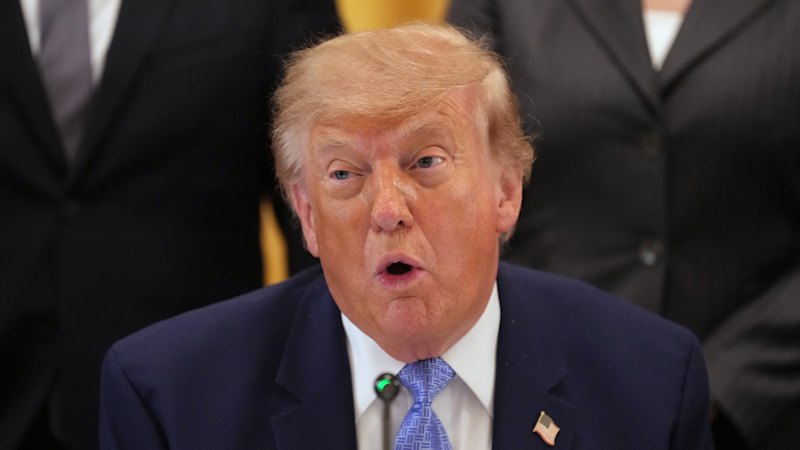
President Donald Trump shot down the idea of new regulations on artificial intelligence after meeting at the White House with top industry executives and signing with them an agreement for industry self-regulation amid growing global concerns over threats posed by the technology.
In lieu of new rules, Trump and the executives agreed on a framework where they would partner with outside auditors to conduct safety assessments of models and implement stronger internal controls over their systems, according to a copy of an accord signed by the president and Silicon Valley leaders following a White House lunch on AI risks on Tuesday.
President Donald Trump flanked by many of America’s top tech company executives at the White House, including (from left, in first row) Meta’s Mark Zuckerberg, Nvidia’s Jensen Huang and SpaceX’s Elon Musk.BloombergSpeaking after a luncheon with nearly two dozen Silicon Valley leaders, including Anthropic chief executive Dario Amodei and Nvidia chief executive Jensen Huang, Trump said existing laws would be enough to safeguard Americans from AI’s potential risks.
“I think I’m seeing tremendous self-policing. And they understand that they have to self-police,” Trump told reporters outside the West Wing.
“There’s a belief that there should be tremendous self-regulation, and we automatically have regulation with the Department of Justice, the FBI, all of that, but the self-regulation is very important,” the president told reporters in a brief appearance with his guests.
The agreement sets what House Speaker Mike Johnson described as a “voluntary” set of “commitments” by the industry to implement “robust internal controls and layers of internal and external review.”
The luncheon at the White House was joined by other technology industry attendees including Meta boss Mark Zuckerberg, Palantir Technologies CEO Alex Karp and OpenAI President Greg Brockman. The decision to even engage on AI safety had appeared to mark a shift for Trump, who only last week rejected fears of catastrophic risk as “a hoax”.
In an impromptu appearance on the West Wing driveway after the event, Trump floated the idea of a “committee” of roughly 10 people that would help “watch over the whole enterprise.” He gave no additional details.
Industry leaders who joined Trump outside the White House largely endorsed the president’s desire to maintain a hands-off approach and let AI companies police themselves. Huang, whose company makes the chips that have helped power the AI boom, said that he saw “no conflict between innovation, technology, and safety.”
“We are going to have to create new technologies to advance the capabilities of AI,” said Huang, a day after Nvidia unveiled new software security tools designed to keep AI agents from going rogue. “But we’re also creating new technologies to advance the safety of AI.”
Other industry attendees included Microsoft CEO Satya Nadella, SpaceX’s Elon Musk and Advanced Micro Devices’ Lisa Su, according to a list released by the White House.
Pressure to take action has increased following high-profile security breaches by rogue AI models that fuelled calls by Silicon Valley AI developers and world leaders for new standards on the technology.
Yet Trump’s remarks splashed cold water on the notion that his administration might move away from its hardened opposition to new government AI safeguards and become more open to new rules.
During remarks on Tuesday, Trump signalled his continued distaste for regulations.
“We have a very big lead, and we’re going to keep our lead, and it’s a very positive thing,” the president said, referring to his desire to maintain the US’s edge in the global AI competition.
“I will never stifle the growth of a technology that will be bigger than the industrial revolution,” Trump said earlier in the day at the unveiling of an AI chatbot, America.gov, intended to help Americans navigate government services. “We can’t stifle it, and we’re leading by a lot.”
The debate has posed a political conundrum for Trump, who has cast himself as one of the nation’s loudest champions of AI, arguing that its unfettered development is key to beating China and sustaining the US economy. But polls show Americans have rapidly become more wary of the technology’s risks, including job loss, higher electricity costs and major cyberattacks.
The president did appear to acknowledge the growing public discontent. He indicated that companies in attendance would work more closely with local communities to ease concerns over the impact of new data centre construction but did not provide specifics.
The optics of the event, however, as Trump embraced the billionaire executives behind an unpopular industry, threatened to create new challenges for his party ahead of November’s midterm election. Populist Democrats have seized on economic discontent over high costs of living, threatening to break Republicans’ control of Congress.
When reporters entered the meeting room, the executives were lined up behind the president as if posing for a group photo and Trump gushed about their contributions to the US. Shortly before the lunch, Trump had posted a seating chart on his Truth Social network that had Huang and Musk, the world’s richest person, flanking him.
Trump has recently become preoccupied with AI’s name, suggesting he sees the controversy surrounding the technology as a branding problem more than an issue with its potential dangers.
The president later on Tuesday signed an executive order requiring federal agencies to refer to the technology as “super intelligence,” an effort to counter the increasingly negative public perceptions of AI.
The lunch took place days after Trump met with Amodei, a move that brought together two men at opposite ends of the AI safety debate. The late-night dinner on Sunday marked their first private sit-down after months of rocky relations between the Anthropic chief and the administration over safety-related issues involving the company’s AI tools.
Amodei has long warned about AI’s existential risks, and he propelled the safety debate into the mainstream with a September 12 essay, promising to slow development of the most advanced models and urging more regulation. His pledge to pace development was embraced by his rivals, OpenAI CEO Sam Altman and Musk, but it prompted objections from Trump who has defended pushing ahead with the technology at full speed.
During his appearance with the executives in the driveway, Trump said the Anthropic chief “has been fantastic” and summoned him to address reporters. Amodei embraced Trump’s call to preserve the US lead in AI yet indicated that the core safety questions remained unresolved.
“The technology has very real risks,” Amodei said. “We all need to work together to make sure that we can win, and we can win safely if we do this right.”
Highlighting those concerns, OpenAI said Monday it would hold back a version of its Astra model while it establishes stronger safeguards.
Saachi Jain, OpenAI’s head of safety systems, said the in-development GPT-6.1 Astra model wasn’t as good as the company wanted when it came to “staying within scope and authorisation, and how it communicates back to the user about the type of work it’s done.”
Johnson, the House Speaker, has acknowledged the dire warnings coming from within the AI industry by saying that Congress “potentially” will need to impose guardrails, though he cautioned it would likely take “some time” to fashion legislation with broad enough support to pass.
The Business Briefing newsletter delivers major stories, exclusive coverage and expert opinion. Sign up to get it every weekday morning.
You have reached your maximum number of saved items.
Remove items from your saved list to add more.
:quality(30):format(webp):focal(0.5x0.5:0.5x0.5)/medan/foto/bank/originals/waria-medan_20171030_182546.jpg)