Trump Says ‘Friend’ Kim Jong Un Sets North Korea Apart From Iran on Nukes - Newsweek
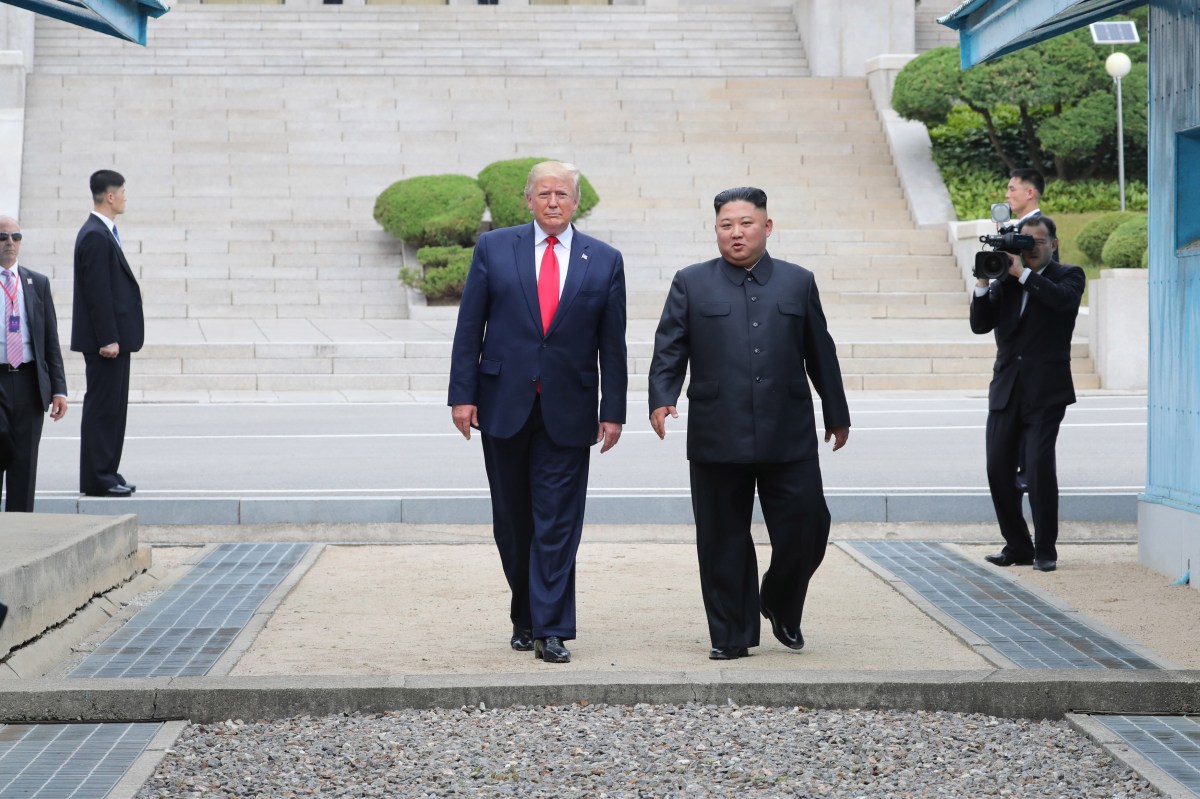
President Donald Trump on Tuesday described North Korean leader Kim Jong Un as a “friend” when asked why Iran should not be allowed to develop nuclear weapons while North Korea already possesses them.
“Ahh, because you had a different president. Kim Jong Un. He’s a friend of mine. He likes Trump. I like him,” Trump said when a reporter pressed him on the apparent distinction.
“As long as I’m around, he’s going to be fine,” Trump continued. “You know why? He respects me.”
Trump has repeatedly emphasized his personal relationship with Kim as he seeks to revive direct talks with the North Korean leader. He has said he expects to meet Kim again this year, while acknowledging that North Korea has a nuclear arsenal.
Rajan Menon, professor emeritus of international relations at the City College of New York, told Newsweek Tuesday night the existence of North Korea's nuclear arsenal does not make it a model for other countries to follow.
“If you stand for nonproliferation, you can't say it's OK because they already have them,” Menon said. “There’s no reasonable way to undo the fact that North Korea is a nuclear-armed state.”
The comments came as the Trump administration continues to press Iran over its nuclear program while seeking a way to end the armed conflict between the United States and Iran.
North Korea has continued developing and testing weapons even as Trump has expressed interest in renewed talks with Kim.
On September 20, North Korea launched two short-range ballistic missiles into the sea from its eastern coastal region, according to South Korean and Japanese officials.
Trump has nevertheless signaled that he wants to reestablish contact with Kim. On August 19, Trump said he expected to meet Kim later this year and said North Korea had 57 “very powerful” nuclear weapons.
The Trump administration has taken a different position toward Iran, repeatedly saying Tehran cannot be allowed to obtain a nuclear weapon.
Iran does not currently possess nuclear weapons, but it has maintained a nuclear program that includes uranium enrichment.
The Obama administration reached the 2015 Joint Comprehensive Plan of Action, or JCPOA, with Iran and other world powers. The agreement imposed restrictions on Iran's nuclear activities in exchange for sanctions relief. Trump withdrew the United States from the agreement in 2018 and restored U.S. sanctions on Iran.
Menon said the history of the agreement and subsequent conflict with Iran could make it more difficult to persuade Iranian hard-liners that diplomacy is the best path forward.
“You scrap a treaty and then attack, and the war doesn't resolve the problem,” Menon said. “You strengthen the hardliners who never believed in the deal in the first place.”
U.S. and Iranian officials have continued indirect talks through mediators, including Qatar, as the two sides seek to end the conflict and resolve disagreements over the Strait of Hormuz, sanction, and Iran's nuclear program.
Trump rejected Iran's latest proposal over the weekend, but officials on both sides have indicated that indirect talks would continue.
The contrasting approaches to North Korea and Iran have brought renewed attention to Trump's longstanding relationship with Kim, which began during his first presidency.
Trump and Kim met three times in 2018 and 2019 as the administration sought to persuade North Korea to give up its nuclear weapons. The talks ended without an agreement, and North Korea continued developing its nuclear and missile capabilities.
Menon also said North Korea's nuclear arsenal has changed the strategic calculation surrounding any potential military conflict with Pyongyang.
“There is no conceivable possibility that we will go to war with North Korea,” Menon said. “Are you prepared to take the risk that they could wipe out San Francisco or Los Angeles? Their second-strike capability makes an attack irrational.”
Newsweek’s reporters and editors used Martyn, our AI assistant, to produce this story. Learn more about Martyn here. Contact Newsweek editors on this story: Edward T. Cummins