
Trump says renewed strikes on Iran after midterms 'possible' as ceasefire talks stall
By continuing to browse our site you agree to our use of cookies, revised Privacy Policy and Terms of Use. You can change your cookie settings through your browser.
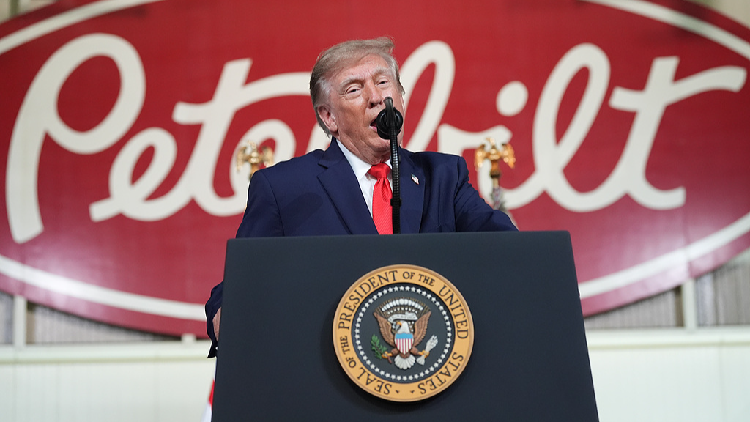
US President Donald Trump speaks at Peterbilt Motors in Denton, Texas, the United States, October 1, 2026. /VCG
US President Donald Trump said Washington could resume large-scale strikes on Iran after the November midterm elections, while rejecting Tehran's latest ceasefire proposal as insufficient, according to an interview with TIME published on Thursday.
Asked whether the United States might intensify its bombing campaign against Iran after the midterms, Trump replied, "Possible." He declined to reveal potential targets but said the US had spent the past six months replenishing its weapons stockpiles.
Trump said he turned down Iran's latest ceasefire offer because its terms were "not good enough." He said conditions he might have accepted a year ago were no longer sufficient after months of fighting, adding that Tehran wanted a deal but Washington was seeking a broader agreement.
The comments came as diplomatic efforts between Washington and Tehran remained deadlocked. An Iranian delegation led by Foreign Minister Abbas Araghchi held talks with US representatives on the sidelines of the 81st United Nations General Assembly in New York. US officials had earlier suggested that the talks could make progress, but the negotiations later reached an impasse.
The breakdown highlighted deep mistrust between the two sides. After the talks stalled, US Secretary of State Marco Rubio reportedly demanded that the Iranian delegation leave the United States immediately.
Meanwhile, the Trump administration on Thursday announced new sanctions targeting Iran's rail and automotive sectors, as well as foreign suppliers linked to those industries, in its latest effort to pressure Tehran economically.
The US Treasury Department said the measures were part of "Operation Economic Outcast," launched on August 24, which aims to restrict Tehran's ability to finance the war, missile development, cyber activities and the Islamic Revolutionary Guard Corps (IRGC).
The sanctions designate Iran Khodro Company, or IKCO, and SAIPA Iranian Automobile Manufacturing Company, or SAIPA. Treasury said the two companies represent more than 90% of Iran's domestic auto market.
They also target the state-owned Islamic Republic of Iran Railway Company, which provides passenger and freight services, the Raja Passenger Trains Company and Sherkat-E Rah Ahan-E Khamle-O-Naghle, also known as the Railway Transportation Company, which it said is a top private freight line.
According to the Treasury Department, US restrictions on Iranian oil exports through the Strait of Hormuz have forced Tehran to rely more heavily on rail and automobile networks to transport petroleum, fertilizer, chemicals and other goods. Thursday's sanctions aim to disrupt those alternative channels.


