Trump’s AI Force Is Outnumbered 5 to 1 - Newsweek
In the first 24 hours of America’s war with Iran this year, the United States used an artificial-intelligence system called Maven to help strike more than 1,000 targets. The system ingests data, helps commanders identify targets and thereby assists in the process in which those targets are hit. AI has already been to war in force.
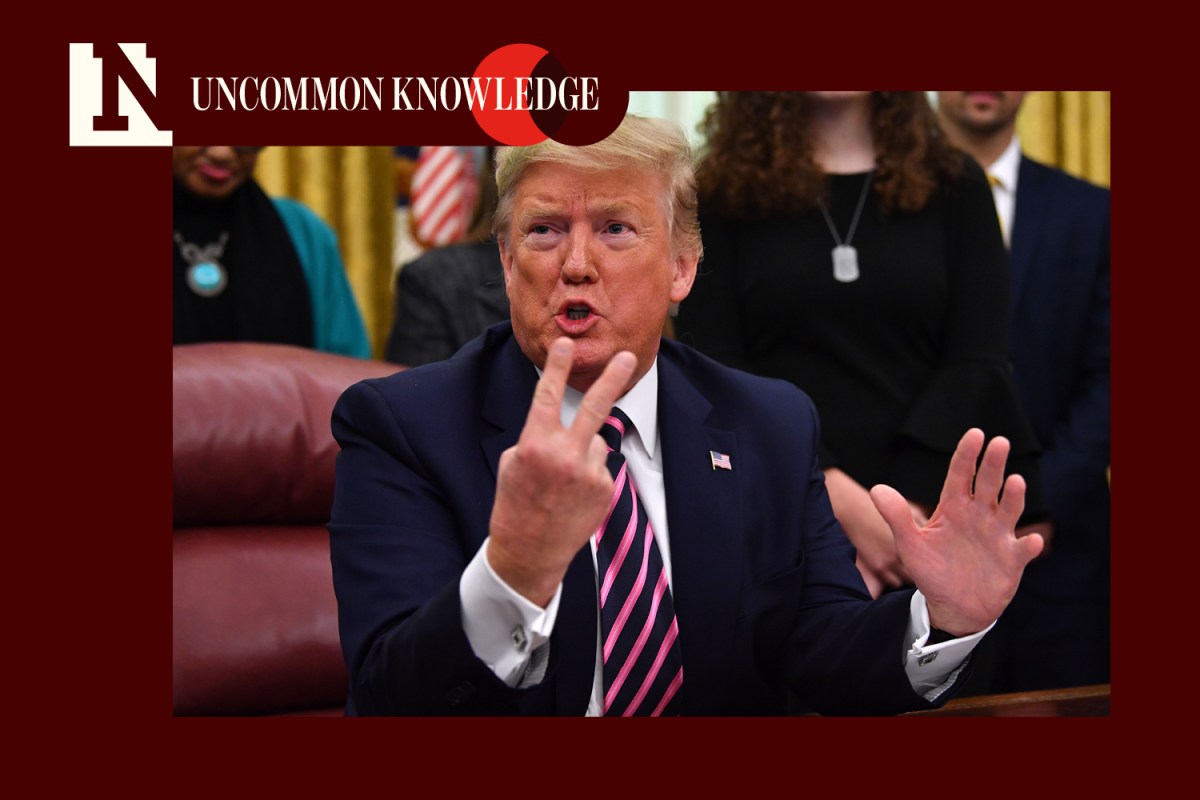
President Donald Trump nevertheless has a new Force under his command. On Saturday he announced an “AI Force,” modeled on the Space Force, and promised to appoint an “AI czar” to lead it. The recruitment criterion is specific, if perhaps disqualifying for many: “Only High I.Q. individuals need apply!” He offered no comparable detail about the organization’s budget, powers, personnel or place in government. He was clear about its philosophy: America will not “hinder or stifle” artificial intelligence but will “cherish it, help it, and watch over it,” though when something “BAD” happens, Trump said, current laws can deal with it.
The timing is notable. On Sunday, after talks in New York with Chinese Vice Premier He Lifeng, Treasury Secretary Scott Bessent said the United States had proposed a “notification mechanism” through which Washington and Beijing could alert one another to AI incidents serious enough to threaten national security. “We want a shared vision of common goals and common threats,” Bessent said. Trump and President Xi Jinping are due to meet at the White House on Thursday.
So Washington acquired, in one weekend, the outline of an AI Force and the outline of a Cold War-style AI hotline. Neither answers the much more difficult question.
America wants to supervise a technology it also insists it must build faster than China. The race has consequently become both an object of policy and the reason policy cannot interfere. That’s where other forces may yet trump Trump’s AI Force.
Senator Bernie Sanders and Democratic Representative Greg Casar announced on September 3 that they would introduce the Ban Artificial Superintelligence Act. It would permanently prohibit the development and deployment of superintelligent AI, temporarily pause advanced development until a federal regulator establishes safety rules, and make it American policy to pursue international agreements intended to prevent superintelligence from being developed elsewhere.
Sanders has since gone further than his proposed statute. At the Pro-Human Assembly in Washington on September 15, he urged Trump to use his meeting with Xi to negotiate “a comprehensive treaty” establishing a pause on advanced AI and a ban on superintelligence. His reasoning is international: “A superintelligent AI that escapes human control will not be an American problem. It will not be a Chinese problem. It will be humanity’s problem.”
Some of the people building the technology have themselves begun raising similar fears. Anthropic’s Dario Amodei published an essay on September 12 calling for the industry to “pace the frontier”; OpenAI’s Sam Altman and Elon Musk made comparable arguments the same weekend, amid concerns that safety systems were not keeping up. Trump publicly pushed in the opposite direction, calling efforts to slow American development part of a “SICK conspiracy” that would let China catch up.
The president’s camp sees a different danger: constructing a regulatory system before using the enormous one Washington already has.
David Sacks, who previously served as Trump’s AI and crypto czar and now co-chairs the president’s science and technology advisory council, put the case at a Politico conference last week. “I think the starting point for talking about AI regulation is to realize the regulations that we already have,” he said. “We have a highly regulated administrative state, and we already have a lot of laws and regulations that pertain to AI.” He pointed to existing rules covering fraud, cyberattacks, privacy and liability.
Americans are not persuaded by either side. Pew found in February that 67 percent of adults had little or no confidence in the federal government to regulate AI effectively, while 59 percent lacked confidence in American companies to develop and use it responsibly. The partisan numbers have reversed since 2024: Republican distrust of government AI regulation fell from 70 to 61 percent, while Democratic distrust climbed from 54 to 74 percent. These concerns may yet weigh on voters' decisions at the Midterms.
Faster or slower is not a theory of who possesses control. For that, it helps to look at the forces already out there. Start with Space Force, since it is the precedent Trump chose.
In June 2018, Trump ordered the Pentagon to begin the process of establishing a sixth military service, promising that the Air Force and the new Space Force would be “separate but equal.” Congress created the Space Force in law 18 months later, on December 20, 2019, making it the first new independent branch of the military since 1947. Air Force Space Command was redesignated immediately and roughly 16,000 active-duty airmen and civilian personnel were assigned to the new service.
Seven years later, its purpose has become much less abstract. Air Force Secretary Troy Meink disclosed on September 14 that the Space Force now possesses “on-orbit space control weapons capable of defending the joint force against hostile adversary action”—the first explicit American acknowledgement of such weapons in orbit.
Space Force has what the AI Force does not yet have: statutory existence, assigned people, command structures and capabilities through which a presidential idea can become government action. The lesson of Trump’s own precedent is that naming the force was the easy part. Congress, money, personnel and, most importantly, many years of bureaucratic construction supplied the actual force.
A police force, by definition, needs something to enforce.
Sacks and Trump are correct in a narrow but important sense: the law does not disappear when AI is involved. The Federal Trade Commission used existing consumer-protection powers against DoNotPay after the company marketed an AI service as “the world’s first robot lawyer” without adequately substantiating claims that it could perform like one. The final FTC order required $193,000 in monetary relief.
But that case also illustrates what existing law does. It punishes a familiar wrong (deceptive marketing) that used new technology. It does not establish that possessing a sufficiently powerful AI model is itself unlawful.
Congress has proposed legislation aimed at that gap. The bipartisan AI Kill Switch Act, introduced in July by Democratic Representative Ted Lieu and Republican Representative Nathaniel Moran as H.R. 9917, would require developers of the most powerful systems to retain the ability to suspend or shut them down. It would also authorize the homeland security secretary, under specified conditions, to order intervention where an AI system could cause catastrophic harm.
The police-force theory reaches its limit there. Existing law can prosecute somebody who uses AI to commit an existing offense. An AI Force seeking to police dangerous capability itself would need authority Congress has not yet supplied.
What is missing is not just the force, but the offense.
Market forces create almost the opposite problem: they already possess a mechanism powerful enough to determine the pace of development.
Goldman Sachs Research estimates that the United States will account for about $581 billion of AI-related investment in 2026, out of more than $1 trillion globally. Its estimate puts American AI capital expenditure at around 1.8 percent of GDP this year.
A measure from Epoch AI reaches the same point from another direction. Investment in AI data centers, computing hardware and networking amounted to about 1.4 percent of U.S. GDP in the first quarter of 2026, up from 0.7 percent.
There is asymmetry. TS Lombard estimates that China’s data-center spending runs at roughly 0.4 percent of its GDP, behind Malaysia and Sweden. The two countries are not running the same race at the same speed, and the one being urged to slow down is much further ahead.
Eventually all that money becomes concrete, chips and electricity. Lawrence Berkeley National Laboratory estimates that data centers could consume 11.8 percent of all U.S. electricity by 2030. The estimate covers data centers generally rather than AI alone, but the update explicitly incorporates the accelerating equipment purchases behind the current expansion.
This is the force a czar cannot simply order around. Markets are determining how many chips are bought, which data centers get built, where capital goes and how much electricity the industry can secure. Government can regulate those things, tax them, subsidize them or constrain them. But without authority over those levers, an AI Force would be a passenger.
The Pentagon already has a system for putting AI into the chain of military action. Maven Smart System takes information from military sensors and other data sources and uses artificial intelligence to assist intelligence, planning and targeting. During the first 24 hours of the war with Iran, according to the Center for Strategic and International Studies, the United States used Maven to help strike more than 1,000 targets, a roughly tenfold increase over the number that could have been processed before the system.
An AI Force may eventually debate how artificial intelligence ought to be governed, but the military has already integrated AI into what government does when decisions carry the most destructive consequences.
Command authority is therefore the missing ingredient. Unless a future AI Force is given power over military AI—which Trump has not said—it does not sit above the institution already deciding how AI is used in combat. On the battlefield, America’s first effective “AI Force” has already arrived. It is simply called the military.
The phrase usually appears in contracts. A force-majeure provision excuses performance when an extraordinary event outside a party’s control prevents it from fulfilling an obligation.
The language surrounding the AI race is increasingly close to it. American companies cannot slow unless competitors slow. Washington cannot impose too much restraint because China may continue. China, in turn, rejects American proposals for coordinated pacing as attempts to constrain its development.
After Amodei’s essay called for maintaining restrictions on sales to China of the most advanced chips and chipmaking equipment, China’s Foreign Ministry responded on September 14. “Fearmongering, confrontation and vicious competition will only disrupt the process of global AI governance, which serves no one’s interest,” said spokesperson Guo Jiakun.
Beijing is not merely objecting, either. On July 16 in Shanghai, 29 countries signed the founding agreement of the World Artificial Intelligence Cooperation Organization, an intergovernmental body headquartered in Shanghai and sitting outside the United Nations system. The United States is not a member.
The fifth limit on Trump’s AI Force follows from all of this, and it is the largest.
Suppose a new organization concludes that American frontier development should slow. It can recommend that Washington slow. It cannot make Beijing do the same. Under Trump’s own argument that unilateral restraint would help China catch up, the behavior of the other participant, which is outside America's control, determines the range of acceptable American choices.
This week’s diplomacy illustrates that gap.
Bessent’s U.S.-China “notification mechanism” would increase transparency when an AI incident becomes a national security threat. He described the purpose as moving relations between the world’s two largest AI powers “from opaque to more transparency.” However, U.S. Trade Representative Jamieson Greer separately said controls on advanced AI chips and semiconductor-manufacturing equipment were not part of the proposed mechanism.
A notification mechanism tells the other side that something dangerous has happened, but doesn't require either side to develop technology more slowly.
That is the crucial distinction. America and China are beginning to construct machinery around the AI race such as domestic rules, export controls, diplomatic dialogue and now perhaps a system for reporting emergencies. But the single variable invoked whenever either government explains why it cannot afford to slow down is the pace of the other side.
A domestic AI Force cannot control that variable.
There is a historical model for what can. In 1982, Ronald Reagan said the United States would refrain from actions that undercut existing strategic-arms agreements so long as the Soviet Union demonstrated “equal restraint.” His administration later described “mutual, verifiable constraints” as important to limiting nuclear danger while negotiations continued. The arrangement did not permanently solve the arms race, and indeed Reagan later accused Moscow of failing to exercise comparable restraint, but the mechanism was reciprocal rather than unilateral.
Yet AI is considerably harder to count than missiles. Its capability resides in chips, software, models, electricity, expertise and data centers rather than a finite number of launchers.
Force majeure is what happens when the remaining factor is said to belong to somebody or something else.
Trump can create an AI Force that tells Washington what it thinks America should do. Unless Congress supplies powers, it cannot manufacture legal authority. Unless the Pentagon places military AI under it, it cannot command Maven. Unless markets respond, it cannot decide how quickly hundreds of billions of dollars become chips and data centers. And unless Beijing participates, it cannot determine the speed of an international race.
That does not necessarily make an AI Force useless. It defines the territory left for it, and there isn’t much territory left.