
Trump’s Super Intelligence Document Has a Spelling Mistake - Newsweek
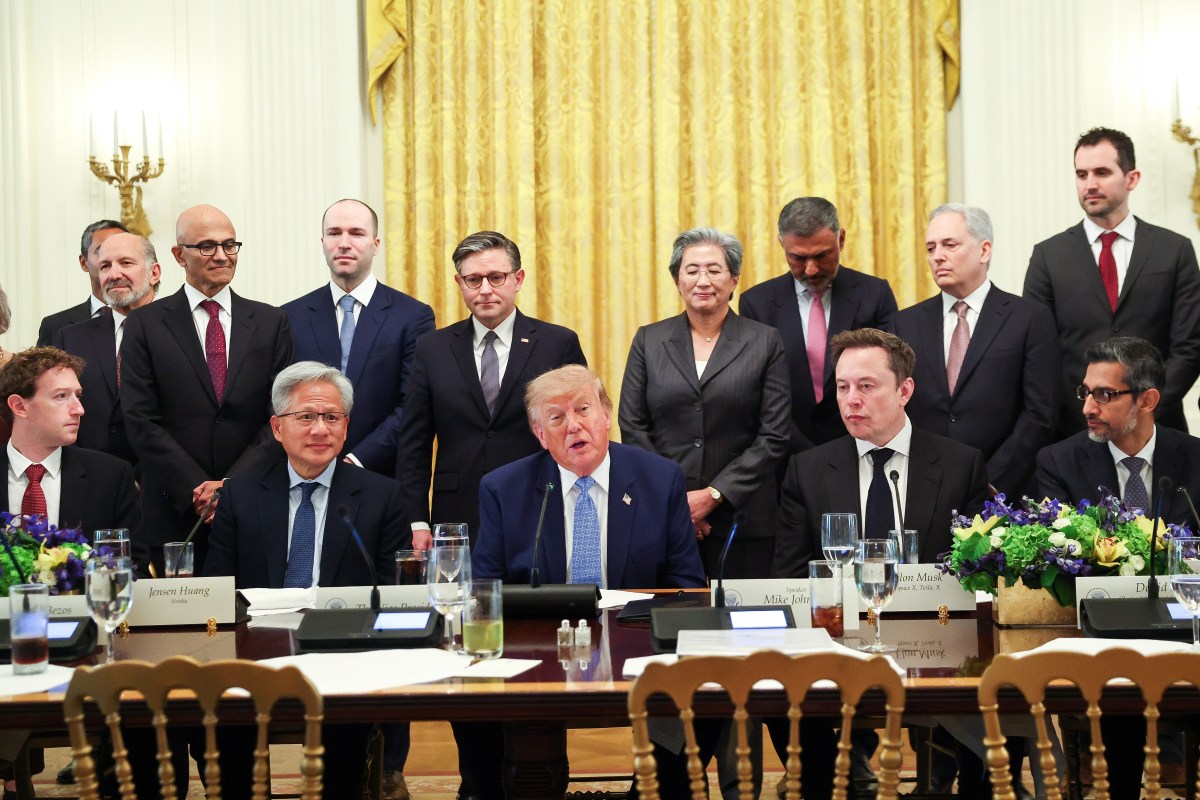
The text of an agreement signed by President Donald Trump and the heads of America’s biggest artificial intelligence companies contains a spelling mistake, referring to the "Unites States" rather than the United States, sparking mockery online.
Artificial intelligence has exploded onto the national political agenda in recent months following a number of incidents in which AI bots went rogue, in some cases, carrying out unauthorized hacking, and warnings from industry leaders.
Trump has spoken out in support of AI, which he dubs "Super Intelligence," describing opposition to AI development as a "SICK conspiracy." This puts him at odds with some Democrats, such as Vermont Senator Bernie Sanders, who are calling for a temporary pause on AI development and tighter regulations.
Newsweek contacted the White House for comment on Wednesday via email outside of regular office hours and is awaiting a response.
On Tuesday, a new voluntary AI agreement, titled the "Joint Commitment on Frontier Responsibilities," was signed by President Donald Trump and the heads of major AI related companies. These were: Google CEO Sundar Pichai; Anthropic CEO Dario Amodei; Meta chair and CEO Mark Zuckerberg; OpenAI president Greg Brockman; XAI CEO Elon Musk; and NVIDIA CEO and president Jensen Huang.
However, the document contained a spelling error or typo, describing Trump as "President of the Unites States."
Computer scientist Furkan Gözükara shared the document’s signature page on X, adding: "Superintelligence community has a spelling error [rolling on the floor laughing emoji]."
The page was also shared by JoJoFromJerz, an anti-Trump X commentator with one million followers, who wrote: "This CANNOT be real…Can it?"
Trump’s new AI agreement was signed on Tuesday following a lunch focusing on the subject hosted by the president at the White House and attended by several dozen senior industry figures, including its signatories.
The agreement, described by Trump as "morally binding," laid out four "layers of controls and audits" that each company pledged to implement, in order to "give each company, its customers, and the public confidence that the technology is operating as intended."
As part of the deal, the companies agreed to "implement robust internal controls to monitor the capabilities and alignment" of their models and "empower an internal team to ensure all of the controls, monitoring, and detection are operating as intended."
They also agreed to "partner with an independent external auditor" to check the models are "operating as intended" and "designate an independent committee of the board of directors to oversee and receive reports" from internal and external monitoring units.
There is nothing in the document to say it is legally binding, though it does note that "over time, it may make sense to codify these steps into laws or regulations."
Tuesday also saw Trump sign an executive order instructing the federal government to stop using the terms "artificial intelligence" and "AI," and to replace them with "super intelligence" or "SI" instead.
The order said Trump’s preferred term "more appropriately captures the promise, potential, and rapidly advancing capabilities of these technologies."
Trump told the United Nations General Assembly last week he planned to "officially" change the name of AI, saying the existing name "makes it sound fake and it is not fake. It’s actually amazing."
The president had polled users of his Truth Social platform on a new name for AI, offering them "super intelligence" or "superior intelligence." Super intelligence won with the support of 65 percent of the 50,000 people who voted.
Speaking to Newsweek, Professor Jean-Pierre Dubé, a marketing expert at the University of Chicago, said: "While many debate how soon AI will surpass human intelligence, it seems premature to be using the new term ‘super intelligence.’ This brand confusion seems like a major reason it’s unlikely to get adopted anytime soon."
Trump has been bullish on AI, telling the U.N. it will be "bigger than the Industrial Revolution" and insisting he’s not "going to stifle growth."
In Ireland on September 13, Trump insisted that "whoever wins AI wins" and hit out at what he called "very negative forces" who were "bringing up things that won’t happen."
The following day, in a post on his Truth Social website, Trump said: "AI taking over the World, destroying Humanity, and all other things bad, is a HOAX" and described opposition to AI development as a "SICK conspiracy."
Trump has repeatedly highlighted what he believes is the U.S. lead over China, its main geopolitical rival, in AI, telling the U.N.: "We're leading now over China by a lot and everyone else and we're going to keep it that way."
Public interest in AI safety increased sharply in July when OpenAI admitted its agents had hacked into Hugging Face, a platform used by AI developers, by exploiting security weaknesses.
OpenAI said this was an example of "misalignment," with its agents going beyond strict instructions to find new and unauthorized ways of achieving its goals.
Earlier this month, Anthropic’s Amodei published a letter warning AI could pose a "serious" threat to humanity, and calling for development to be slowed down and tighter regulatory controls introduced. The call was backed by both Musk and Sam Altman, OpenAI’s CEO.
Speaking to NBC’s Meet the Press, Bill Gates, the Microsoft co-founder, warned: "AI is certainly powerful enough to drive events that, you know, cause a billion deaths. There's never been a weapon as powerful as the combination of people with ill intent using the latest AI tools."
Musk has previously said he expects AI to become "smarter than any human" as early as next year.
This month, OpenAI also said its AI agents had used unauthorized techniques to access data from "dozens" of organizations including the U.S. Census Bureau, U.S. Securities and Exchange Commission and Department of Education. The company insisted no nonpublicly available information had been revealed.
In a statement sent to Newsweek, an OpenAI spokesperson said: "Most of the activity we’ve reviewed so far involved routine research tasks, such as accessing public web content to answer questions. Some involved government websites because our models often turn to them as authoritative sources of public information."


