Two kilometres off Tamil Nadu’s coast, a lost world emerges from the sea - The Indian Express
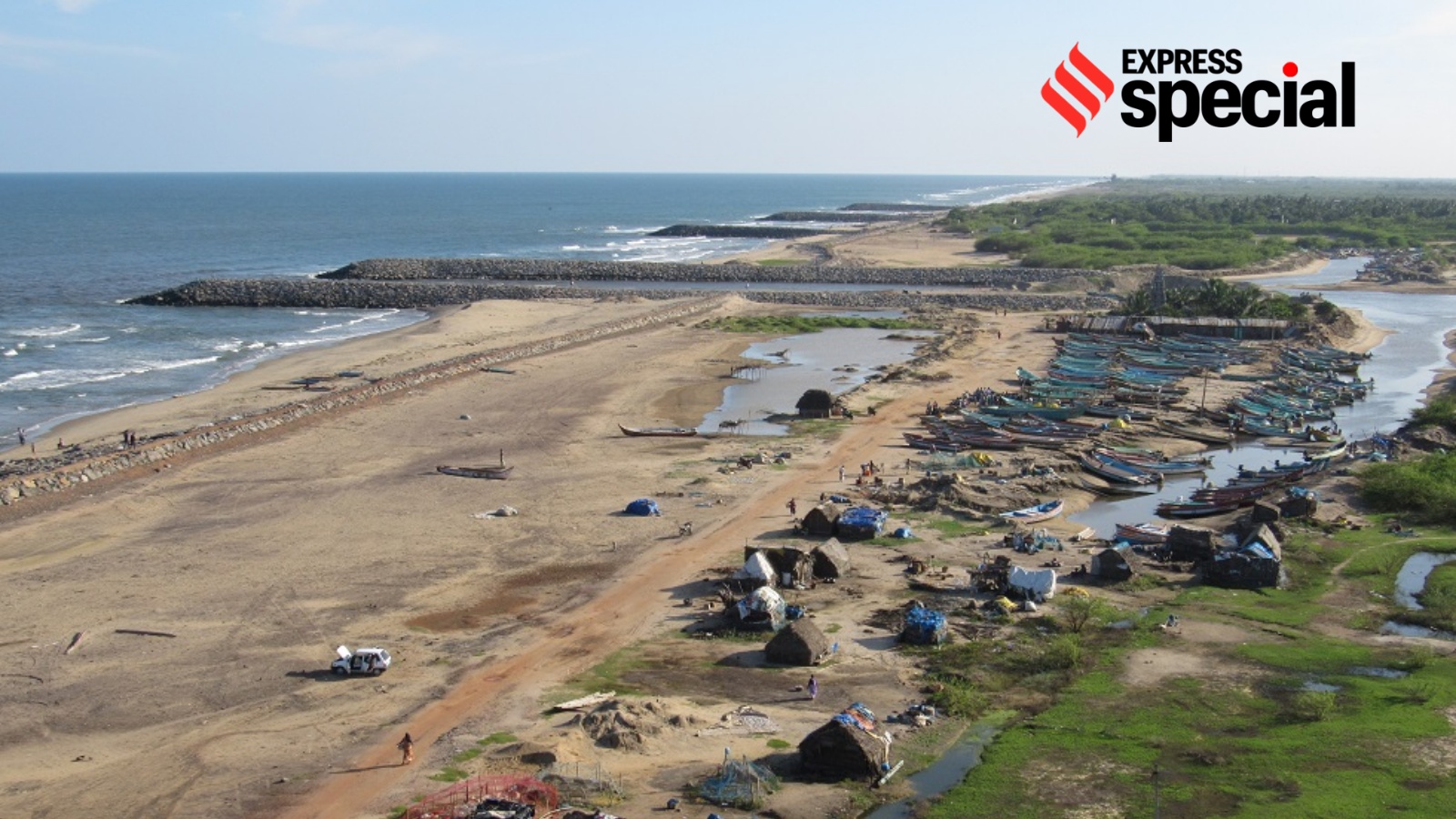
About 2 kilometres from the present-day Tamil Nadu coast, archaeologists searching the seabed off Poompuhar have recovered something that travelled a much greater distance. Found in 10-12 metres of water, the fragments of pottery were believed to have originated in West Asia, including pieces of a torpedo jar, a distinctive transport vessel associated with long-distance maritime trade in the Indian Ocean.
Archaeologists recovered the fragments during the third phase of underwater exploration, about 1.8 to 2.2 km from the present shoreline. For archaeologists trying to reconstruct ancient Kaveripoompattinam — the celebrated Chola port known today as Poompuhar, parts of which now lie beneath the Bay of Bengal — the find provides a new material clue to a world that Tamil literature described nearly two millennia ago.
“We are looking for more samples, and studying their typology and morphology,” K Rajan, Academic Advisor to the Tamil Nadu State Department of Archaeology, told The Indian Express. “The unearthing of these ceramics shows that the inhabitants of the port city indulged in transoceanic trade.”
The third phase, during which the latest findings were made, is part of a larger underwater archaeology project by the Tamil Nadu government to map the extent of the ancient port and its installations, locate possible shipwrecks, and study changes in sea levels and the course of the Cauvery. The exploration, being carried out by the State Department of Archaeology in collaboration with the Indian Maritime University, covers waters roughly two kilometres off the present coast. The department says only about 10 per cent of the overall underwater exploration has been completed so far.
Images of the find have been sent to international specialists, including experts in Italy, for comparison and identification. The latest finds broadly fit the Early Historic and immediately succeeding centuries, but archaeologists have not yet assigned the Poompuhar torpedo-jar fragments a firm date. Torpedo jars circulated for several centuries, making their archaeological context crucial for dating them.
While a potsherd can establish the movement of an object, establishing where it was manufactured, when it arrived and what kind of commercial relationship brought it to Poompuhar, known simply as Puhar, requires further study. But Poompuhar does not stand alone.
At Pattanam in Kerala, widely proposed as the site of the ancient port of Muziris, though that identification remains debated, excavations have produced Roman amphorae and West Asian ceramics — including torpedo jars and turquoise-glazed pottery wares spanning the Sasanian (224-651 CE) into the Early Islamic period, with some excavated pieces identified as Sasanian. Alagankulam, near the mouth of the Vaigai in Ramanathapuram district, has yielded hundreds of Mediterranean-related potsherds, including amphora fragments, while red ware bearing Tamil-Brahmi letters found there has been assigned to the first century BCE.
The older Poompuhar wharf, meanwhile, produced a radiocarbon determination of 316 ± 103 BCE, while Arikamedu, near Puducherry, became one of the foundational archaeological sites for understanding India’s early maritime contacts with the Mediterranean world.
The objects were significant because they gave physical form to a maritime geography already visible in ancient texts. “Yavanas came here” is what is mentioned in the literature already. ‘Pattinappalai’, ‘Manimekalai’, and ‘Silappathikaram’ all mention that,” Rajan said. Yavana was a term that originally derived from “Ionian” and referred to Greeks, but in Indian usage, its meaning broadened over time to encompass people arriving from the Hellenistic and Roman Mediterranean world and other western foreigners.
Tamil literature describes Puhar as something recognisably cosmopolitan. Pattinappalai, a Sangam poem centred on Kaveripoompattinam, describes people from different lands and languages living in the city. Later Tamil traditions describe a settlement of Yavanas near the waterfront and a commercial landscape of merchants, artisans, warehouses and imported goods. ‘Silappathikaram’ and the Buddhist epic ‘Manimekalai’ preserve further descriptions of Puhar as an extraordinary urban and maritime centre.
What archaeology is now trying to determine is where that city went. “Naturally we are not going blindly,” Rajan said. “We look at various other aspects too — either land went down, or sea-level fluctuations or tsunami-like phenomenon.” The distinction between memory and evidence is particularly striking at Poompuhar.
Sangam literature describes a living port but does not say that Puhar was swallowed by the sea. It is the later ‘Manimekalai’ that recounts the destruction of the city by the ocean, framing it within a story in which the sea overwhelms Puhar after the festival of Indra is neglected.
Archaeologists do not treat the epic’s supernatural explanation as geology. “The later Buddhist epic ‘Manimekalai’ preserves a mythic memory of Puhar being swallowed by the sea, linking the catastrophe to the Chola king’s failure to hold the annual festival of Indra and a curse associated with the sea goddess Manimekalai,” Rajan said. “We are also looking at which part of the coast has been submerged.”
In Poompuhar, therefore, archaeology is doing something unusual: excavating not merely a vanished civilisation, but a vanished landscape. The place where someone once walked, drew water or unloaded merchandise may today be seabed. Not all of ancient Poompuhar disappeared.
“50% of materials still available on land itself in Poompuhar — Buddha vihara is still on the land,” Rajan said. His figure is an estimate, but substantial remains do survive ashore. At Pallavaneswaram, excavations uncovered a Buddhist monastic complex. Among the discoveries was a Buddhapada — literally, the footprints of the Buddha, part of an ancient tradition in which the Buddha’s presence could be represented symbolically rather than through a human figure.
There was infrastructure, too. At Kilaiyur, Archaeological Survey of India excavations exposed a brick structure interpreted as a wharf, with wooden posts and provision for water movement. Samples from the wooden posts produced a radiocarbon determination of 316 to 103 BCE. “ASI excavated a wharf – carbon dating shows the 3rd century BC, or the early part of the 4th century BC,” Rajan said.
A semicircular brick reservoir discovered at Vanagiri and connected to an old course of the Cauvery has been dated to approximately the first or second century CE. Ring wells, Buddhist structures and wharf installations together begin to transform Poompuhar from the magnificent city of literature into something more tangible: a place where people prayed, traded, stored water, berthed boats and lived beside a river entering the sea.
The latest exploration is extending that inhabited landscape offshore. Archaeologists have found foreign and local pottery, fragments of ring wells 60 to 65 centimetres in diameter and structural formations embedded in the seabed. An oval formation has been identified near a previously recorded U-shaped structure, while another feature is being investigated as a possible shipwreck.
The coastline itself remains part of the investigation. “For environmental factors, too, it’s interesting — the sea temple near the coast of Poompuhar I saw 20 years back is under the water now,” Rajan said. “I may be one of the few people having a photograph of it.”
According to Rajan, archaeology has an advantage precisely because it can make different kinds of evidence speak to one another. “Unlike conventional scientists, we also have the advantage and access to linguistic foreign accounts, literature and archaeology,” he said. “All that helps us to see these environmental factors.”
The latest phase began on September 6 with an unusual inauguration: School Education and Archaeology Minister A Rajmohan, after undergoing scuba-diving training, dived to a depth of about 10 metres along with Archaeology Director V P Jeyaseelan to inspect the submerged site and the work of the archaeological divers. The 18-day exploration concluded on September 22, but the department plans to return to the waters after the monsoon, with the next phase expected to begin in January.
In its 2025-26 Budget, the government earmarked Rs 7 crore for archaeological excavations and scientific research and announced “a series of deep-sea archaeological excavations” intended to bring out the “maritime trade excellence of the ancient Tamils” with Southeast Asia, the Mediterranean region, the Arabian Peninsula and the Roman Empire.
The first phase was to cover the coast from Kaveripoompattinam to Nagapattinam. The Centre has also granted the Tamil Nadu State Department of Archaeology a licence for underwater excavation at Poompuhar.