
Tylenol murders investigators link Dr. Mathew Betkouski to killings - Newsweek
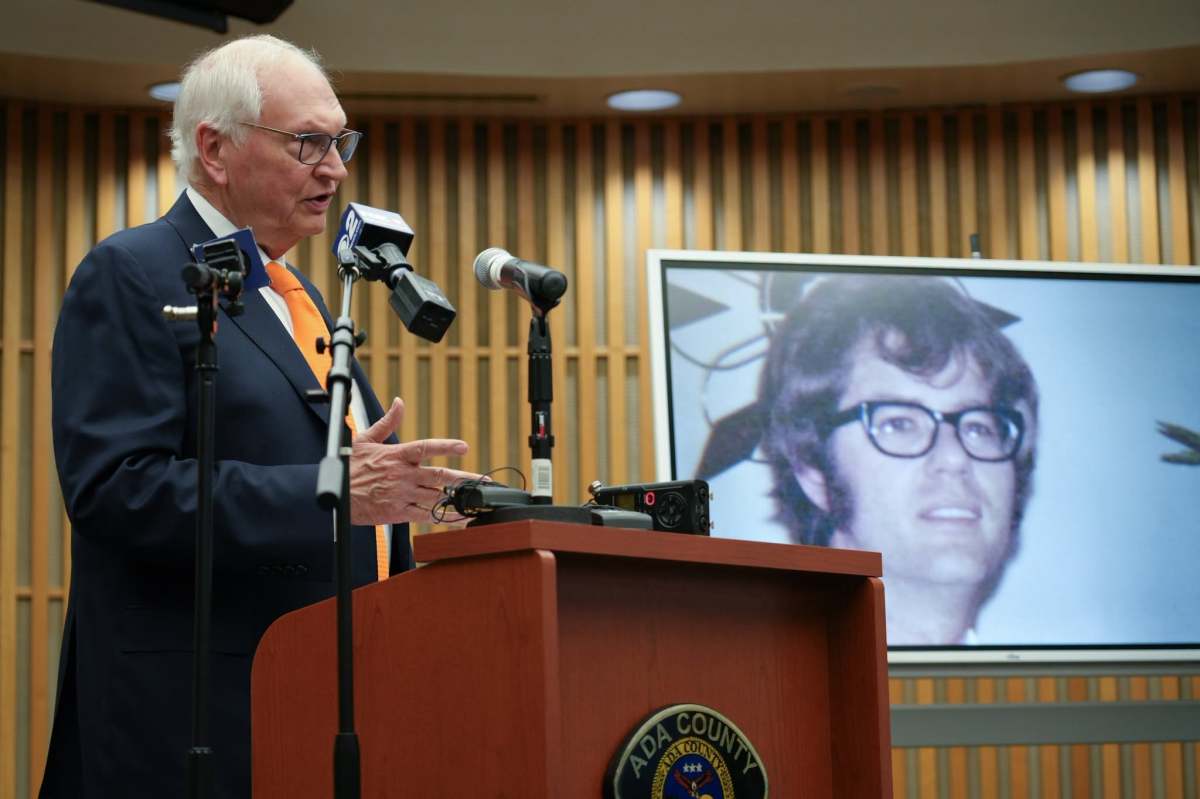
An organic chemist found dead on an Idaho church pew more than 40 years ago is being investigated over the infamous Tylenol murders, a series of seven unsolved poisoning deaths in Chicago in 1982.
Several pieces of evidence could link Mathew Betkouski, who held a PhD in chemistry and struggled with mental illness, to the killing spree in which painkillers were fatally laced with fast-acting poison cyanide, according to investigators.
His body was found inside Sacred Heart Catholic Church in Boise on December 4, 1982, with $1,900 in cash and a note signed with an alias, "Wm. L. Toomey." He had taken a cyanide capsule. Yet his identity remained a mystery, earning him the nickname the "Unknown Wanderer," until now.
At a press conference on Wednesday to reveal his identity, Ada County Sheriff Matt Clifford said investigators could not name Betkouski as a suspect in the Tylenol murders at this time, and could not place him in Chicago when the poisonings took place. But investigators have passed information—including some not disclosed during the press conference—to Chicago police.
Forensic psychiatrist Dr. Park Dietz, who worked on the initial investigation, went further.
"Law enforcement is being careful not to use the word suspect in connection with Dr. Betkouski. But I'm not bound by the same rules," Dietz told the same press conference. "It's an extraordinary thing to have been around at the beginning in 1982, and now today in 2026 to see a very likely closure, that the identity of the Tylenol killer from 1982 can be shared."
The Tylenol murders occurred in the space of three days beginning September 29, 1982, and claimed the lives of seven people, including a 12-year-old girl and three members of the same family.
Mary Kellerman was hospitalized on September 28, 1982, after consuming a cyanide-laced capsule of Johnson & Johnson's Extra-Strength Tylenol; she died the next day. In the following two days, six others died: Adam Janus (27), Stanley Janus (25), Theresa Janus (19), Mary McFarland (31), Paula Prince (35), and Mary Reiner (27). The Januses had all taken Tylenol pills from the same bottle.
In response to the FBI said it will release "credible information ... once the evidence yields a true case resolution."
"There have been repeated claims over the past 44 years about alleged links to the Tylenol Murders which remain unsubstantiated," a bureau statement to ABC7 Chicago said. "Out of respect for the ongoing, legitimate investigation, those impacted by the tragedy, and the law enforcement partners who have provided genuine support since the start, the FBI remains the lead on investigating and releasing credible information to the public once the evidence yields a true case resolution."
Michelle Rosen, whose mother, Mary Reiner, was killed, called for investigative records to be made public. "The Unknown Wanderer is not a random name pulled from thin air. He presents as a serious and compelling person of interest whose background merits careful examination," Rosen told ABC7.
All of the findings by the Ada County sheriff will be aired in the upcoming documentary Unmasking the Tylenol Killer, which is set to premiere on The Roku Channel on October 9.
Betkouski was identified thanks to a DNA test that matched a sample from his wallet with his brother, who lived in Los Angeles until his death in 2021, revealing the two men very likely had the same father.
Clifford said he held a fascination with chemistry and explosives from a young age, something that Dietz said could be connected to the psychology of the Tylenol murderer.
A traumatic brain injury sustained in 1974 caused some of his existing problems to manifest in "more concerning ways than they had before," Clifford said.
In documents from the late 1970s, Betkouski wrote about possibly experiencing schizophrenia and depression, and the possibility to experience feelings of euphoria brought on by imaginary thoughts of violence.
As an adult, Mathew Betkouski lived in five states: California, Texas, New Mexico, Ohio and Florida.
He worked for a flavors and fragrances company in Jacksonville, Florida, from 1975 until 1979, before joining Lockheed in New Mexico, working on a NASA-related project at White Sands Test Facility. He lost his job following there an incident at a local pharmacy where he was attempting to obtain some pills or capsules for what he said was an experiment.
His mother died in 1979, His father died shortly after Betkouski lost his job in 1982.
Betkouski was living in Jacksonville, Florida, in 1982 when he disappeared, according to his brother.
"Dr. Betkouski was described by those who knew him over the years as odd, strange, a loner, and paranoid," according to Dietz.
"It's very important to understand that mental illness itself does not lead people to become violent. It is not associated with higher risk of violence. But when someone remains untreated for paranoid, delusional ideas and also abuses substances, they put themselves in a higher risk category for future violence. And I regard that as significant in this particular case," he said.
"Then we have a cascade of stressors. The death of his mother, losing his job, a divorce, the death of his father, and an embarrassing event in which he introduced at a trade conference, an invention of his, and the press reported it as a flop, a failure. That was on the very day his father died in 1982. And it is not long thereafter that uh all of these proximal behaviors, his disappearance, that the Chicago homicides and his suicide occurred," he added.
Mathew Betkouski was declared dead in absentia in 1989.
Investigators are now seeking cold cases involving cyanide poisoning or suspicious pill medication related to deaths from the late 1970s to the early 1980s, with a special focus between October 15 and December 4, 1982.
Sales of the best-selling pain reliever plummeted after the poisonings, but later rebounded. The poisonings are the reason behind today's tamper-proof bottles. Product tampering became a federal crime in 1983, largely as a response to the murders.
No one has ever been formally convicted for the Tylenol murders.
Until now, Chicago police considered a man named James Lewis as the prime suspect. Lewis, who died in 2023 at the age of 76 in his home in near Boston, was the only person to be convicted in relation to the poisonings.
Lewis was convicted of attempting to extort $1 million to Tylenol maker Johnson & Johnson in 1982 in exchange for putting a halt to the poisonings. The letter he sent to the company included details about how "easy" it was to tamper with Johnson & Johnson's Tylenol pills and place cyanide inside them. He was sentenced to federal prison, where he spent several years. He always denied having committed the killings, and he was never charged with the murders.
Police at the time of the murders also looked into another suspect, Roger Arnold, a dock worker at a Jewel-Osco in Melrose Park who was reported to investigators by the owner of a bar he used to frequent, who said Arnold had discussed killing people with a white powder and was behaving erratically after the end of his marriage. Arnold was never charged and died in 2008.
After his death, his body was exhumed so as to conduct a DNA test against the samples found on the bottles linked to the poisonings; it was not a match.


