UOB Thailand drives SME transition financing to bridge ecosystem gaps, meet ESG demands - Bangkok Post
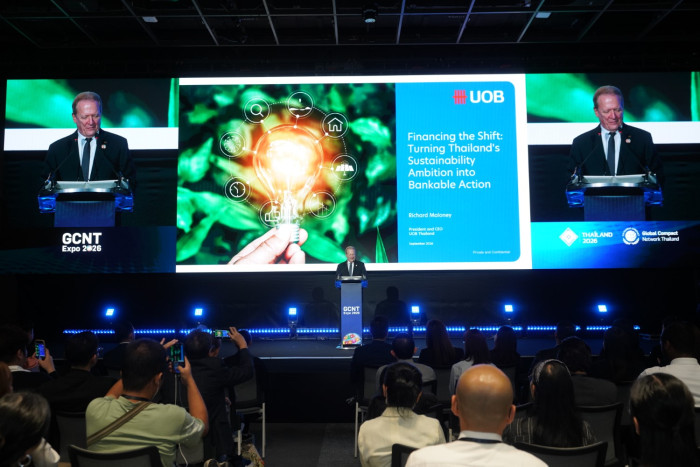
Pressures on Thailand to achieve its Net Zero ambitions are shifting decisively toward bridging transition gaps for small and medium-sized enterprises (SMEs). As global ESG regulations tighten across supply chains, SMEs must adapt rapidly to maintain their position in international markets.
At the recent Global Compact Network Thailand (GCNT) forum, Richard Maloney, President and CEO of UOB Thailand, highlighted that the nation has moved past general awareness and into the implementation phase of the green transition. UOB Thailand had cumulatively extended 74.6 billion baht in sustainable financing of by the end of 2025, reflecting growing activity across supply chains, spanning contractors, corporate entities and households. Since 2020, projects supported through the bank’s U-Solar programme in Thailand have helped avoided more than 167,000 tonnes of carbon emissions.
While sustainable finance solutions support green activities and sustainable projects, UOB recognises that energy-intensive sectors, such as data centres, and hard-to-abate sectors, such as oil and gas and aviation, require different financing pathways to support credible decarbonisation plans. Its transition finance solutions are designed to help businesses invest in their transition and adapt to evolving international trade and sustainability requirements, including the EU’s Packaging and Packaging Waste Regulation (PPWR) and other green trade standards.
Richard Maloney, President and CEO of UOB Thailand, encouraged SMEs to begin their sustainability journey by identifying immediate operational pain points, such as high electricity bills, customer-mandated emission reporting reporting, aging machinery (e.g., boilers and cooling systems) or the need to electrify vehicle fleets.
“A well-defined first project is easier to finance than an ambitious but vague five-year plan, and it builds the track that makes the next one, and the one after that, easier still, “ said Mr Maloney.
Through the UOB Sustainability Compass, more than 1,800 SMEs in Thailand have already received customised guidance. UOB’s advisory tea, works directly with businesses to establish structured, practical frameworks for their transition.
Understand: Building foundational awareness and grasping what sustainability means for your specific industry.
Measure: Assessing current data baseline and resource use e.g., carbon footprints, energy consumption, etc.
Formulate: Structuring realistic transition targets.
Implement: Executing the action plan across operations.
Integrate: Embedding sustainable practices into core business strategy.
Thamolwan stressed that transition plans must demonstrate sound commercial logic to unlock bankable financing solutions.
Despite available financial liquidity, severe structural and non-financial hurdles persist for smaller entities attempting to access transition funding. Speaking on behalf of the Federation of Thai Industries (FTI), Dr Saowanit Boonyasuwa highlighted that SMEs—which form the backbone of Thailand’s industrial supply chain—face significant operational barriers that prevent them from securing green capital.
“Without the active participation and completion of the transition journey by SMEs, Thailand’s national Net Zero ambition will remain out of reach,” stated Dr Saowanit Boonyasuwat. “Capital alone is not enough. Many smaller enterprises are tripped up not by a lack of willingness but by non-financial obstacles—including complex technical jargon, intricate financial underwriting mechanics and a lack of internal capacity or resources to draft formal ESG audits and bankable proposals.”
Supported by government-to-government funding, industry bodies are creating streamlined gateways for businesses seeking green financing. “SMEs require an integrated, accessible gateway to apply for loans. The transition is happening now, and an inclusive, shared transition is crucial for Thailand to achieve its national goals,” Dr Saowanit emphasised.
Addressing verification integrity, Soranee Achawanantakul highlighted that emission records must be backed by credible, auditable data sources to avoid claims of “greenwashing” and ensure international credibility. She recommended adopting transition credit frameworks, similar to models pioneered in Singapore, and leveraging government incentives alongside foreign corporate partnerships to ease the financial burden on smaller suppliers.
“The world requires an estimated US$ 30 trillion to achieve Net Zero as planned,” noted Soranee. “Transition bonds and loan measures are designed to help high-emitting sectors reach their targets faster. Waiting for future technologies is no longer an option.”
For larger energy-intensive and hard-to-abate sectors, UOB uses established financing frameworks and relevant benchmarks to assess transition plans and their expected decarbonisation outcomes. This reflects the different pathways required across sectors, from digital infrastructure to industries where emissions are more difficult to abate.
Demonstrating this approach, UOB helped arrange 7.3 billion baht in green financing for GSA Data Center 01, a joint venture between Gulf Development, Singtel and Advanced Info Service (AIS). The project will support a highly energy-efficient 25.6-megawatt data centre designed to LEED Gold standards.
“Thailand’s sustainability transition is not simply about renewable energy. It is also about how we build the next generation of economic infrastructure,” concluded Mr Maloney.