
US-China rivalry is reshaping global trade — and Europe is caught in the middle.
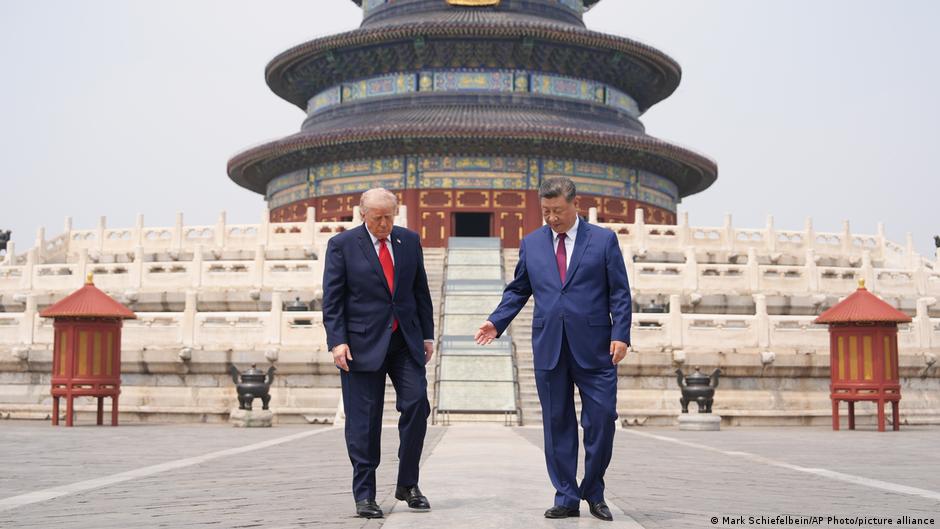
Donald Trump is set to meet Xi Jinping for the third time this week since returning to office in January 2025Image: Mark Schiefelbein/AP Photo/picture allianceAdvertisementLast week, German and Chinese business leaders met in the German city of Düsseldorf for an economic dialogue. Although the panel focused on trade, and investment between China and Europe, ongoing US-China rivalry was the elephant in the room.
As Xi Jinping and Donald Trump sit down in the US capital Washington this week, there is some hope that talks will show progress on alleviating the ongoing trade war launched by the US president. The last time the two leaders met at a Beijing summit in May did not yield any tangible results.
"The assumption in Beijing, and that's the way they're operating, is that China and the US will hold each other in check for the foreseeable future," Mikko Huotari, director of the Berlin-based China think tank MERICS, told a policy briefing last week.
"Xi really doesn't need a breakthrough in Washington. He needs more time. And the same is true for Washington. So we have this strategic stalemate situation, which I think is the best description of what we see currently."
A deal could benefit Trump's Republican Party ahead of the important US midterm elections in November, but that outcome remains far from certain.
"We will discuss everything,"Trump said about Xi's visit to the White House.
Beijing and Washington are competing on multiple levels, and nowhere is this rivalry more consequential than with artificial intelligence (AI).
The US government prohibits the export of high-performance chips to China. Beijing, in turn, restricts the export of rare earth elements, which are indispensable for semiconductor production.
And amid concerns about the dangers of unregulated AI, there is some expectation that Xi and Trump will discuss AI guardrails during their talks. Xi has called for international cooperation on AI development, while Trump sees its regulation as a threat to the US' leadership in the field.
After meeting with Chinese Vice Premier He Lifeng in New York on Sunday, US Treasury Secretary Scott Bessent said that US and Chinese officials have already discussed creating a "notification mechanism" to share information about AI-related security incidents.
From a European perspective, both China and the US are currently considered difficult partners.
The second "China shock … is already here" in Europe, said European Commission President Ursula von der Leyen in her 2026 State of the Union address last week.
The first "China shock" came 25 years ago, triggered by China's accession to the World Trade Organization (WTO), when inexpensive "Made in China" products began to flood the global markets.
The second one stems from Chinas technological progress in industries such as battery technology, green energy and mobility.
"It shows in our communities and in factories across our Union. It leads to deindustrialization in the industrial heartlands of Europe. This is unsustainable," von der Leyen said in her address.
The EU is aiming for a rapid transition to e-mobility and wants to drastically reduce CO2 emissions from road traffic. At the same time, Brussels is calling for additional tariffs on low-cost electric cars from China, as China enjoys competitive advantages with cheaper cars and high government subsidies.
China denies having an unfair advantage, and German automakers VW and BMW also oppose punitive tariffs due to potential revenue losses resulting from Chinese retaliatory measures.
A Chinese participant at the Düsseldorf economic dialogue told DW anonymously that China's domestic consumption cannot absorb manufacturing.
"China's economy is weak. Companies are worried about their business and urgently need to tap into foreign markets," said the Chinese executive, who used to work in the European branch of a Chinese state-owned enterprise.
"Against the backdrop of the ongoing escalation of strategic rivalry between the US and China, the US is constantly urging its allies to tighten restrictions on China in the areas of technology, supply chains, and security," said Yang Xiepu, director of the Center for Sino-German Cooperation at the Chinese Academy of Social Sciences (CASS).
At the same time, Trump frequently threatens the EU with tariffs while injecting instability into the strategic NATO alliance. When the EU offered Canada "associate membership" last week, Trump floated the possibility of new punitive measures from the US.
While Carney expressed interest , Trump called the idea "ridiculous."
"If I think it's at all a hostile act, I will put very serious tariffs or stop trading with Europe on many things," Trump said, without specifying what he considers about EU-Canada ties to be "hostile."
Facing Trump administration's tariff upsets and caustic rhetoric, Canadian Prime Minister Mark Carney is openly hedging his bets on the world stage.
"We know the old order is not coming back. We shouldn't mourn it," he declared at the 2026 World Economic Forum in Davos in January, with the US allies rattled by Trump threatening to annex Greenland from Denmark.
Carney said that great powers can "afford for now to go it alone" but middle powers need to work better together.
"When we only negotiate bilaterally with a hegemon, we negotiate from weakness. We accept what's offered. We compete with each other to be the most accommodating. This is not sovereignty," Carney told the forum.
"If we're not at the table, we're on the menu," he emphasized.
In early 2026, Carney visited China and agreed to a "new-era strategic partnership." Ottawa subsequently lowered import tariffs on Chinese electric cars from 100% to 6.1%. The quota stands at 49,000 vehicles per year.
Separately, China has launched a charm offensive toward US allies, "more specifically, the fragile allies," according to MERICS Director Mikko Huotari.
For example, Xi attended the BRICS summit in India in September despite the rocky relationship with New Delhi. He also attended the Shanghai Cooperation Organization (SCO) summit in Kyrgyzstan. In November, China will host the G-20 summit.
Carney has described this new form of diplomacy as "variable geometry" — different alliances for different issues based on common values and interests. In November, he will travel to Shenzhen for the APECE summit. He will also be at the table there — and hopefully not on the menu.

