US-China talks in New York set stage for Trump-Xi summit on AI and tariffs
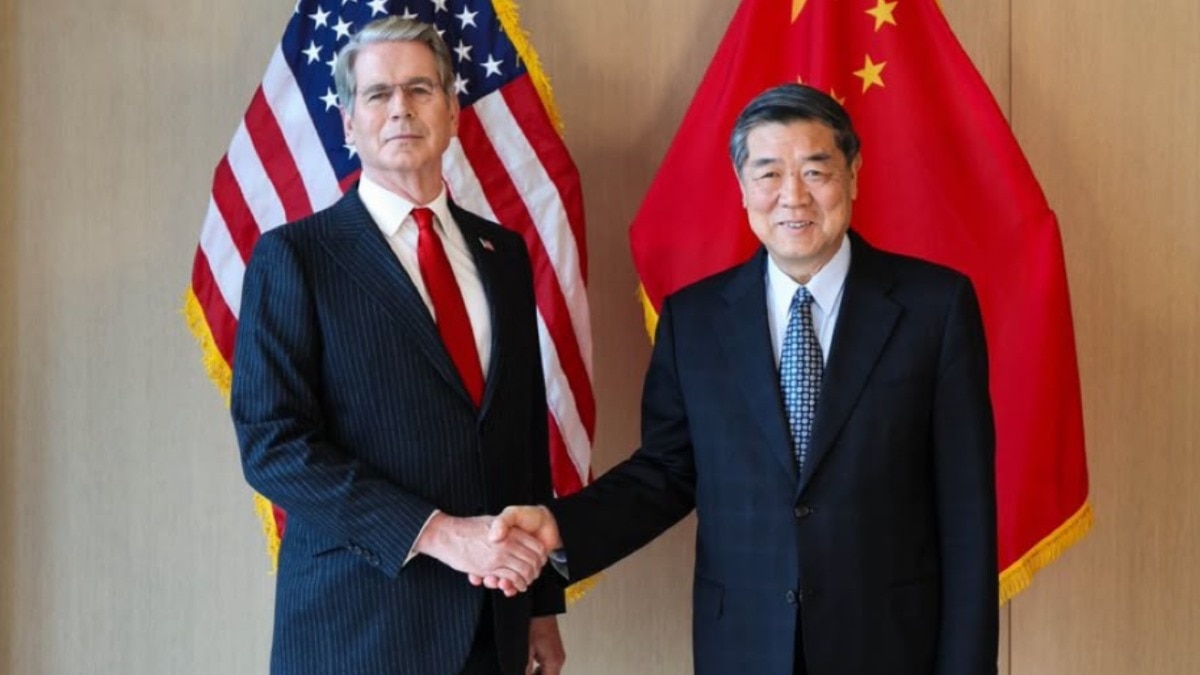
US Treasury Secretary Scott Bessent and Chinese Vice Premier He Lifeng began high-stakes talks in New York on Sunday, seeking common ground on artificial intelligence, trade and critical minerals before US President Donald Trump and Chinese President Xi Jinping sit down for their closely watched summit in Washington.
The meeting is effectively a negotiating session before the leaders meet. US officials are trying to narrow differences and work towards potential agreements that Trump could either approve or reject before his meeting with Xi.
Sources familiar with the discussions said both sides were looking for areas of common ground, particularly on AI and rare earth minerals. The goal on the US side is to reach a point where Trump can make a "thumbs up or thumbs down" decision on potential deals before meeting Xi at the White House. The talks, held at JPMorgan Chase's headquarters in Manhattan, also include US Trade Representative Jamieson Greer.
The negotiations briefly broke for lunch, with the Chinese delegation leaving the building to eat off site while the US delegation remained inside. The Chinese officials were expected to return after lunch, with discussions set to resume.
The unusual rhythm of the talks offered a glimpse into the working-level negotiations taking place before the much bigger political meeting between Trump and Xi. Before entering the meeting, Bessent signalled that Washington wanted substantive but constructive discussions.
"I look forward to focused, fulsome and constructive talks," he told reporters, describing the negotiations as an effort to pave the way for the Trump-Xi summit. The agenda is broad. It includes the future of the current US-China trade truce, which is due to expire on November 10, Chinese shipments of rare-earth magnets and other critical minerals, and possible safeguards around artificial intelligence.AI EMERGES AS A NEW BATTLEFIELD
Artificial intelligence is another major focus of the talks, reflecting the increasingly competitive relationship between Washington and Beijing over one of the world's most important emerging technologies. Bessent said Friday that the discussions would cover "both open and closed-weight models". Open-weight AI models allow users to access core elements of the systems and modify or fine-tune them for specific uses.
Chinese open-weight models have gained interest among some US companies because they can offer lower-cost alternatives to closed-weight systems developed by companies such as Anthropic and OpenAI. Bessent said Washington wanted to find ways to manage risks without allowing the US and Chinese technology ecosystems to split completely.
"The United States remains the leader in AI. And we are open to discussions on avoiding shared risks and avoiding bifurcation of our two systems," Bessent said in a statement on the China talks.
He has also pushed for US-China AI "guard rails" to prevent powerful models from falling into the hands of malign non-state actors.TRADE TRUCE AND TARIFFS STILL HANG OVER TALKS
Despite the focus on newer areas such as AI, traditional trade disputes remain at the centre of the US-China relationship.
Many of the issues facing Bessent, He and Greer date back to Trump's May meeting with Xi in Beijing. They include efforts to reduce tariffs on non-strategic goods, along with Chinese pledges to increase purchases of US agricultural products by $17 billion a year and buy more than 200 Boeing aircraft.
The latest talks are part of a negotiating pattern that has unfolded over the past 16 months, with Bessent, He and Greer repeatedly meeting in European and Asian cities to prepare possible agreements for Trump and Xi.
One of the key milestones was the November 2025 truce reached in Busan, South Korea. The agreement capped US tariffs on Chinese goods at about 20 per cent after tit-for-tat measures had pushed duties into triple-digit territory on both sides.
The US Supreme Court later struck down tariffs imposed by Trump under a national emergencies law, including duties linked to fentanyl trafficking. His administration has since been rebuilding some tariffs under other legal authorities, including a 12.5 per cent tariff on Chinese goods over forced labour allegations.
Washington is also preparing a separate tariff investigation focused on what it describes as excess industrial capacity in China.- EndsPublished By: Satyam SinghPublished On: Sep 21, 2026 00:38 IST