US uranium deal a conundrum for Niger's decolonisation drive
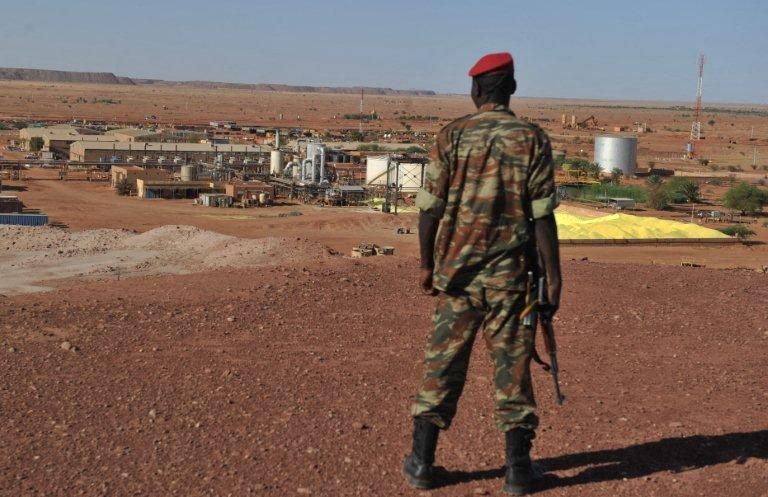
A Nigerien Soldier walks outside France's state-owned nuclear giant Areva's uranium mine on September 26, 2010 in Arlit. The pursuit of decolonisation and sovereignty does not always mean disconnection from the global economy, says the writer.
Just two years after Washington was pushed to remove its troops from Niger, America could be returning.
The US International Development Finance Corporation has approved a debt facility of up to $414.2 million for the Dasa uranium project, operated by Canadian company Global Atomic. The United States is not purchasing the mine. The DFC facility is debt financing for Global Atomic.
It is not a grant to Niger. Global Atomic owns 80% of SOMIDA, the Nigerien company operating Dasa. The Nigerien government holds the remaining 20%. For Washington, the project carries considerable strategic value in its pursuit of new nuclear-fuel supplies.
At first glance, this deal appears to contradict the strong stance Niger and the Alliance of Sahel States (AES) have taken on sovereignty and decolonisation. Over the past three years, Niger has driven out both French and American influence to gain greater control over the country's security and natural resources.
Now a US government institution is readying itself to finance a Canadian-operated uranium mine in Niger. A cynical reading is that this development could signal a return to the old order.
However, decolonisation is not necessarily measured by counting foreign soldiers or the number of commercial agreements with governments or companies. A better measure is proper scrutiny of who sets the terms of extraction, who derives value, and whether this economic value fully translates into sustainable development and sovereignty.
Niger's rupture with France matters because uranium sat at the epicentre of the country's relationship with its former coloniser. The Nigerien government seized control of the Somaïr uranium operation after its confrontation with France's Orano.
Orano had dominated the sector for decades; Orano is now challenging Niger's actions through international arbitration. For Niger, replacing a French company with a Canadian one is not, on its own, decolonisation.
However, accepting American finance does not automatically amount to recolonisation. The pursuit of decolonisation and sovereignty does not always mean disconnection from the global economy. This was illustrated in 1966, when Charles de Gaulle ordered NATO's headquarters and foreign troops out of France so that the country could "regain on her whole territory the full exercise of her sovereignty."
While France built an independent nuclear force, it continued to trade within Western markets. This provides an important lesson.
At this juncture, Africa needs capital, technology, infrastructure, and markets to foster meaningful and lasting national and regional development. Interestingly, Botswana did not expel De Beers from the country's diamond industry.
Instead, it chose to develop a 50:50 partnership with De Beers in Debswana. This has resulted in much stronger local beneficiation. Like Botswana, Ghana has also used its strategic leverage to dictate terms of engagement.
In 2025, the Ghana Gold Board insisted that large-scale miners sell twenty per cent of export-destined gold locally. While these are small steps towards resource sovereignty, they are a huge leap away from historically exploitative partnerships with foreign nations.
Any country that lacks adequate capital investment, national infrastructure, manufacturing and processing capacity, technology know-how and reliable trade routes and markets will remain structurally dependent. While Niger has sovereign authority over its resources, this has not yielded economic power or sustainable prosperity.
The Dasa project has exposed serious constraints Niger currently faces.
Secondly, instability and threats of insurgency are making its transport corridors increasingly vulnerable. Global Atomic is exploring alternative export routes. A potential corridor through Algeria is under review. The financing itself is conditional on a viable export route and on agreements still being negotiated with the Nigerien government.
The immediate challenge facing Niger and the AES is to build an economic order in which African states capture a substantially greater share of the value their resources generate. Building optimal domestic capital, best-in-class technical expertise, durable and scalable manufacturing and processing facilities and alternative, future-focused trade routes and markets is the work of decades.
In many ways, political sovereignty is easier to achieve. It can even be as simple as marching foreign troops to the border. Economic sovereignty, by contrast, requires the slow, methodical work of capacity building.
For now, the Dasa deal should not be read as proof that Niger's sovereignty project has succeeded. Nor should it be prejudged as evidence of its failure. If Dasa becomes another enclave where raw material leaves Niger while profits, technology and strategic decision-making stay elsewhere, then AES's language of sovereignty will be little more than a sorry slogan.
However, if Niger can convert the deal into public revenue, skilled employment, local procurement, infrastructure, technical capability, and stronger bargaining power, then foreign finance becomes an instrument of transformation.
Decolonisation is about sovereignty. Decolonisation is not a single event or a linear process. It will be practical and pragmatic in implementation, rather than theoretical. It is about determining the terms of engagement. It is about changing the master-slave relationship. So far, African countries have been dictated to. That must change.
Niger expelled foreign soldiers. It confronted France's historic hold on its uranium. It is now negotiating the terms on which American finance might support a Canadian-operated mine. General Abdourahamane Tiani has stated that Niger has "the legitimate right to dispose of its natural riches to sell them to whoever wants to buy them, under the rules of the market, in complete independence."
What matters is what Niger does next. It must use its leverage to ensure that this significant uranium project benefits the people of Niger. If it does so, this uranium deal will be a reconfiguration, not a pullback from its decolonisation and sovereignty agenda.
* Kim Heller is a political analyst and author of No White Lies: Black Politics and White Power in South Africa.
** The views expressed do not necessarily reflect the views of the National Media Group.