
Vaughan Metropolitan Centre was supposed to be a vibrant new downtown. Then the condo crash hit - Toronto Star
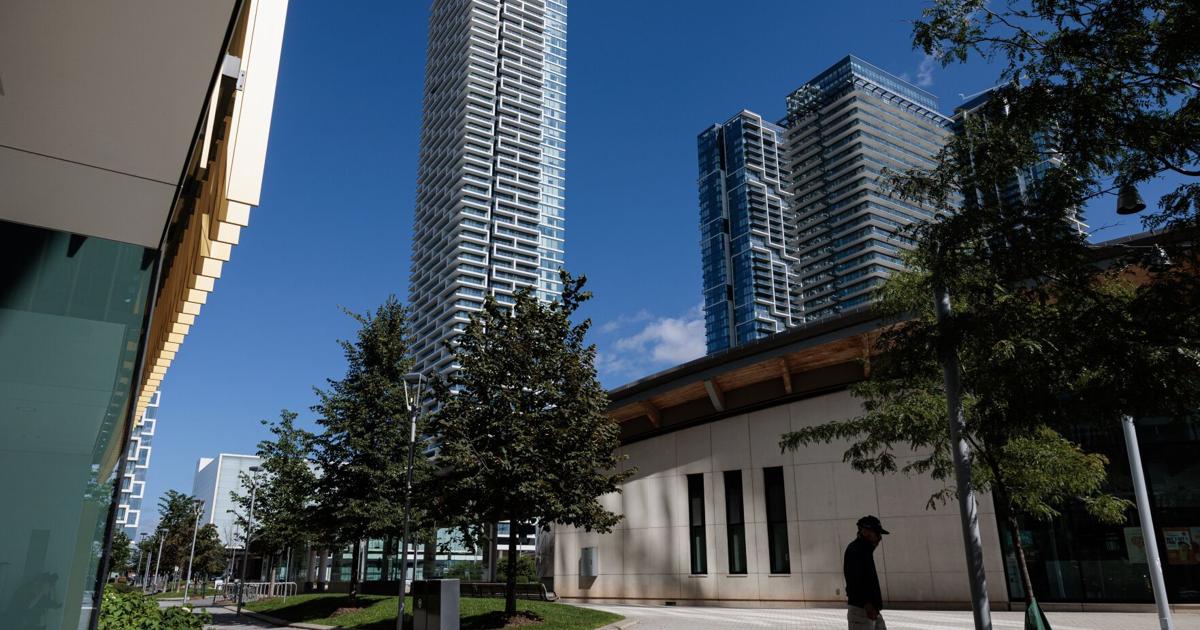
Roughly 43 per cent of planned units in Vaughan's new master-planned downtown are unsold, according to real estate data firm Zonda.
Vaughan Metropolitan Centre was billed as a master-planned “emerging downtown poised to be the financial, innovation and cultural centre of Vaughan,” according to the city. But amid the condo crash, many units aren’t selling.
If Aras Jand could do it over again, he wouldn’t have chosen the condo as his home.
The 39-year-old freight industry broker lives in a 700-square-foot two-bedroom unit on the eighth floor of a newly built tower with his dachshund puppy Max, with whom he was walking outside the building along a grassy path on a recent sunny September day.
“It’s small,” he said, as Max pulled on his leash to greet a passing little black and white dog. Jand doesn’t like living close to so many people. They’re often moving in and out. There’s no gym, and he doesn’t have parking.
He pays almost $2,200 in rent and has been there since 2021.
“I was thinking, should I move from this area? Should I just go somewhere else?” he wondered.
Jand may have the space of a downtown Toronto condo, but he lives about 45 minutes from Union Station via the subway (on a good day). His home is in the Vaughan Metropolitan Centre (VMC), a new campus of condo towers, office space and some retail at the terminus of Line 1.
Aras Jand rents a condo at Vaughan Metropolitan Centre and is considering leaving for more space.
VMC was billed as a master-planned hub, “an emerging downtown poised to be the financial, innovation and cultural centre of Vaughan,” according to the city, a sharp contrast to its surrounding highways and urban sprawl. It has a target of 12,000 residential units, 1.5 million square feet of office space and 750,000 square feet of new retail space by 2031. The Vaughan Metropolitan Centre subway stop, which opened in 2017, was seen as the gateway to all of this.
But the downturn in the condo market, with a dip in prices and demand, arrived just in time to impact the project. Now, 43 per cent of planned units are unsold, according to data from real estate analysis company Zonda — 966 out of 2,233.
The units are generally small, with many originally targeted to investors during the height of the market when many thought prices would never stop rising. Homes were also constructed before some of the amenities, leaving residents who had been promised a walkable oasis without much to walk to.
The City of Vaughan did not respond to a request for comment on this story.
Now, as the investor model has collapsed, residents and housing experts are raising questions about whether the project can ever really become a complete community, and, as developers try to reignite the condo market, if there are lessons for other mega projects to avoid a similar fate.
It’s been 25 years of “build, build, build,” said Naama Blonder, an architect, urban planner and the co-author of a new book called “Building Charm” about the difficulty of creating new neighbourhoods.
“Are we building places where people actually want to live?”
A plan to revitalize the mostly industrial space at the intersection of Highway 7 and Jane Street goes back years. In addition to several new condo towers, the area is home to a new community centre with a library and YMCA, and a public square.
There’s a sushi spot, a dentist’s office and big-box retail like Shoppers Drug Mart. PwC Canada and KPMG have offices there.
A rendering of Vaughan Metropolitan Centre.
But many amenities are still in the works.
New Catholic and public elementary schools are planned in a shared building (the York Region District School Board says construction has not started, but the project is on track to open in 2031).
And in late 2025, the city broke ground on a $224-million plan to beef up flood protection that includes adding green space to absorb water during storms and improving infrastructure, with funding from the province and federal governments.
Parts of the area are in the Black Creek floodplain and flooded badly during a storm earlier this month.
Annette Tamorada, sitting outside a busy Balzac’s Coffee Roasters with her toddler son, said she likes living at the VMC. She’s a tenant of the only exclusively rental building.
She said she’d like to see more greenery and walking trails, “rather than all cars, all buildings.”
Tamorada added that rentals in the area are also expensive. Her two-bedroom costs $2,975 per month, plus $300 a month for parking, and the unit is about 650 square feet.
“It’s pretty small, that’s a shock for me, the amenities are great, but it’s not for families,” said the 24-year-old. “I think there would be more families if they had bigger places.”
Annette Tamorada, out with her toddler, rents in the only exclusively rental building in Vaughan Metropolitan Centre. She says her two-bedroom is small for the nearly $3,000 she pays for it.
Harpreet Brar, sitting in a blue Muskoka chair in the nearly empty Transit Square, a large grassed area across from the subway station with public seating and string lights, also likes the area. The condo owner has been living in his unit for about six months and appreciates the transit access, with a new York Region bus terminal.
“You live away from the city but in the city,” said the 31-year-old network technologist while soft jazz pumped out of speakers nearby. “And with the transit, it’s amazing.”
But Brar would like to see more grocery stores, convenience stores and restaurants within walking distance.
“You can go a 15-minute drive and there is everything, but for walking there are less amenities than you expect,” he added.
Brar, who bought his condo on the resale market, is not the typical owner in the VMC.
Harpreet Brar, who lives at Vaughan Metropolitan Centre, relaxes in a park on a warm Friday morning.
Aside from the one rental building, the rest are condos, according to Zonda, that were sold before they were built. In general, these kinds of units, known as preconstruction, are attractive to investors who never intend to live in them.
And many in VMC were sold around the time of the pandemic real estate peak.
Investors, who prefer small units for their lower carrying costs, have fled the GTA market, and live-in buyers like Brar can be hard to find, let alone purchasers for unbuilt units — of which the VMC still has hundreds in the pipeline.
Pauline Lierman, Zonda’s vice-president of market research for Ontario and Quebec, said that all but 85 of the more than 900 unsold units in VMC are preconstruction, which she pins on the timing of the launches.
Prospective buyers, she said, would have been “catching a wave when the market was starting to slow down.”
Lierman said there is no “standing inventory” — completed units that aren’t yet sold — at VMC, but plenty of units for resale and “stressed” assignments. That’s hurting sales for hundreds of remaining preconstruction units, as potential buyers can see what’s already available in the area, often at a cheaper price.
With preconstruction condo sales, buyers sign a contract long before a shovel hits the ground, agreeing to purchase a unit once it’s finished. During the pandemic, this model attracted investors on the assumption the units would be worth more at the time of completion, a few years later.
“Prices were ridiculous,” said Steve Massaroni, managing director of Lendworth, a private lender, based in Vaughan. “Everybody got greedy.”
While the VMC has a new community centre with a library and YMCA, and a public square, amenities such as two schools are still to come.
But prices dropped and now some owners are facing gaps between what they agreed to pay and what the unit is now worth.
Jackson Scarfe, a realtor with Re/Max Plus City Team Inc. who specializes in distressed sales, said he’s been selling some recently completed units at VMC on the assignment market, where someone else buys the contract from the original owner.
But it’s hard to find those buyers now.
“It’s honestly getting to a point now where people, they don’t have enough money in the property to assign it even if they wanted to,” he said.
However, Stefano Guglietti, one of the developers behind the Vincent, a recently completed condo at the VMC, isn’t concerned. He said the team has been closing units since July and is about halfway through.
“For the most part, we’re not seeing that people are not able to close. It’s just taking more time for them to get their finances in order,” he said.
He said RBC is offering blanket appraisals for the project, a financing arrangement where the bank uses the purchase price of the units rather than the current-day value so that buyers can get a mortgage for what they originally agreed to pay (this can be controversial as it leaves buyers with loans worth more than their home’s value).
At the Vincent, they also skipped the occupancy period and went straight to closing, allowing buyers to start paying down their mortgages faster, Guglietti added.
Some of the other big developers include Menkes, QuadReal and SmartCentres. Menkes and SmartCentres did not respond to a request for comment. A spokesperson for QuadReal said they were unable to comment.
With fewer investors, the VMC needs to attract end users, industry jargon for those actually wanting to live in their units. But there’s a mismatch between the supply that exists and what those buyers demand, said Massaroni.
“Dog crate” condos never made sense for the area, as they weren’t big enough for families or even downsizers, he said. If people wanted a small space, they could get something comparable in downtown Toronto.
“They built them for investors to buy them and rent them out. That’s not good planning in my opinion,” he said.
Single people will inevitably have to move out, and there will be a lot of turnover. He feels it will also be harder for small businesses to thrive in this environment.
“That does not build a community,” Massaroni said. “Families build community.”
Due to the condo crash, prices for units across the GTA have dropped and some owners are facing gaps between what they agreed to pay and what the completed unit is now worth.
Guglietti, however, said that smaller unit sizes allow young families to get into the market earlier, at a lower price point, as a “stepping stone” to a bigger place.
The Vincent also has a range of units, from studios at about 400 square feet to larger three-bedrooms at 1,400 square feet, with the majority one-bedroom-plus-dens in the 550-to-650-square-foot range and two-bedrooms in the 650-to-900-square-foot range, he said. And the owners aren’t just investors, but a mix that includes downsizers and older local couples purchasing starter homes for their kids.
“I do think we did some steps to try and make sure that we gave the best shot to all our purchasers to make sure that they have a community that they can call home, that they have an ability to close,” he said. “The market has dipped a little bit, but it doesn’t mean that the VMC is any less desirable.”
Blonder, the urban planner, said she herself is raising kids in a small condo in downtown Toronto. The difference is that the streets there are smaller, safer and less car-centric.
It’s clear “a lot of time and energy and money” were invested in VMC. But there are a few things she’d do differently.
More “human scale” streets that are less car focused, for example, and smaller parks that could be built more quickly instead of taking time to add them in after the fact, leaving residents waiting for green space. A park spanning three city blocks is currently under construction.
Maybe now that the boom that drove VMC’s creation is done, at least for the time being, it’s a good time to reflect on what could be done better in future developments like this, Blonder said.
“The craziness is over. Now we can focus on quality.”
Error! Sorry, there was an error processing your request.
There was a problem with the recaptcha. Please try again.
You may unsubscribe at any time. By signing up, you agree to our terms of use and privacy policy. This site is protected by reCAPTCHA and the Google privacy policy and terms of service apply.
May Warren is a Toronto-based housing reporter for the Star. Follow her on Twitter: @maywarren11.

