
Whale shark selfies in the Philippines’ seaside ‘theme park’: A tourist experience that's out of control? - CNA
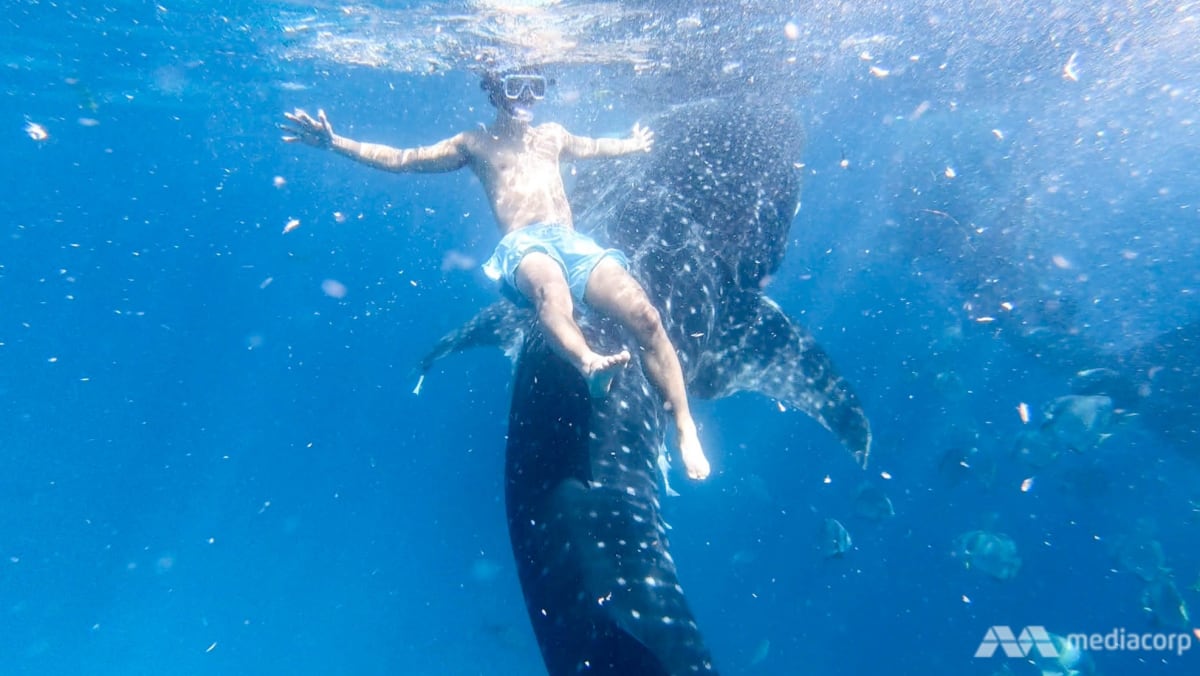
A fleeting sighting of the world’s biggest fish - a rare and mysterious creature - would be special. In Oslob though, a small fishing village in the central Philippines, they appear in a procession, a controversial operation that has divided the country.
A snorkelling tourist gets too close to a passing whale shark on an interaction tour in Oslob. (Photo: Jack Board)
Jack Board 30 Mar 2019 06:26AM (Updated: 02 Feb 2021 02:30PM) Bookmark Bookmark Share WhatsApp Telegram Facebook Twitter Email LinkedIn Set CNA as your preferred source on Google Add CNA as a trusted source to help Google better understand and surface our content in search results. Read a summary of this article on FAST. Get bite-sized news via a newcards interface. Give it a try. Click here to return to FAST Tap here to return to FAST FAST OSLOB, Philippines: The effortless glide of the whale shark is a spectacular sight. Close to the surface of the water, the spotted skin of each passing giant shimmers in the refracting sunlight.
A fleeting glimpse of the world’s biggest fish - a rare and mysterious creature - would be special. In Oslob, though, a small fishing village in the central Philippines, they appear in a procession.
On this day, some 15 sharks, most of them male juveniles, have made their way into the so-called “interaction zone”. About 2,000 people will join them, and for five hours the sharks will perform lap after lap along their underwater catwalk.
These are hungry beasts, constant feeders being lured from their wild hunting grounds. They raise their colossal mouths to the surface, searching out the slow-moving feeding boats and scoffing the handfuls of food being tossed their way.
CNA Games Guess Word Crack the word, one row at a time Buzzword Create words using the given letters Mini Sudoku Tiny puzzle, mighty brain teaser Mini Crossword Small grid, big challenge Word Search Spot as many words as you can Show More Show Less A whale shark feeds from a boat in Oslob, Philippines. (Photo: Jack Board) Orbiting their calmness is the chaos of hundreds of snorkellers, scuba divers and boat passengers. A flurry of flippers, selfie sticks, and frenetic splashing trail and surround the majestic creatures.
“Oslob is really a feeding frenzy,” said AA Yaptinchay, the director of Marine Wildlife Watch of the Philippines. “Now it’s become part of bucket lists. People need to do it. Everyone wants a whale shark now.”
The spectacle begins as the sun rises with the day’s first tourist boats assembling, barely 100 metres from the shore.
The visitors out early on the water have won out in the predawn hustle for a number in the first come, first served queue. About half of the daily contingent are foreign tourists - mostly from China, Korea and Japan - and they scramble for prime position in the tightly managed schedule to get their chance to see the sharks up close.
Thirty boats are allowed in the feeding zone at any given time, for only 30 minutes each. Though in principle there are rules designed to protect the welfare of the sharks, such as a three-metre buffer zone, the reality is akin to an aquarium with no barriers.
Tourists test the boundaries of what is allowed, unable or unwilling to resist touching the sharks as they pass.
A study in 2014 showed non-compliance rates with keeping a minimum distance from the sharks was 97 per cent. It is behaviour described as a “guilty pleasure” by environmental researchers.
There is nowhere else on earth where this happens.
The Oslob practice has been controversial since its inception in 2012. The industry was born by chance on the supposed request of a Korean diver who wanted to see the sharks, which are regular visitors to the food-rich waters, closer to shore.
Fishermen had always considered whale sharks pests, disruptive to their work as they tangled in their nets. Recently, they've been seen as valuable generators of cash.
For about 15 years, another eco-tourism project allowing visitors to swim with wild whale sharks had been operating with huge success in Donsol, a small fishing village in southern Luzon.
Oslob locals seized their chance to not only replicate that success but take it to whole new levels. They started feeding the whale sharks - a practice strictly prohibited in Donsol and elsewhere - and watched as the business exploded.

